

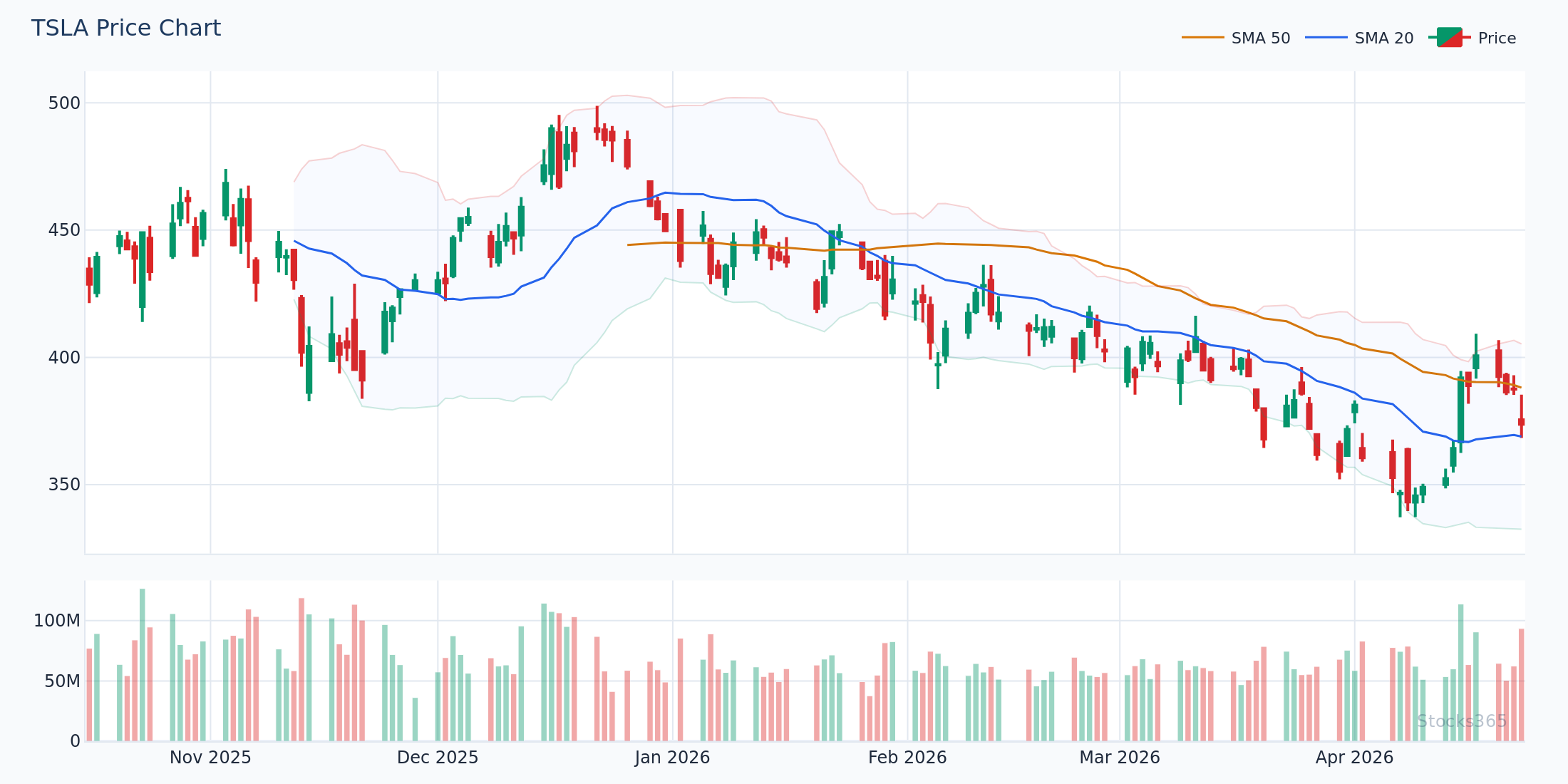
One company signs a 15-year, $7.5 billion contract with an unnamed U.S. hyperscaler, and the AI infrastructure narrative gets a fresh headline to celebrate. Meanwhile, Microsoft (MSFT) drops 4.0% and Tesla (TSLA) sheds 3.6% on the same day. That's the contrarian's first red flag: when a genuinely positive AI infrastructure print can't lift the two largest consumer-facing tech proxies, you have to ask whether the optimism is already exhausted — or whether the market is pricing in something the deal announcement doesn't address.
Fifteen Years, 300 Megawatts, and a Name Nobody's Allowed to Say
Applied Digital's agreement is structurally impressive by any measure. The company has executed a 15-year lease at its 500-acre, 430-megawatt Delta Forge 1 campus, committing 300 MWs of AI and high-performance computing infrastructure to a U.S.-based hyperscaler whose identity the company has not disclosed. CEO Wes Cummins characterized the priority as execution — "bringing capacity online on schedule and operating it with discipline over the long term," per the company's press release. Initial operations at Delta Forge 1 are expected to begin in mid-2027. This is not a letter of intent. This is not a pilot program. This is a long-dated, capital-intensive commitment from one of the largest categories of cloud buyer in existence.
What makes the deal more than a one-off is the accumulation. This marks Applied Digital's second agreement with a U.S. hyperscaler, and the company's total contracted lease revenue now stands at more than $23 billion. That's a backlog figure that rivals, in proportion, what much larger industrial and data center REITs have taken years to build. The design of Delta Forge 1 — emphasizing efficient power supplies and advanced cooling — positions it explicitly for both AI model training and inference workloads, which means its utility extends beyond the current training-compute boom into the inference scaling wave that most analysts expect to define the second half of this decade.
The consensus read writes itself: AI infrastructure demand is so strong that even a mid-tier data center developer can lock in $23 billion in contracted revenue on 15-year terms. The hyperscalers are so hungry for capacity that they'll sign with whomever can deliver power, cooling, and acreage on time. Applied Digital jumped. Case closed. Except — that reading assumes the rest of the tech stack is confirming the same thesis. It isn't.
What Our Models Are Seeing in MSFT and TSLA Right Now
Here's where Stocks365's proprietary data complicates the easy narrative. Microsoft (MSFT) closed Thursday at $415.75, down 4.0% on the session. Tesla (TSLA) closed at $373.72, off 3.6%. Both are trading under normal volatility regime classifications per our market-regime model — meaning these aren't panic-driven dislocations, they're deliberate repricing. That distinction matters. Panic selling creates mean-reversion setups. Deliberate repricing tells you the market is revising its forward assumptions.
What nobody's talking about: Microsoft's April 29 earnings print is now set up as the most consequential near-term event in large-cap tech. The stock is down -4.0% today heading into that report — which means either the market is pre-positioning for a disappointment, or it's hedging against guidance language that doesn't match the capex-heavy AI expansion story Microsoft has been selling. It's a statement. The consensus case for MSFT rests on Azure growth reaccelerating in the AI era — and that thesis may not hold if enterprise AI adoption is slower to monetize than the infrastructure buildout implies.
Tesla's situation is structurally different but thematically linked. The company's most recent 10-Q, filed with the SEC on April 23, 2026, reflects the Q1 period — and while we're not extrapolating specific line items beyond what's disclosed, the 3.6% decline on a day when AI infrastructure is signing $7.5 billion deals suggests the market is separating Tesla's AI narrative from its core automotive fundamentals. That's a healthy and overdue decoupling. Priced-in optimism about Tesla's robotaxi and autonomous driving timelines has long subsidized a multiple that the vehicle delivery business alone doesn't justify. When the tape starts making those distinctions in real time, it's worth paying attention.
The 2018 Hyperscaler Capex Cycle Has a Warning Buried in It
The closest historical parallel to Applied Digital's current position isn't flattering if you squint at the right part of it. In 2018, as cloud hyperscalers accelerated their data center buildouts, a wave of smaller infrastructure providers signed long-term leases and supply agreements that looked bulletproof on paper. Many were. But several suffered from the same structural vulnerability: they were dependent on a single counterparty or a single technology generation, and when the hyperscalers pivoted their architecture — from CPU-heavy to GPU-accelerated workloads, for example — the older facilities faced utilization headwinds that the lease terms couldn't fully protect against.
Applied Digital's Delta Forge 1 is explicitly designed for the current GPU-and-cooling paradigm, which reduces that specific risk. But the unnamed counterparty caveat is worth watching. A $7.5 billion contract with a single unnamed hyperscaler is a concentration risk, not just a revenue milestone. The broader lesson from the 2018 cycle is that infrastructure developers who diversified their counterparty base early — and whose facilities remained architecture-agnostic enough to adapt — outperformed those who optimized for a single buyer's current spec. As Jensen Huang said at NVIDIA's Q3 FY25 earnings, "The data center of the future is an AI factory. You generate intelligence, and intelligence is the new currency." The question is whether Delta Forge 1 is flexible enough to keep generating that currency as the factory design evolves, or whether it's optimized for today's model at the cost of tomorrow's adaptability.
Before April 29 Changes Everything, Watch These Fault Lines
The next 72 hours are going to tell us whether Thursday's declines in Microsoft (MSFT) and Tesla (TSLA) were preemptive hedges or the leading edge of a broader recalibration. Microsoft's April 29 print is the immediate stress test. If Azure growth guidance comes in soft — or if management signals that AI monetization is lagging the infrastructure investment — then the Applied Digital contract, however large and real it is, will be read as a supply-side story in a world where demand-side conversion is still uncertain. That's a different and more troubling setup than the AI bull case requires.
For Tesla, the variable to watch is whether the Q1 10-Q filed on April 23 reveals any commentary on delivery cadence or margin structure that differs materially from what the street has modeled. Tesla's stock is a sentiment instrument as much as a fundamental one — which means a 3.6% single-session decline can either be overdone or prescient depending entirely on what the next data point shows. The contrarian position here is not that Applied Digital's deal is fake or that the AI infrastructure boom is a mirage. It's that the consensus is currently holding two incompatible views at once: AI infrastructure demand is unstoppable, and the large-cap tech companies who are the buyers of that infrastructure can still miss their own revenue and margin targets. Both can't be fully true at the same time. The April 29 earnings call may be the moment that forces the market to pick one.