

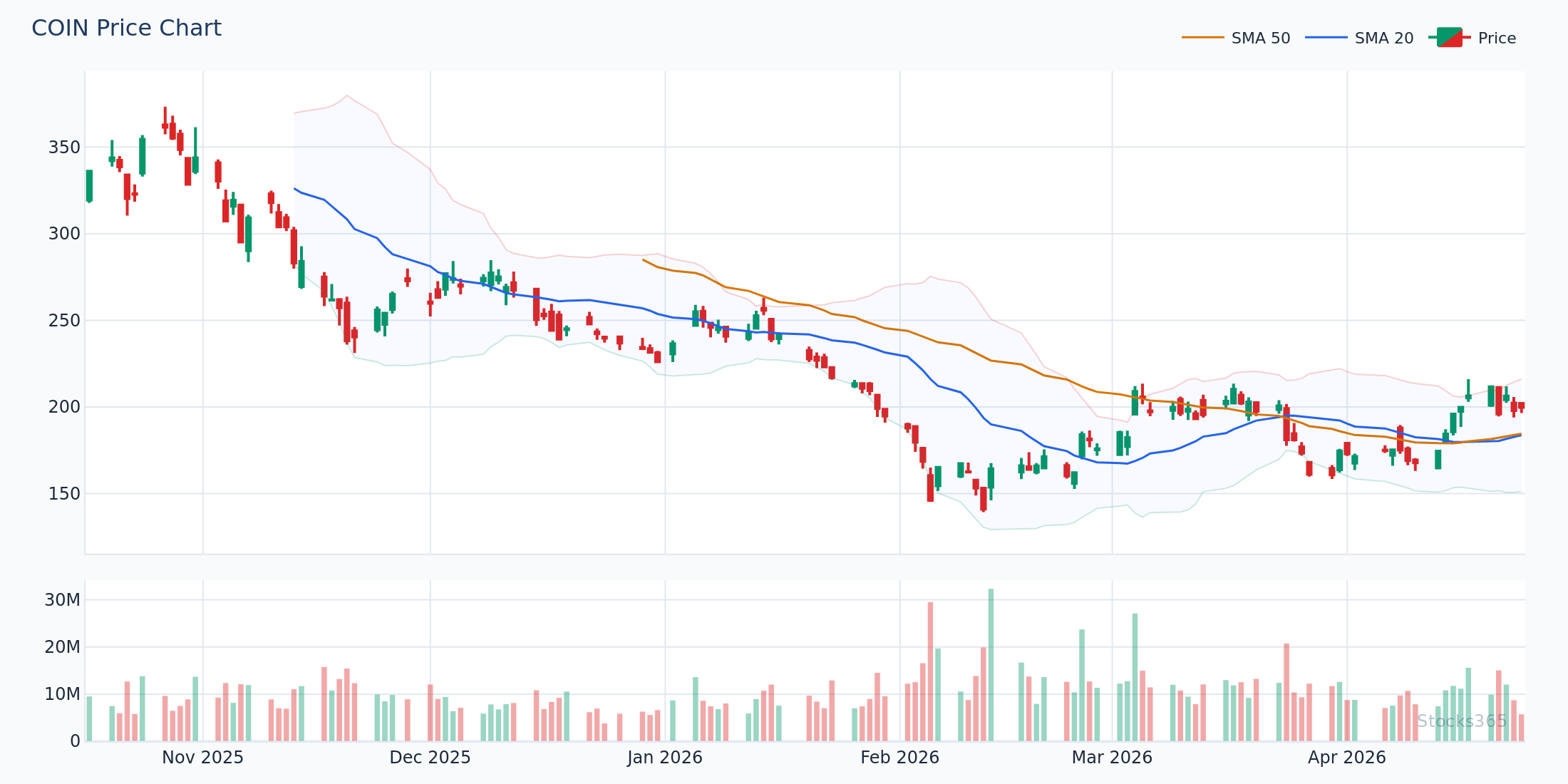
The CFTC filed suit against the state of New York on Friday, accusing Attorney General Letitia James of encroaching on exclusive federal authority to regulate prediction markets — and Coinbase Global (COIN) is right at the center of it. The complaint, filed in Manhattan federal court, targets James's April 21 lawsuits against both Coinbase Financial Markets and Gemini Titan, calling them an intrusion on the federal framework Congress designed to oversee commodity derivatives, including event contracts. COIN is trading at $199.77, up 0.9% on the session. The market, for now, is not taking cover.
One Week After Albany Moved, Washington Pushed Back
The sequence here matters. New York AG James filed against Coinbase and Gemini on April 21, alleging both companies operated prediction markets without obtaining New York State Gaming Commission licenses. Her argument: event contracts are "quintessentially gambling" because outcomes sit outside bettors' control. She also flagged that both platforms allowed 18-to-20-year-olds to participate, below the state's 21-year minimum for mobile sports betting. Three days later, the CFTC answered with its own complaint.
This isn't the first time the CFTC has moved on this front. The commission filed similar preemption suits on April 2 against Arizona, Connecticut, and Illinois. New York is the fourth state to face federal pushback — and arguably the highest-profile battleground, given that both Coinbase Financial Markets and Gemini are Manhattan-based, and given that James and Governor Kathy Hochul carry considerable political weight as a unified Democratic front against a Trump-era CFTC. Their joint statement accused the administration of "prioritizing big corporations" over consumer protections. The CFTC's position is the exact inverse: that Congress, not Albany, owns this jurisdiction.
Gemini's parent, Gemini Space Station, is led by Tyler and Cameron Winklevoss — CEO and president respectively. A third operator, Kalshi, sued New York's gaming commission back in October to preemptively block any event-contract ban; that case is still pending. The prediction market space is fighting this regulatory war on multiple legal fronts simultaneously. Notable.
What the COIN Chart Is Telling Traders Right Now
According to Stocks365 proprietary data, COIN is sitting at $199.77, up 0.9% intraday, with the market regime currently reading as normal volatility. That's a meaningful signal on its own. In a week where the company's core prediction market business is being litigated from two directions simultaneously — New York coming down, the CFTC stepping in — the stock is not cracking. It's holding the $199 handle with conviction into midday.
The positioning setup here suggests the market is reading the CFTC intervention as net-positive for Coinbase's near-term operating outlook. Federal preemption, if it holds, would effectively neutralize the most aggressive state-level enforcement risk. Traders appear to be pricing that probability in real time. The bid under $199 has not broken, and there's no rotation out of the name despite the legal noise. That's worth watching as we move into the close — if the stock reclaims $200 on volume, that's the market making a statement about how it views federal jurisdiction risk versus state jurisdiction risk for crypto platforms.
On the regulatory optics side, Coinbase also filed its proxy statement (DEF 14A) with the SEC on April 24, per public EDGAR records — routine governance disclosure, but it underscores that the company's investor relations machinery is running normally alongside the legal turbulence. No sign of defensive positioning at the corporate level.
The March 2023 Echo — Federal Override, State Resistance, Same Playbook
This jurisdictional standoff has a clear historical parallel. In March 2023, during the banking stress that followed Silicon Valley Bank's collapse, state regulators and federal agencies clashed repeatedly over who held supervisory authority over fintech and crypto-adjacent institutions. The pattern was identical: state AGs moved first, citing consumer protection mandates; federal agencies responded by asserting preemption under existing federal frameworks. What followed was a prolonged legal back-and-forth that lasted well into late 2023, ultimately resolved in favor of federal primacy in most jurisdictions — but only after significant operational uncertainty for the platforms caught in the middle.
The key difference this time is speed. The CFTC moved within three days of New York's filing, compared to weeks-long response times in the 2023 banking friction. That aggressive federal posture likely explains why COIN isn't selling off — traders who lived through the 2023 episode know that once the federal agency plants its flag this quickly, the legal outcome tends to favor the platform over the state enforcement action. Unlikely that New York prevails on the jurisdiction question if the 2023 template holds.
The Court Calendar That Will Drive This Trade
The immediate question is whether Manhattan federal court grants any preliminary injunction that pauses New York's enforcement actions while the CFTC's preemption case proceeds. If a stay comes through — even a temporary one — that's a near-term catalyst for COIN. Watch for any docket activity out of the Southern District of New York in the next two to three weeks. Kalshi's parallel case against the New York Gaming Commission also remains in play; any ruling there could set persuasive precedent that either emboldens or weakens the CFTC's position.
The longer arc here is the one that matters for positioning over the next quarter. Prediction markets surged in public relevance after their accuracy in calling the 2024 presidential election, and the platforms that run them — including Coinbase — are now operating at the intersection of fintech, gambling law, and federal commodity regulation. Is this the moment the regulatory framework for event contracts finally gets forced into clarity? That's the question traders should carry into next week's open. A clear federal win in court doesn't just protect one product line — it potentially unlocks a much larger addressable market for platforms that have been operating under a legal gray cloud.