

Syensqo SA (SHBBF) reported a 13% year-on-year decline in underlying EBITDA for Q1 2026 even as it locked in a new multi-year agreement with Boeing Co (BA) — and that tension between commercial wins and cost erosion defined nearly every earnings call that crossed the tape Friday evening. With the 10-year Treasury yield at 4.47% per the FRED DGS10 series as of May 14 and the fed funds effective rate holding at , the financing environment continues to compress margins across capital-intensive sectors — from chemical composites to Bitcoin ASICs to underground silver mines.
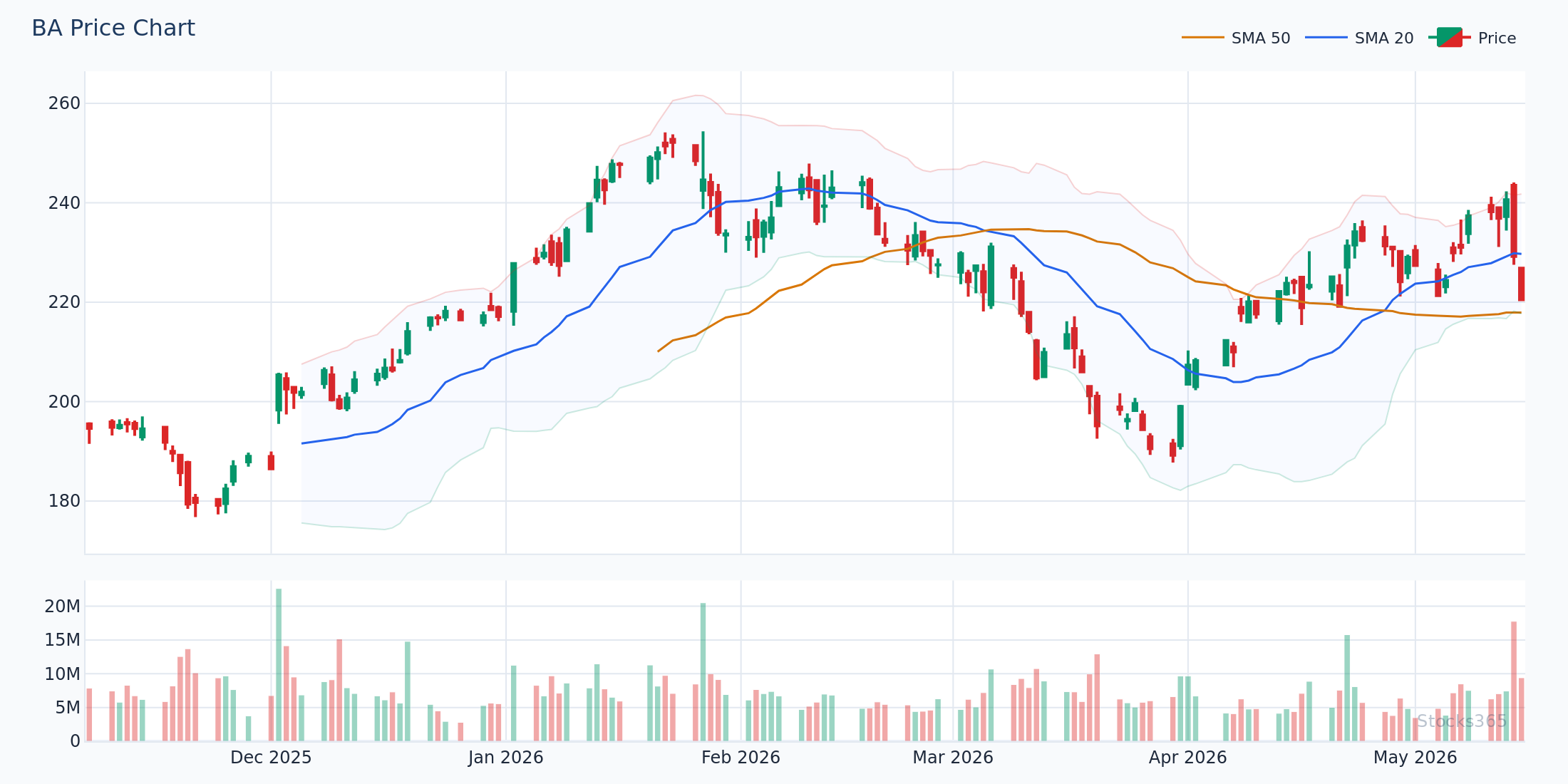
BA itself slid 3.8% on Saturday per Stocks365 pricing data, closing at $220.49 — a read-through that sits awkwardly alongside Syensqo's headline Boeing deal. The specialty-chemicals supplier secured what it described as a reinforced position in the aerospace sector, but the same filing reported a 44% year-on-year reduction in capital expenditure and acknowledged that specialty polymers and electronics are underperforming. The gross margin held at 32%, but net sales came in at EUR 1.4 billion with underlying EBITDA of EUR 251 million — a 6% sequential increase that masks the deeper annual erosion.
The spread context matters here. The 10Y-2Y yield curve has steepened to as of May 15 per FRED's T10Y2Y series — positive territory, but not wide enough to ease refinancing pressure for companies carrying significant fixed-cost bases. That dynamic is visible across all five reports released Friday. As our earlier analysis of Bitdeer and Miran's results noted, the same rate regime is squeezing very different business models in nearly identical ways.
Syensqo's Boeing Deal Can't Fully Offset Middle East Cost Creep
The headline from Syensqo is the Boeing agreement — multi-year, undisclosed in value, reinforcing composite material supply into one of the world's largest aerospace programs. But the filing context complicates the narrative. Per the earnings call highlights, the ongoing Middle East conflict has introduced higher energy costs, logistics complexity, and elevated raw material prices. Syensqo responded with pricing actions that held gross margin at 32%, but those actions couldn't prevent the 13% annual EBITDA decline.
CEO Mike Rodosic, per the call highlights, stated the company has not seen material impact from changes in the competitive dynamics in NovCare or specialty polymers — and characterized import pressure as limited. That's a cautious read. Rodrigo Elizondo, President of Composite Materials, pointed to thermoplastic composite synergies between specialty polymers and the composites division, but the company explicitly acknowledged its exposure to data centers is modest, limiting upside in one of the only high-growth segments in advanced materials right now.
The EUR 130 million in net proceeds from the oil and gas business sale gives Syensqo a cleaner balance sheet heading into H2, and the CapEx reduction — 44% year-on-year — signals deliberate capital discipline. At these levels, the Boeing contract provides a durable revenue anchor, but the question traders will ask Monday is whether EUR 251 million in quarterly EBITDA justifies current valuations against a yield environment where the 2-year sits at 4.00% per FRED DGS10's companion series DGS2.

Bitcoin Mining's Record Hash Rate Hides a $10 Million Loss — and a Structural Cost Argument
LM Funding America Inc (LMFA) reported the highest energized hash rate in its history — approximately 790 petahash — alongside a net loss of $10.1 million for Q1 2026, compared with a $5.4 million net loss in Q1 of the prior year. Total revenue came in at $2.1 million — down from $2.4 million in both the prior quarter and the year-ago period. The mining margin contracted slightly to 24.1% from 25% the quarter before.
The standout operational number: Bitcoin (BTC-USD) production of 26.1 coins in the quarter, a 19% increase quarter-over-quarter. The company also generated approximately $305,000 in energy and curtailment revenue during a winter storm — a real dollar figure that validates the strategic value of grid relationships and points toward a diversified revenue model beyond pure mining.
CEO Bruce Rogers, per the call transcript, framed hardware acquisition purely around electricity tariffs: payback time is the driving variable, which pushes the company toward used equipment or second-fastest generation ASICs rather than cutting-edge machines. That's a rational posture at current hash economics, but it also caps the efficiency ceiling. The $7 million negative fair market value adjustment — driven by the decline in Bitcoin prices during the quarter — turned what could have been a manageable operating loss into a significantly larger reported figure. The company's market capitalization continues to trade at what management described as a material discount to the value of its Bitcoin holdings. That MNAV discount is a recurring theme across small-cap miners right now, and it rarely resolves quickly.
Bit Digital Inc (BTBT) told a structurally different but directionally similar story. Total revenue fell 13.7% quarter-over-quarter to $27.9 million, with digital asset mining revenue down nearly 33% quarter-over-quarter. The net loss was $146.7 million — an improvement from Q4, per the filing, though the magnitude of that number demands unpacking. Cash dropped from $118.4 million at year-end to $79.5 million as of March 31.
Where Bit Digital diverges from LMFA is in its pivot: the company is explicitly repositioning around Ethereum (ETH-USD) treasury, AI infrastructure, and cloud services. Cloud revenue was $16.8 million — down 13.1% quarter-over-quarter — but the Ethereum staking book held approximately 155,444 ETH with a market value of $327 million as of March 31. Post-quarter, that figure increased to $334 million. The company has been approved by the Ethereum Foundation to purchase ETH directly — a validator-level relationship that distinguishes it from competitors holding ETH purely as a treasury instrument. The convergence of AI infrastructure and Ethereum that management is positioning around is a genuine structural thesis; whether execution matches ambition is the open question.

Metals Earnings Offer a Clean Contrast: Gold's Cost Problem vs. Silver's Revenue Surge
Alkane Resources Ltd (ALKEF) reported record consolidated production of 45,800 gold equivalent ounces in Q3 — a 5% sequential increase — and operating cash flow of $189 million, up 40% from the prior quarter. The company holds $374 million in cash, bullion, and liquid investments with access to $520 million in total liquidity — a fortress balance sheet that reflects elevated gold (GC=F) prices this cycle.
But the cost side tells a more cautious story. All-in sustaining costs exceeded AUD 2,900 per ounce, driven by higher processing costs, diesel prices, and a one-off $4 million inventory adjustment at Costerfield that alone pushed that operation's AISC up 17%. The Bjorkdale mine operates with a fixed cost base of 65–70%, per management comments, making cost reductions structurally limited regardless of volume. Alkane was recently included in the S&P ASX 200 index — an event that typically improves liquidity and attracts passive flows — but the AISC trajectory is the number to watch, particularly if diesel prices respond to Middle East supply disruptions that Syensqo flagged in the same evening's slate.
Americas Gold And Silver Corp (USAS) delivered the most dramatic revenue swing on the tape Friday: revenue up 84% from the prior quarter and 189% from Q1 of the prior year, driven by record consolidated silver (SI=F) production of 787,000 ounces. Net income swung to $10 million Cash stands at approximately $122 million.
The cost structure, however, remains elevated. Cash costs of approximately $24 per ounce sold and all-in sustaining costs at $34 per ounce are only workable at current silver price levels. The company made four major new high-grade discoveries at the Galena Complex and is permitted to run at 1,200 short tons per day — though current throughput sits around 400 tons per day, ramping toward 650 by year-end. The Pace backfill plant commissioning, targeted for Q4, is the operational linchpin. Management also flagged ongoing uncertainty from geopolitical conditions in Sinaloa affecting shipments — a risk that carries no clean quantification but has historically created quarter-to-quarter shipment volatility in Mexican silver operations.
What the Pattern Across Five Reports Tells Traders Heading Into Monday
The common thread running through all five Friday prints is not sector-specific — it's the cost side of the income statement. Syensqo is pricing against Middle East logistics inflation. LMFA is managing electricity-driven ASIC economics. Alkane is absorbing diesel and processing cost spikes. USAS is running cash costs of $24 per ounce in a precious metals market that only works at these levels if silver prices hold. Bit Digital is burning cash at $79.5 million while repositioning a balance sheet. None of these are idiosyncratic stories. They are the same macro story — input cost pressure against a rate backdrop that makes cheap financing a memory — told through five different product lines.
The historical parallel worth anchoring: in the Q3 2018 earnings cycle, specialty chemicals and mining companies simultaneously reported margin compression driven by freight and commodity input inflation — even as top-line revenue held. That cycle resolved not when rates fell, but when input cost pass-through mechanisms caught up to pricing. Companies that had multi-year contracts with anchor customers — as Syensqo now does with Boeing — held margins through the transition; those without pricing power did not. The analog isn't perfect, but the mechanism is nearly identical. Our earlier note on RWE's EBITDA surge and Wesdome's record cash flow mapped the same dynamic in energy and gold — the rate regime rewards operators with long-dated revenue visibility more than those chasing spot prices.
For Stocks365 data, BA at $220.49 — down 3.8% on the session — sits as the single most tradeable number connected to Friday's slate. The Syensqo-Boeing contract provides supply-chain visibility for Boeing's composite programs, but BA's equity remains under pressure from its own operational cadence per its most recent 10-Q filed April 22 with the SEC. 57 — a historically modest edge that becomes meaningful only when the setup aligns with a clear fundamental catalyst. A new multi-year materials contract qualifies; a single session's 3.8% decline after a supplier's earnings call does not, on its own, constitute a tradeable signal.
Monday's session will test whether the Boeing-Syensqo headline gets repriced into BA directly, whether Bit Digital's $334 million post-quarter Ethereum mark generates any institutional attention, and — most importantly — whether Alkane's ASX 200 inclusion triggers passive buying that overrides the AISC deterioration in the print. Those three catalysts, running simultaneously across aerospace, crypto, and gold, are where the Q1 2026 earnings season's final Friday slate leaves the most open positions. The crypto volume dynamic we flagged earlier this week around smaller miners remains the frame: operational metrics can improve while reported financials deteriorate, and the market's ability to hold both of those truths simultaneously is what separates informed positioning from reactive trading at the open.