

Alphabet (GOOGL) is up 1.6% to $344.40 as of midday Saturday trading, while Apple (AAPL) is pulling back 0.9% to $271.06 — a 250-basis-point intraday spread between two of the most widely held technology names on the planet. That gap is not noise. It reflects a deepening market consensus that differentiated AI infrastructure and platform monetization are now the determining variables for large-cap tech multiples, and the data flowing through this week's filings and earnings reports is making that case harder to ignore.
Alphabet's Proxy and Apple's 8-K Put Two Very Different Governance Stories on the Tape
Alphabet (GOOGL) filed its definitive proxy statement — Form DEF 14A — with the SEC on April 24, 2026, per EDGAR filing data. The timing matters: a proxy drop the day before a Saturday with GOOGL shares printing fresh intraday highs is a signal that institutional holders are re-engaging with the governance story, not just the revenue line. Proxy filings set the agenda for annual shareholder votes — executive compensation structures, board composition, and capital allocation priorities all land in this document — and the fact that Alphabet dropped its DEF 14A this week, concurrent with shares moving higher, gives portfolio managers a cleaner lens into how management is thinking about its AI investment cycle and the returns it expects those investments to generate.
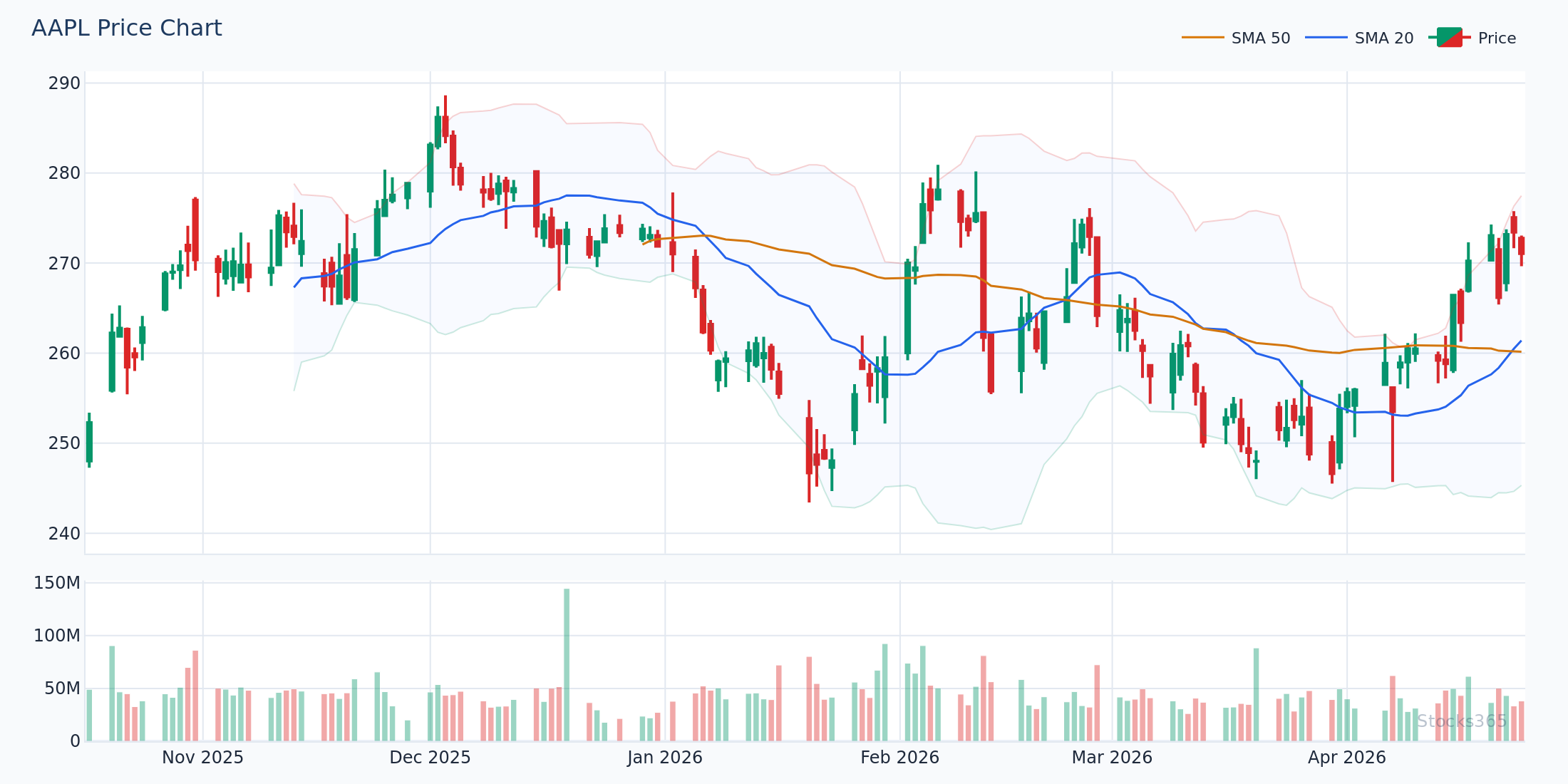
Apple (AAPL), meanwhile, filed an 8-K on April 20, 2026, per SEC EDGAR — a current-report filing typically used for material events that don't wait for quarterly earnings. Apple also saw insider Form 4 activity filed April 17, 2026, per EDGAR, as did Alphabet on the same date, per Alphabet's Form 4 filing. Insider Form 4s are disclosure events — not directional signals by themselves — but their clustering in the same week as Alphabet's proxy and Apple's 8-K adds filing density that traders with a catalyst-driven lens will track closely. Apple's 0.9% pullback to $271.06 today suggests the market is not reading the 8-K as a positive near-term catalyst.
The read-through: Alphabet's governance calendar is aligning with price momentum. Apple's filing cadence is landing into a price retreat. These are not necessarily causal — but at these levels, the divergence in intraday performance across two $2-trillion-plus franchises is the kind of spread that demands an explanation, and the filing activity this week is part of it.
What Our Algorithm Sees Across the GOOGL-AAPL Spread Right Now
Stocks365's proprietary signal on Alphabet (GOOGL) is currently rated BUY at a trust score of 57% — a moderate-conviction read, not a high-confidence slam. A 57% trust score means the model sees more favorable than unfavorable conditions, but the margin is narrow enough that position sizing discipline matters. GOOGL's market regime is flagged as normal volatility, which means the signal is operating in a regime where historical hit-rates are most reliable — extreme-volatility regimes tend to degrade model performance, and we are not in one now. The 1.6% intraday gain is consistent with a name where buyers are stepping in at the margin, but the signal's moderate trust score tells you this is not a runaway momentum trade.
Apple (AAPL) carries no active directional signal in our system as of this writing — the regime read is also normal volatility, but the 0.9% pullback to $271.06 is happening without a model trigger to the downside either. That absence of signal in a declining name is itself informative: the move is not large enough, or patterned enough, to register as a regime shift. What it does tell you is that the market is applying a modest valuation discount to AAPL intraday — possibly in response to the 8-K filing, possibly in response to the broader AI hardware and services narrative that is currently rewarding platform plays with cleaner AI monetization stories. At $271.06, AAPL is giving back ground without a fundamental breakdown signal attached to it. Traders should watch whether that 0.9% decline widens into a pattern or resolves as noise by the close.
The 250-basis-point intraday spread between GOOGL and AAPL — two names that frequently move in tandem given their shared index weight — is, by itself, a data point worth anchoring. When mega-cap tech names decouple on a relatively quiet Saturday session, the underlying driver is usually either filing-related or narrative-driven. This week, it appears to be both.
SoundHound's Margin Compression Maps the Exact Risk That Makes GOOGL's Scale an Asset
Zoom out from the large-cap tape for a moment and the competitive dynamics shaping GOOGL's positioning become even clearer. SoundHound AI (SOUN) — a developer of speech and audio recognition services that went public via SPAC at $8.72 per share — is currently trading below $8, per Motley Fool data published April 25, 2026. Its revenue rose more than fivefold from 2022 to 2025, climbing from $31 million to $169 million, per the same source. That looks like growth. The margin story tells a different narrative entirely.
SoundHound's gross margin compressed from 69% in 2022 to 42% in 2025 — a 2,700-basis-point collapse — driven by acquisitions of lower-margin businesses including SYNQ3, Allset, Amelia, Interactions, and a pending deal for LivePerson. Adjusted EBITDA improved from negative $73 million to negative $58 million over the same period, per Motley Fool's April 25 analysis — directionally better, but the company remains deeply loss-making at scale. The read-through for GOOGL is direct: when smaller AI infrastructure players are forced to buy revenue through M&A at the cost of margin, it validates the competitive moat that large-scale platforms like Alphabet's Google carry in voice AI, search AI, and cloud services. SoundHound's Houndify platform competes in the same enterprise voice-recognition space where Google Cloud and its AI services division have structural cost advantages. The numbers are making that advantage visible in real time.
How the 2022 Growth-to-Value Rotation Set the Template for This AI Valuation Split
The intraday divergence between GOOGL and AAPL — and the broader bifurcation between profitable AI platform plays and loss-making AI infrastructure names — rhymes closely with a dynamic the market has navigated before. In early 2022, as the Federal Reserve began its most aggressive tightening cycle in four decades, markets applied a severe and rapid re-rating to high-multiple, loss-making technology names. The mechanism was straightforward: rising discount rates punish long-duration assets, and loss-making growth stories are the longest-duration assets in the equity universe.
SoundHound fits that template almost precisely — a SPAC-origin company, fivefold revenue growth fueled by acquisition, gross margin now at 42% and declining, adjusted EBITDA still deeply negative at negative $58 million. The difference between the current setup and 2022 is that the AI narrative is providing a valuation floor that pure-growth-without-profit stories did not have four years ago. But the floor has limits. If the margin compression at SoundHound and similar names continues without a credible path to profitability, the market's patience — even in an AI bull cycle — has a precedent for expiring abruptly. The 2022 re-rating took approximately six months from peak to trough in affected names. Traders pricing AI infrastructure stocks at premium multiples today should keep that compression window in their models.
The Levels and Catalysts That Will Confirm or Break This Week's Divergence
For Alphabet (GOOGL), the actionable question is whether the 1.6% intraday gain at $344.40 is a sustained re-rating or a one-session move. The Stocks365 BUY signal at 57% trust is not high-conviction enough to warrant aggressive position additions without confirmation — traders should watch for follow-through in the next full trading session. If GOOGL holds above $344 on volume that matches or exceeds this session, the signal trust score becomes more meaningful. If shares retrace sharply on the next open, the 57% trust read becomes the governor: this was a moderate-conviction setup that did not deliver. For Apple (AAPL), the 8-K filed April 20 is the overhang — until the market fully digests whatever material event that filing contains, the path of least resistance intraday is lower. At $271.06, the question for AAPL holders is whether the pullback is a buying opportunity in a name with no negative model signal, or the beginning of a wider derating that the 8-K is telegraphing.
The broader setup heading into next week: if AI platform names with real margins and governance transparency — GOOGL being the clearest example on today's tape — continue to pull away from loss-making AI infrastructure plays, the valuation gap that is currently visible in intraday price action will become a structural feature of Q2 positioning. Alphabet's proxy disclosure, its insider filing activity, and its $344.40 print are all pointing in the same direction. Whether the market ratifies that direction when full liquidity returns is the question every AI-exposed portfolio manager should be carrying into the next open.