

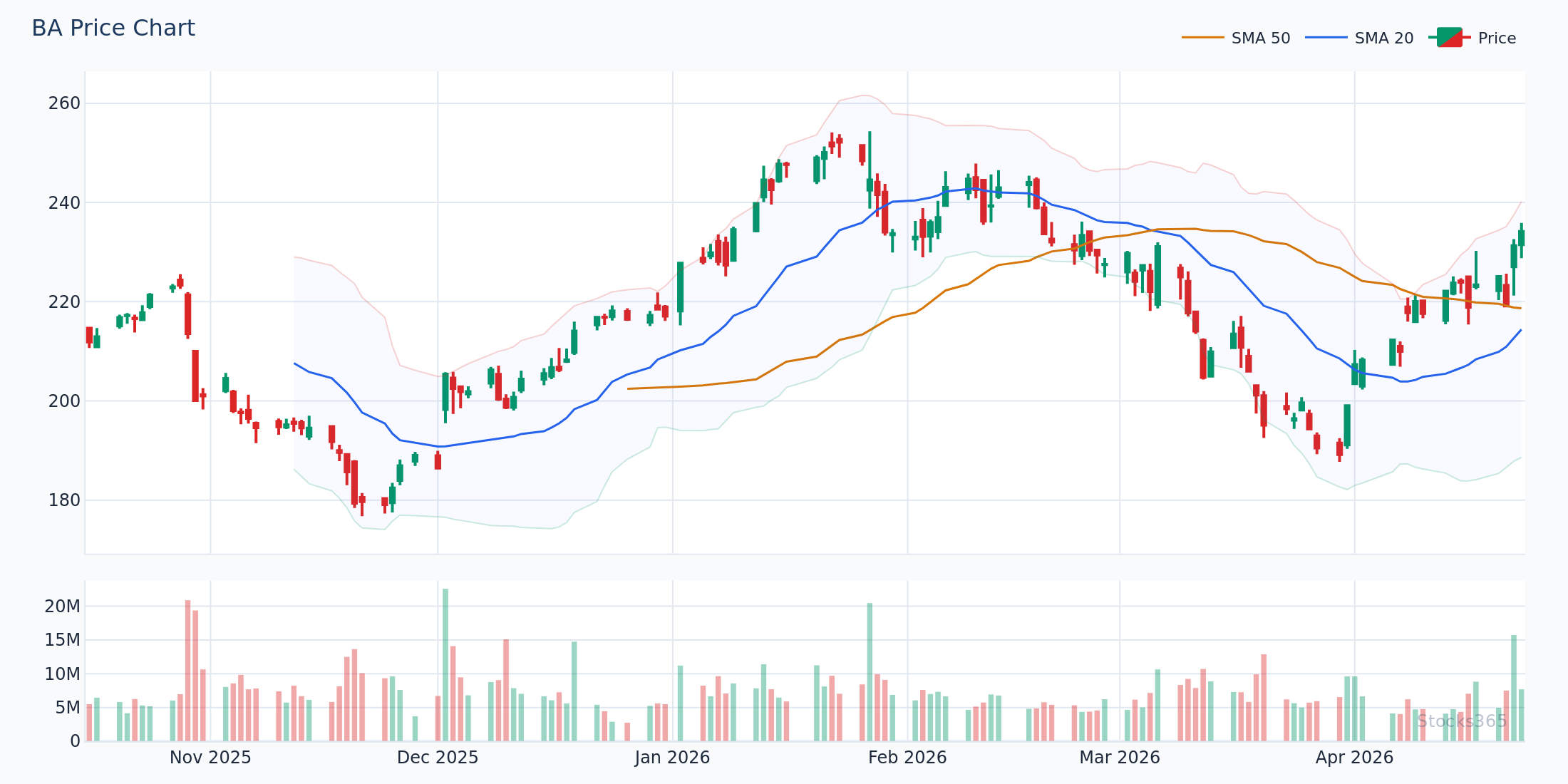
Hexcel's first-quarter earnings, reported Thursday, put a specific number on something the aerospace supply chain has been promising for two quarters: the Boeing (BA) 737 MAX ramp is no longer a forecast — it is a production reality. Commercial aerospace sales rose 8.8% in constant currency year over year, the A350 destocking cycle is described as largely behind us, and management confirmed Boeing is likely to exceed Hexcel's own mid-range assumptions for the MAX program. Meanwhile, Newmont (NEM) dropped a $3.1 billion free cash flow print for Q1 — a record — backed by 1.3 million ounces of gold production, underscoring how commodity-linked balance sheets are generating extraordinary cash in the current macro environment. Boeing shares are trading at $234.15, up 1.2% in early activity. Both prints, read together, contextualize where the aerospace-industrial complex sits entering the middle of Q2.
How the 737 MAX Ramp Shows Up in a Composites Supplier's Income Statement
Hexcel is not a household name to retail investors, but to anyone who tracks the aerospace supply chain, the company's quarterly results function as a real-time stress test for Boeing and Airbus production rates. Hexcel supplies the carbon fiber composites that go into aircraft structures — it cannot sell product that has not been ordered, and it cannot recognize revenue on programs that are not building. When Hexcel reports an 8.8% constant-currency sales gain and confirms that 737 MAX production is running at a level that will likely push Boeing above Hexcel's own mid-range guidance, that is a bottoms-up data point that carries weight. Per the Hexcel earnings call transcript, Commercial Aerospace segment sales were up meaningfully from the same period last year, with all major programs — A350, A320, 787, and 737 MAX — contributing to the gain. The A350 destocking that weighed on results through much of last year is described as approximately finished, with roughly the expected unit volume now in the pipeline. Chairman and CEO Tom Gentile described the quarter as reflecting "strong execution across the business in a very dynamic environment," and the operating leverage language — a phrase management has been telegraphing for several quarters — is now appearing in the gross margin line, which expanded versus the year-ago period.
Newmont's Q1 print adds a different but complementary data point. The miner produced 1.3 million ounces of gold, 30,000 tonnes of copper, and 9 million ounces of silver, delivering $3.8 billion in cash flow from operations and $3.1 billion in free cash flow — record levels, per management, despite typical seasonal working capital headwinds. The company announced a new $6 billion share repurchase authorization and reaffirmed full-year guidance. An earthquake at the Cadia mine created an operational disruption, but Newmont said recovery efforts are underway with a return to 80% capacity expected soon. Management also flagged that Q2 production will be slightly lower before rebounding — a sequencing note worth tracking. The Nevada Gold Mine default notice, issued in February, remains open-ended per Interim CFO and Chief Legal Officer Peter Wexler, adding a low-level legal overhang that analysts will continue to monitor.
Where Our Signals Stand on BA This Morning
Our proprietary data has Boeing (BA) trading at $234.15, up 1.2% with the market regime classified as normal volatility. That classification matters. A normal-volatility regime on a name that spent most of the past two years operating under elevated-volatility conditions is itself a signal — it suggests the fat-tail pricing that characterized BA options through the MAX and quality-control crisis periods is compressing. When composites suppliers like Hexcel confirm production ramps with hard revenue data rather than management guidance alone, and when Boeing's own SEC filings — including the most recent 10-Q filed April 22 — are available for line-item verification, the information quality around the recovery thesis improves materially. Lower uncertainty, in normal markets, translates into tighter vol premiums. That is what we are observing. According to Boeing's most recent 8-K filing dated April 22, the company has been active in communicating its financial position to the market this week, providing the disclosure backdrop against which Thursday's supplier earnings should be read.
The asymmetric setup here runs in two directions. If Hexcel's production rate commentary proves accurate and the 737 MAX ramp continues to accelerate through Q2, Boeing's commercial deliveries — the metric that most directly drives cash generation — should improve sequentially. That would be consistent with a regime where BA continues to trade above its recent consolidation range. The bear scenario, however, is not implausible: supply chain normalization is a process, not an event, and single-quarter supplier beats have previously set expectations that subsequent quarters failed to sustain. The Stocks365 model is not flashing an extreme directional signal on BA at current levels. What it does show is a name where the information environment is improving — and improving information environments tend to precede re-rating, if the underlying fundamentals are intact.
The 2023 Defense-Industrial Echo, and Why This Cycle Has Three Differences
The closest historical parallel to the current aerospace supply chain recovery is the 2022-2023 defense and commercial aerospace restocking cycle, where companies like Hexcel, TransDigm, and Spirit AeroSystems all reported sequential improvements in composite and aerostructure demand beginning in Q3 2022, only to see investors punish the stocks on concerns that the ramp was fragile. The market's skepticism was partially justified — the actual delivery ramp at Boeing lagged supplier optimism by two to three quarters, and several names that front-ran the recovery thesis gave back gains when the MAX quality halt in early 2024 reset the timeline. That episode is worth internalizing: supplier revenue growth does not automatically translate into Boeing delivery growth on the same schedule.
This cycle has three differences that make the parallel instructive but imperfect. First, the destocking cycle — particularly on A350 — appears genuinely resolved based on Hexcel's commentary, whereas in 2022-2023 channel inventory was still a confounding variable. Second, Hexcel's gross margin expansion in Q1 reflects actual cost absorption improvement, not just volume leverage; that suggests the operational leverage is real rather than accounting-driven. Third, Newmont's record free cash flow and the broader commodity sector's capital return posture — a new $6 billion buyback authorization is not a distressed-balance-sheet move — signals that the macro environment supporting capital-intensive industrial names remains constructive. If commodity cash flows are this strong in Q1, and aerospace composites demand is accelerating, the industrial complex is not operating in a recessionary regime. The bear case requires that thesis to break.
The Production Rate Assumptions That Will Define BA's Q2 Narrative
The key variable to track into the next four to six weeks is whether Boeing's actual Q2 delivery data confirms or contradicts what Hexcel's production-rate language implies. Hexcel described the 737 MAX ramp as "tangible" and said Boeing will likely exceed the midpoint of Hexcel's own guidance range — specific language that sets a verifiable bar. If Boeing's April and May delivery releases show MAX units running above that midpoint, the supply chain recovery thesis gains a second confirming data point and the BA setup becomes more directionally interesting. If deliveries disappoint despite the supplier optimism, it raises the question of whether the bottleneck has migrated further downstream — into final assembly, into inspection, or into airline acceptance — rather than in the composites and materials tier where Hexcel operates.
On the Newmont side, the Q2 production guidance — slightly lower before rebounding — means the real test of the $3.1 billion FCQ benchmark is whether the rebound materializes in Q3, or whether the Cadia earthquake recovery timeline slips. Management expressed confidence in the 80% capacity restoration, but earthquake-related production guidance has a credibility lag; the Nevada Gold Mine default notice adds a second open-ended variable. For investors holding both industrial and commodities exposure into this earnings season, the question to carry into tomorrow is straightforward: if Hexcel's production-rate confidence is right and Newmont's Q2 dip is transient, what does that say about the broader industrial and materials complex pricing in a soft-landing regime — and how much of that is already reflected in BA at $234?