

Intel (INTC) stock surged 24% to a record high on Friday, its data center and AI division posting $5.1 billion in revenue — a 22% year-over-year jump — while across town, Comcast (CMCSA) was getting taken apart for nearly 13% on a single analyst downgrade. Same Friday. Completely different worlds. That kind of tape split doesn't happen by accident — it tells you exactly where the institutional positioning is sitting right now, and it sets up a Monday open that deserves your full attention.
A 156% Earnings Surge, a Marvell Order, and a Downgrade That Landed Like a Hammer
Start with Intel, because the numbers are genuinely hard to ignore. Total Q1 revenue came in at $13.6 billion, up 7% year over year. That headline number is solid. But the story is in the bottom line: adjusted net income surged 156% to $1.5 billion, or $0.29 per share — against a Wall Street consensus that was sitting at just $0.01 per share. That's not a beat. That's a demolition of expectations. Intel's CFO David Zinsner pointed to factory network optimization as the mechanism, saying the company remains focused on improving supply to meet customer demand throughout the year. For Q2, management guided for revenue of $13.8 billion to $14.8 billion and adjusted EPS of $0.20 — compared to a loss of $0.10 per share in the same quarter last year. The turnaround narrative just got serious legs.
Then there's Poet Technologies (POET). The fiber-optics specialist climbed 28.8% on Friday after a brief Thursday pullback, capping a 120.5% gain over the last week. The catalyst is straightforward: CFO Thomas Mika confirmed that Poet has secured orders with a company that Marvell acquired earlier this year, validating a previously announced roughly $5 million target from a leading data-center systems integrator. The door is now open for that contract to climb well above the original number. Small-cap, high-risk, but the Marvell confirmation is a real commercial anchor — not just a press release. Positioning in names like this accelerates fast when institutional buyers decide the commercialization story is credible.
Comcast is the other side of the ledger. The cable giant actually beat consensus Q1 estimates. Didn't matter. Barclays analyst Bryan Craft downgraded the stock to hold from buy before Friday's open, cutting his price target to $34 from $35, citing lower EBITDA and free cash flow estimates from 2027 onward, stiff broadband competition, and reduced upside given the stock's recent appreciation. The market listened. Shares dropped nearly 13%. In the shadow of the Skydance/Warner Bros. Discovery consolidation, Comcast is suddenly looking like a smaller fish in a pond that keeps getting bigger. Craft's framing — that Comcast isn't differentiated enough to be compelling at current valuations — is the kind of language that sticks with institutional risk committees.
Where AMD and TSLA Sit on Our Tape Right Now
Our proprietary data at Stocks365 puts Advanced Micro Devices (AMD) at $347.81, up 13.9% on the day. That's the kind of move that resets technical levels and forces short-covering — it's not just a drift higher. AMD's session gain is notable in the context of Friday's broader tech rotation. The market that punished software names on Thursday turned around and bid semiconductors aggressively into the close on Friday. AMD didn't report earnings today — this is sympathy and sector rotation off Intel's blowout. When the largest CPU player in the world posts a 156% earnings surge and guides up, the second-largest CPU/GPU player gets bid. That's the setup.
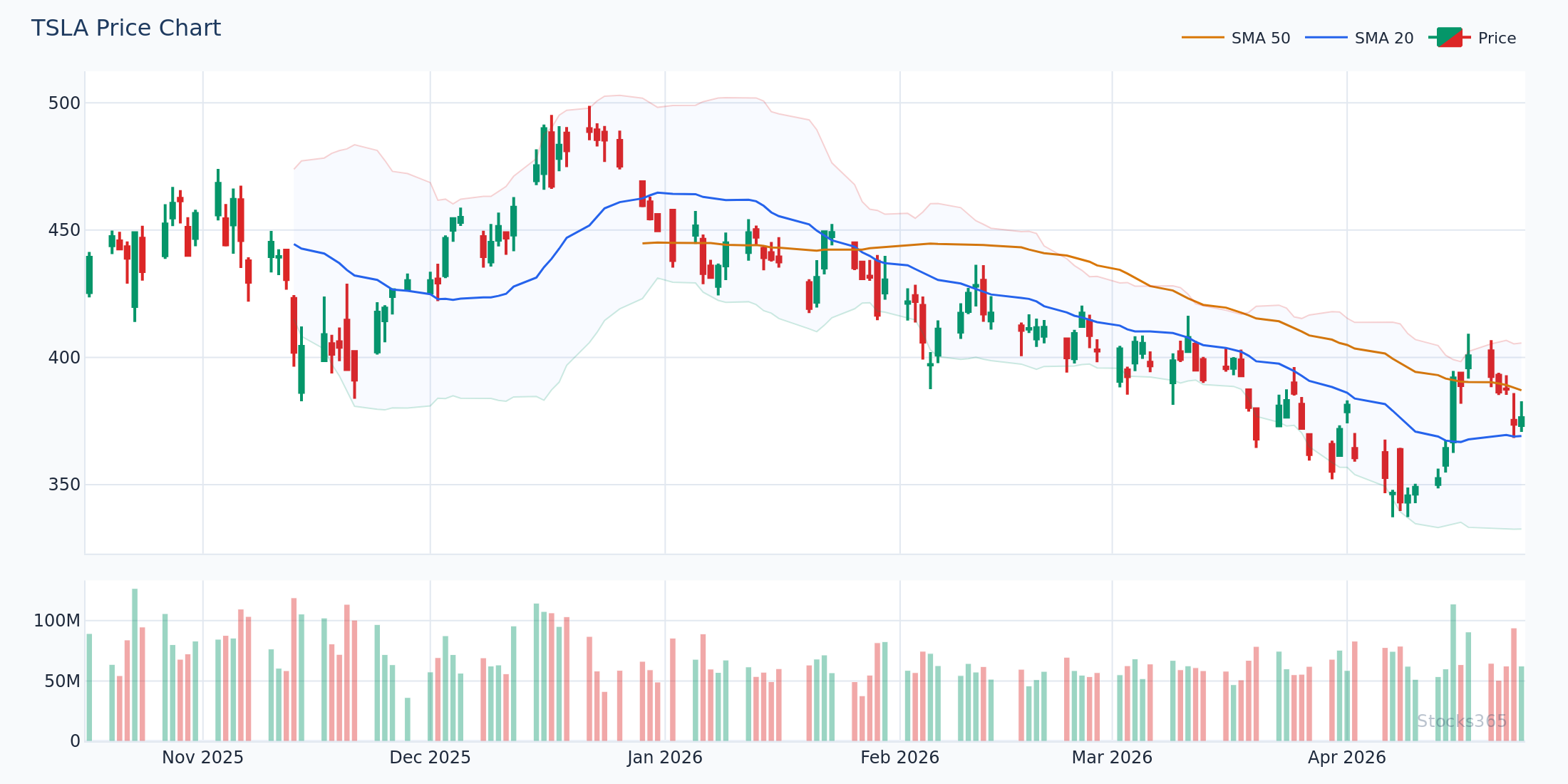
Tesla (TSLA) closed at $376.30, up 0.7% — a quiet day by Tesla standards. Both names are currently operating in normal volatility regimes per our market regime classification. That's significant context. Normal volatility means the big moves we saw today in Intel and AMD are earnings-driven and sector-specific, not a sign of broader regime stress. If volatility were elevated at the regime level, you'd read Friday's 24% Intel surge differently — as a fear-covering bounce rather than genuine price discovery. It reads as genuine. The signal here is that the AI infrastructure trade is rotating and broadening. Intel is back at the table. AMD is already there. The question is whether this is a one-day flush of shorts or the beginning of a sustained re-rating.
Remarkable.
Intel's Last Big Earnings Surprise — and Why This One Feels Different
Intel has had earnings-driven pops before. The more useful parallel is the 2023 semiconductor cycle bottom, when chip names that had been written off as cyclical losers began posting sequential recovery numbers that caught the Street flat-footed. The pattern then was similar: consensus was anchored to trailing weakness, the actual print showed demand recovery in data center and cloud, and the stock responded with multi-standard-deviation moves because positioning was short and crowded. Intel's Q1 print today — with EPS of $0.29 against a $0.01 estimate — has that same character. The miss on expectations wasn't narrow. It was structural. Analysts had baked in a loss scenario that didn't materialize, and that means the positioning re-set is larger, not smaller. The critical difference this time is the AI inference angle. In prior cycles, Intel was a pure CPU commodity player. What the Q1 data center numbers suggest is that the shift toward AI inference workloads — which lean more on CPUs than model training does — is creating a demand tailwind that wasn't in anyone's model twelve months ago. That's a qualitative change, not just a cyclical one. And qualitative changes in a stock's demand narrative tend to hold longer than cyclical beats.
The Comcast parallel cuts the other way. Think about the regional media and cable shakeout of the mid-2010s, when cord-cutting went from a theoretical risk to a line-item reality in subscriber tables. Analysts who had been buy-rated on cable stocks for years started downgrading one by one, and each downgrade had an outsized impact because it forced portfolio managers to revisit position sizes. Today's Craft downgrade has that feel. It's not the end of Comcast. But when a name beats on Q1 and still drops 13%, the market is telling you that the forward multiple was already stretched and the margin-of-safety trade is gone. That's a regime change in how the stock gets priced — and those tend to be sticky.
Into Next Week — The Levels and the Catalysts That Will Settle This
For Intel, the setup into Monday is straightforward to describe and hard to trade. A 24% single-session move on earnings is a statement, but it also burns a lot of the near-term upside in one day. The Q2 guidance of $13.8 billion to $14.8 billion is the new anchor — if the AI inference demand story holds through the summer, Intel has a credible path to re-rating further. Watch for any commentary from data center operators or hyperscalers next week about CPU procurement trends. That's the confirm or deny for Intel's thesis. For AMD, the $347.81 close is technically significant — a 13.9% single-day move on sympathy buying is the kind of price action that either holds and becomes support, or fades quickly when the Intel glow wears off. If AMD holds above Friday's open level into Tuesday, the rotation is real. If it gives back half the day's gain, it was just a short squeeze.
Comcast is the name to watch as a tell on how the market is pricing legacy media consolidation risk. The Skydance/Warner Bros. combination looms large here, and if any new details surface on that deal's structure next week, Comcast's relative positioning in the media landscape gets re-evaluated again. The stock's drop to the $34 price target area on a day when the broader market was healthy is the kind of technical damage that takes more than one good week to repair. Is there a scenario where Comcast finds a bid at these levels? Yes. But the burden of proof just shifted firmly onto the bulls, and they don't have a catalyst lined up.