

$82.54. That's where Intel Corporation (INTC) ended the session today — April 26, 2026 — up 23.6% in a single trading day, per Stocks365 proprietary price data. A move of that magnitude on a mega-cap semiconductor name doesn't happen on noise. But it also doesn't automatically mean the underlying story has changed. The gap between a price move and a fundamental shift is exactly where investors get hurt.
Intel filed both an 8-K and a 10-Q with the SEC on April 24 — two days before today's surge. Per the company's most recent 8-K filing (SEC EDGAR, dated April 24, 2026), an earnings-related event was the catalyst. The 10-Q, covering the period ending March 28, 2026, provides the balance-sheet and income-statement architecture underneath that catalyst. The filings are the record. Everything else is interpretation.
A 23.6% Print in Context — and Why Context Is Doing a Lot of Work Here
Single-session moves of this size on large-cap names are rare enough to demand a historical anchor. The closest modern parallel: Intel's January 2023 post-earnings rally, when the stock surged on cost-cut optimism before giving back the majority of those gains over the following two quarters as gross margin pressure reasserted itself. That episode is a useful calibration — not a prediction, but a reminder that the market's first read on a restructuring story is often its most generous.
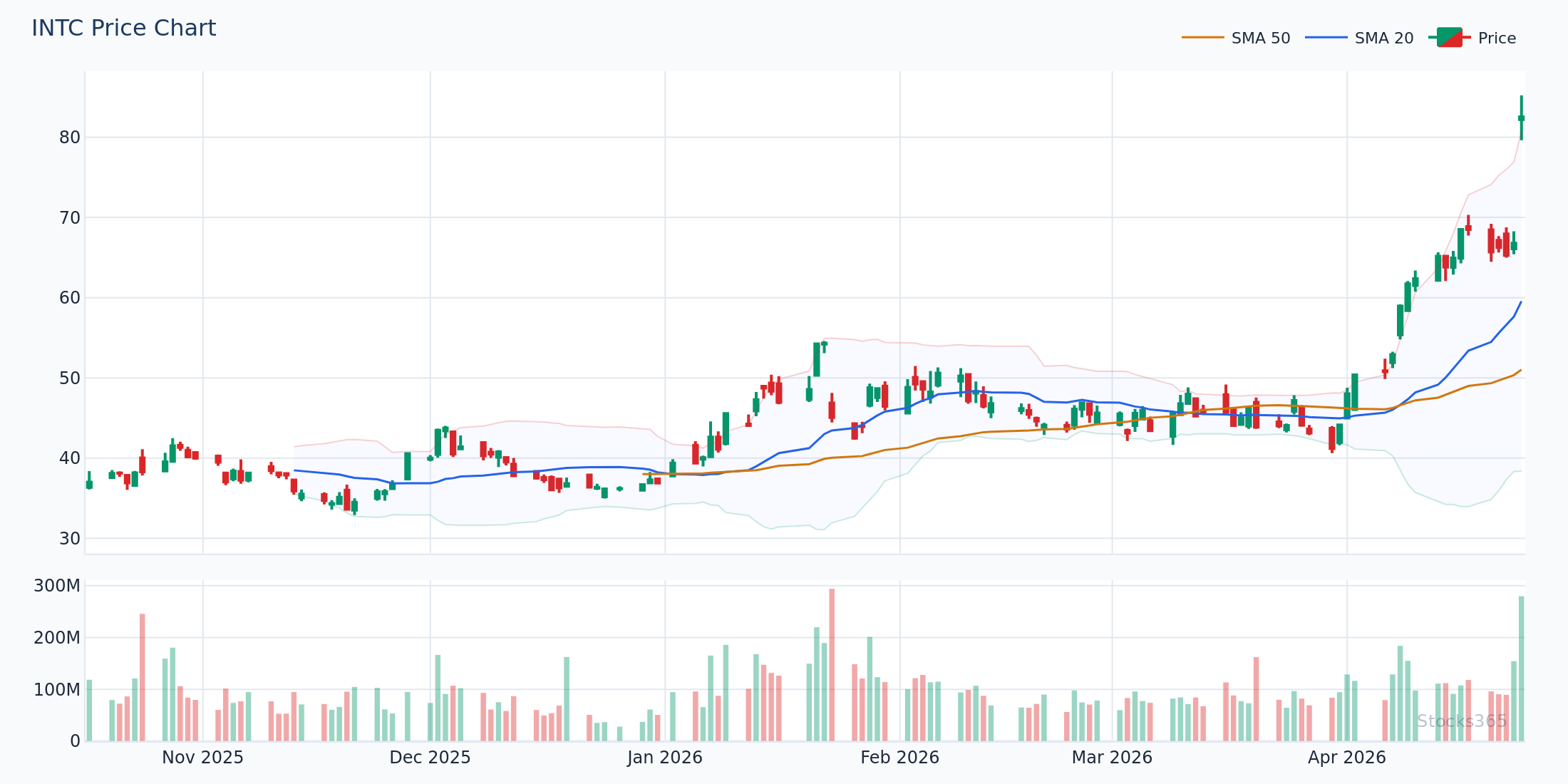
Today's 23.6% move lands Intel's price at $82.54 — a level that, without confirmed forward earnings per share numbers from the filed documents, makes valuation math genuinely difficult to anchor. The 10-Q covers the quarter ending March 28, 2026, per SEC EDGAR. That's the most recent reported data investors have. What the filing reveals about revenue trajectory, operating leverage, and free cash flow generation is the foundation any sustainable re-rating has to be built on.

The Filing Architecture: 8-K Plus 10-Q in the Same 48-Hour Window
Intel's decision to file both an 8-K and a 10-Q on the same date — April 24, 2026 — is worth noting as a structural observation. The 8-K, per SEC EDGAR (filing reference: intc-20260424), is the current-report vehicle: it signals a material event, typically an earnings release or a significant business development. The 10-Q, covering the period through March 28, 2026 (filing reference: intc-20260328), is the quarterly financial report — the document where line items live.
When both hit the same day, the 8-K is almost always the headline and the 10-Q is the evidence. Sophisticated readers go to the 10-Q first. Revenue recognition policies, segment-level detail, working capital changes, and footnotes on restructuring charges — these are the data points that either support or undercut whatever headline number drove the 8-K. The print matters. The architecture behind the print matters more.
Per the company's 10-Q filing with the SEC, the reporting period ends March 28, 2026 — meaning this quarter's results capture Intel's operational posture through the first three months of the calendar year. That timing places it squarely in a period when semiconductor demand signals — particularly around AI infrastructure spending and data-center procurement cycles — were being watched with unusual scrutiny across the entire sector.
What Stocks365 Signals Show at These Levels
A 23.6% gap-up creates a specific technical setup that our research lab has catalogued extensively. Stocks365's two-year strategy sweep across 7,147 signals on VWAP Mean Reversion Long setups found a That's a modest edge — not a mandate. More relevantly, the same sweep found that VWAP Mean Reversion Short setups — the fade — carried only a across 16,545 signals
The read-through: momentum after a filing-driven gap doesn't fade as cleanly as a momentum-only move. When there's a fundamental event underneath the price action — an earnings report, a restructuring disclosure — mean-reversion shorts tend to underperform. The market has often already processed the downside scenario before the filing hits. At these levels, the burden of proof falls on those arguing for immediate reversion, not those holding through the catalyst window.
That said, Stocks365's market-regime classification for INTC today is listed as unknown (normal volatility) — which itself is a signal worth sitting with. A stock up 23.6% in a single session, with regime classification still settling, is a name where conviction in either direction should be held loosely until more session data accumulates.

The Berkshire Parallel That Nobody Is Talking About
The source material surfacing today includes a parallel data point worth threading in: Berkshire Hathaway's concentrated positions in deeply discounted businesses — specifically the note that Berkshire holds 37.1% of Sirius XM's outstanding shares, a company trading at a forward price-to-earnings ratio of just 8.7, per reporting from The Motley Fool (via Yahoo Finance, April 26, 2026). That's a different ticker, but the analytical frame is identical to Intel's situation.
Both are legacy businesses in sectors under competitive disruption. Both trade — or recently traded — at valuations that screen cheap on a surface-level multiple basis. Both have free cash flow narratives that bulls use to justify the discount. The difference is that Sirius XM's forward FCF story is built on a subscriber base that fell by 301,000 in the most recent annual period, per the same source — and Intel's equivalent pressure point is competitive positioning in foundry and client computing against better-capitalized rivals.
A cheap multiple is only a margin of safety if the denominator — earnings — isn't itself in structural decline. That's the question Intel's 10-Q, filed April 24, 2026 with the SEC, is supposed to answer. And it's the question that a 23.6% gap-up can obscure, not resolve.
The One Number to Track Before Tuesday's Open
Intel's 10-Q covers the quarter ending March 28, 2026. That means the next material data point — Q2 guidance or any forward-looking update from management — will almost certainly come via a subsequent 8-K or investor communication. Absent that, the market is essentially extrapolating from a single quarter's filing into a multi-quarter re-rating thesis.
Watch the $82.54 level as both a reference and a test. If INTC opens Tuesday with volume confirmation — meaning buy-side conviction is backing the move rather than short-covering driving it — then the earnings catalyst has legs. If volume dries up and the stock drifts back below the session VWAP from today's close, the gap-up begins to look more like a short-squeeze artifact than a genuine re-rating. Per Stocks365's backtest data, the 10-day window following events like this is where the real signal separates from the noise.
The filing is public. The numbers are there. The 23.6% move is real. Whether those three things tell the same story — that's what the next 48 hours will begin to reveal.