
The consensus trade into Intel (INTC)'s April 23 earnings is straightforward: the Terafab partnership with Elon Musk's SpaceX validates the 18A process, the AI foundry pivot is real, and an 85% year-to-date gain is simply the market repricing a turnaround that skeptics underestimated. It's a striking narrative. The challenge is that Intel's own guidance, issued just three months ago, tells a materially different story about what Thursday's results are likely to show.
Q1 Guidance Highlights a Gap Between Excitement and Fundamentals
When reporting fourth-quarter results in late January, Intel management guided Q1 revenue to fall between $11.7 billion and $12.7 billion. That represents a significant sequential decline from the $13.7 billion posted in Q4. The outlook was given while industry focus was turning to Terafab, but the sources do not confirm management's knowledge of that deal at that time. Investors appear focused on the external validation from Terafab but risk underestimating near-term headwinds highlighted in company guidance.
Margins are also under pressure. Intel expects Q1 non-GAAP gross margin to compress to about 34.5%, down from 37.9% in Q4. The company attributed part of this to supply constraints, with management stating available supply would be at its lowest in Q1 before improving in Q2 and beyond. This sets up Thursday's results as a critical test: Is the recovery already priced in, or is there more near-term pain to come?
Stocks365 Take: Event Risk Surges While Peers Stay Rational
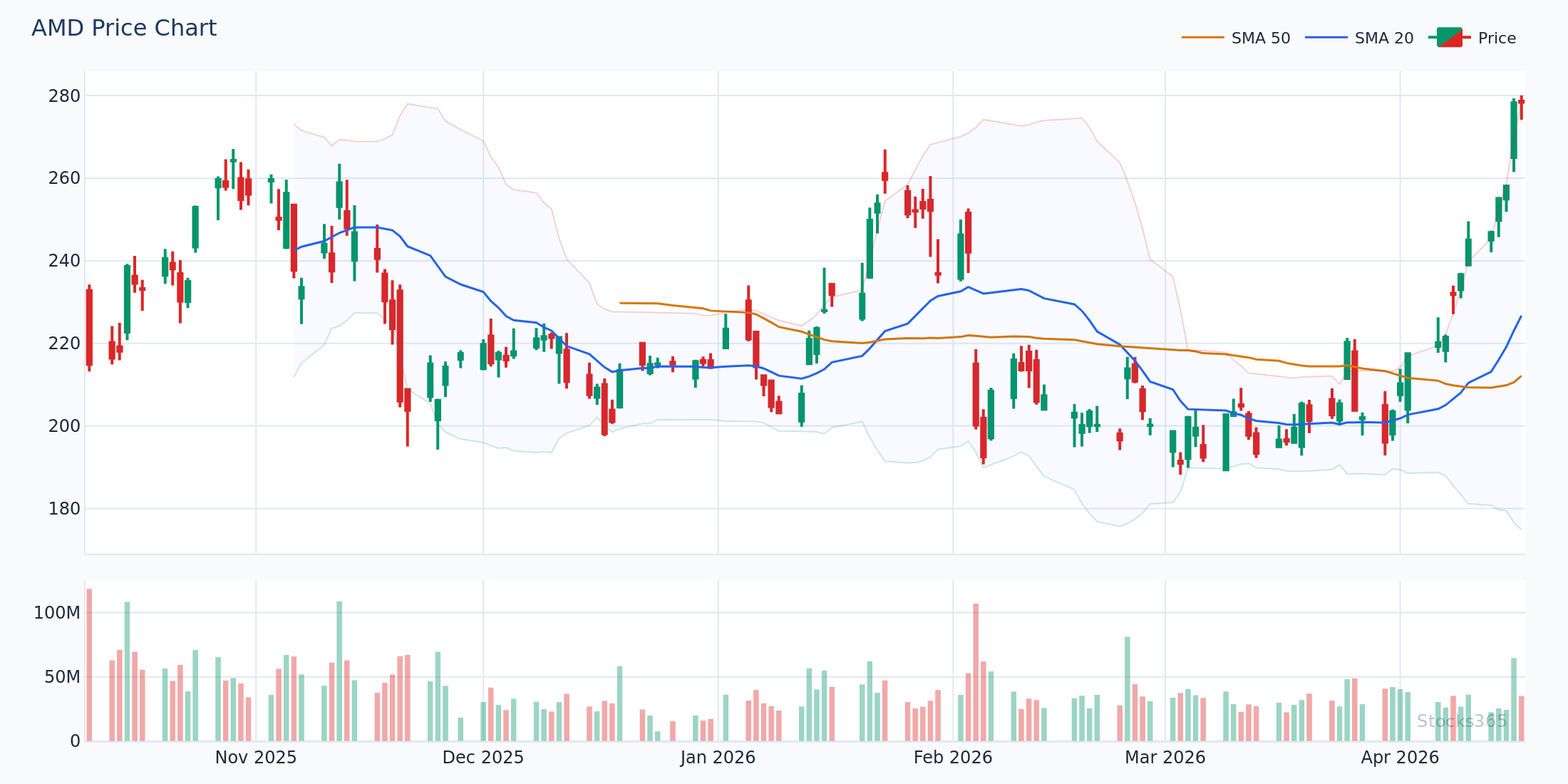
Stocks365's proprietary data shows that Intel's sector peers are trading with less excitement. Advanced Micro Devices (AMD) closed at $278.39, flat on the session—our system classifies this as a normal-volatility regime. Unlike Intel, AMD is not seeing the same year-to-date multiple expansion, highlighting that the sector-wide demand narrative is not driving similar stock repricing for all chipmakers. This points to the deal-specific nature of Intel's rally.
Elsewhere, Visa (V) gained 0.6% to $317.02, also within our normal-volatility regime. This signals that the macro environment remains stable leading into the dual earnings prints on April 23, which matters at the margin for chipmakers with enterprise exposure. However, macro stability does not address Intel’s core margin and supply chain pressures.
Recalling the 2021 Foundry Hype — New Validation, Same Risks?
While the Terafab partnership is an external validation that IDM 2.0 lacked, the fundamental question remains: Will the numbers follow the narrative more quickly this cycle, or will Thursday mark the beginning of another slow grind between ambition and financial delivery?
The difference this time is that Terafab offers tangible, third-party validation. Still, the risk is that with the stock up 85% year to date, the recovery is already priced in, leaving little margin for disappointment. Management itself flagged heavy investment costs and a 34.5% Q1 margin—hurdles that cannot be overlooked.
Critical Numbers and Signal Markers for April 23 Earnings
As Intel reports after the close on April 23, the key metrics are clear: Does Q1 revenue fall within the guided $11.7 billion–$12.7 billion band, and does management provide an outlook for a Q2 recovery? A below-guided Q2 could undermine the bull case, especially if gross margins sink further below 34.5%. On the other hand, forward guidance regaining or surpassing 37.9% on gross margin would strongly support the re-rating. American Express's results on the same morning—consensus at $4.01 per share EPS and $18.62 billion revenue—will also define the macro sentiment. Ultimately, Thursday's print poses the fundamental question: Has Intel's 85% rally accurately priced a structural shift, or is it a fragile response to a high-profile announcement?
