

The announcement hit before most traders finished their morning coffee: Meta Platforms (META) is axing roughly 8,000 employees — 10% of its entire workforce — while simultaneously leaving 6,000 job posts unfilled. Hours later, Microsoft (MSFT) followed with a voluntary redundancy programme targeting roughly 8,750 people, or 7% of its U.S. workforce, with offers going out in early May. The consensus reading is practically writing itself: leaner cost structures, sharper AI focus, unlocking capital for the next growth phase. Analysts are nodding. But as both stocks bleed into Friday afternoon, something in that tidy narrative deserves a harder look.
Two Different Scalpels, One Uncomfortable Pressure
Meta (META) and Microsoft (MSFT) are taking structurally different approaches — and that distinction matters more than the headlines suggest. Meta is executing outright layoffs, the harder and faster route, led by Mark Zuckerberg's directive to redirect capital toward AI talent and infrastructure including chatbots and large language models. The memo sent to staff framed it as creating room for "new investments in parts of the business." Microsoft, by contrast, is using voluntary redundancy — softer optics, slower execution, and offers rolling out in early May rather than immediate terminations. Same destination, different vehicles.
Matt Britzman, senior equity analyst at Hargreaves Lansdown, offered the consensus framing cleanly:
"Reports of further headcount reductions at Meta come as little surprise and, while unfortunate for all involved, should be taken as a broadly positive signal. With heavy investment in top AI talent, trimming elsewhere points to a sharper focus on the individuals driving the next leg of growth."That view is reasonable. But notice the assumption buried inside it: that trimming the old workforce and hiring AI talent is a one-for-one value swap. The consensus case rests on that assumption — and that assumption may not hold if the AI cost curve continues to steepen faster than productivity gains materialize.
Both companies are set to brief investors with trading updates next week. That timing is not accidental. The layoff announcements today function partly as narrative pre-positioning — framing the cuts as proactive efficiency before the earnings lens lands on capital expenditure lines that are growing, not shrinking.
What the Tape Is Actually Saying Right Now
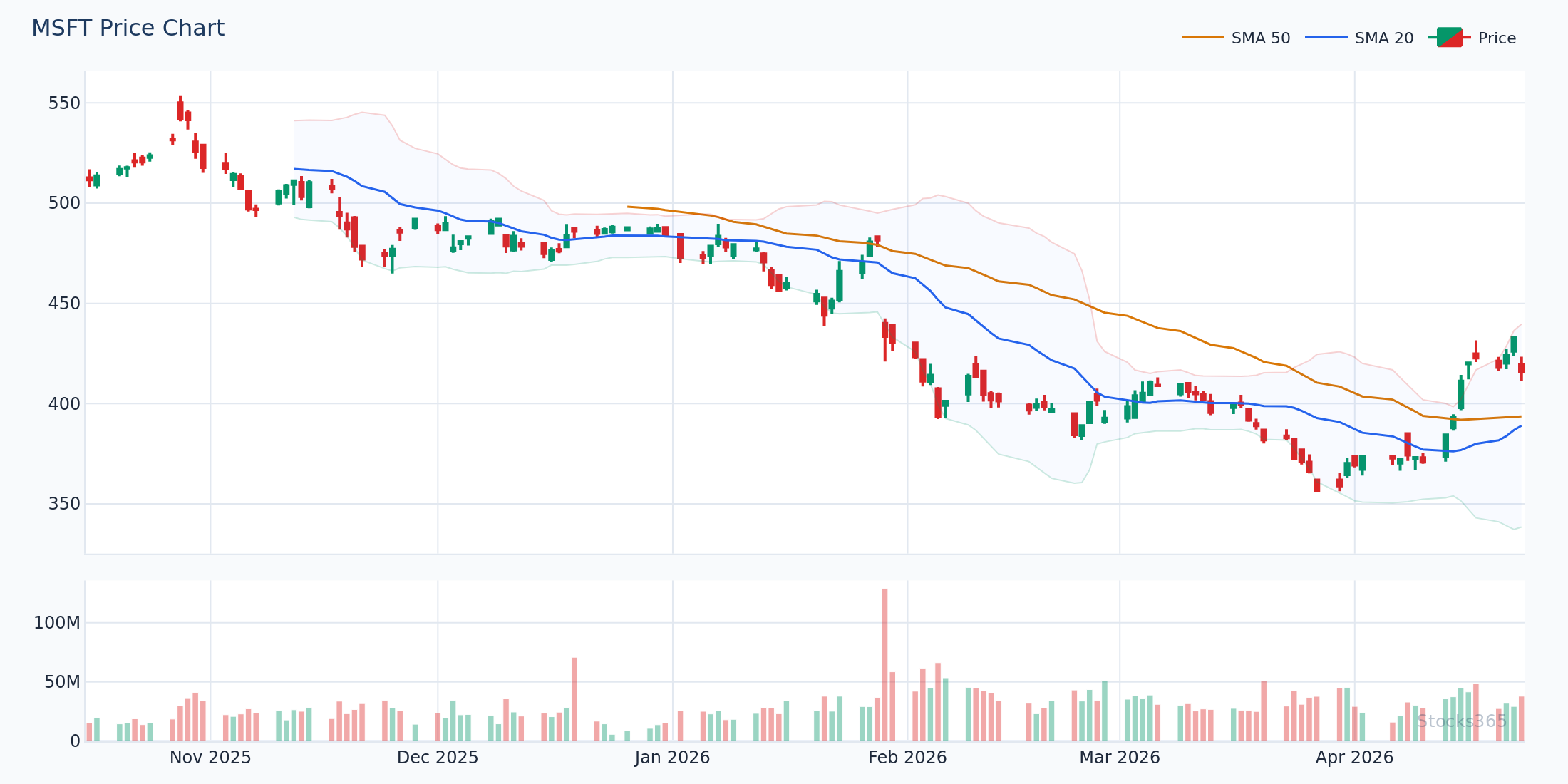
Here's where it gets interesting. If the market read these announcements as straightforwardly bullish, you wouldn't expect both stocks to be underwater midday Friday. Yet that's precisely what's happening. Microsoft (MSFT) is trading at $415.75, off 4.0% on the session — a meaningful single-day drop in a stock this size. Meta (META) is holding somewhat better at $659.15, but is still down 2.3%. Normal volatility conditions, per our regime model, mean this isn't a liquidity-driven panic — it's considered selling.
Our Stocks365 model carries a BUY signal on META with a trust score of 53% — a signal that exists but is far from a high-conviction call. Fifty-three percent is barely above a coin flip. What that number is telling sophisticated readers: the model sees upside probability, but the edge is thin. In a market where AI spending momentum has been the dominant narrative for consecutive quarters, a thin-edged BUY on a stock that's down 2.3% on its own good news is not the clean entry point the headlines might suggest. The real story here isn't the job cuts themselves. It's the market's muted — and in MSFT's case, actively negative — response to what should theoretically be shareholder-friendly news. That divergence between narrative and price action is where the contrarian lens finds its sharpest focus.
A Pattern That Rhymes With 2018 — With One Critical Twist
This configuration has a historical echo worth naming. In late 2018, a wave of large-cap tech restructurings — framed at the time as AI and cloud pivots — were initially met with investor applause before the sector repriced sharply lower as it became clear that the capital being "freed" was being redeployed into cost structures that would take years to generate returns. The pattern: announce efficiency, promise reinvestment in transformational tech, watch near-term multiple compression as the market waited for proof. It wasn't a collapse. It was a prolonged period of underappreciated execution risk.
The critical twist in the current setup is scale. The AI infrastructure spending both companies are protecting — and expanding — dwarfs what was being deployed in 2018 cloud pivots. That means the upside case, if the AI investment pays off, is larger. But so is the downside if it doesn't. Convexity cuts both ways. Investors pricing in a clean efficiency narrative today may be underweighting just how long the runway to AI ROI actually is — and how much capital will be consumed while they wait.
Before Next Week's Earnings Calls Change Everything
The immediate catalyst is sitting right there on the calendar: both companies brief investors next week. That creates a narrow but important window. If the trading updates reveal that capital expenditure guidance is being revised upward — even as headcount falls — the efficiency narrative collapses into a reframing exercise. Watch specifically for any language around AI infrastructure spending plans, because that line item is the actual variable the market is pricing, not the headcount reduction itself. A company can cut 10% of its workforce and simultaneously accelerate its cost base if the capex line is moving fast enough in the opposite direction.
For Meta (META), the question entering next week is whether Zuckerberg's memo language about "new investments" gets quantified — or stays qualitative. Qualitative framing at this valuation level, with a 53% trust-score BUY signal and a stock already down on the news, leaves meaningful tail risk on the table if the earnings call disappoints on specificity. For Microsoft (MSFT), trading at $415.75 and down 7% intraday, the voluntary redundancy timeline extending into May means the market won't see clean cost structure data for at least another quarter. Can the consensus's efficiency thesis hold that long without a harder catalyst? That's the question carrying into Monday's open.