

Three separate catalysts fired across three separate sectors on Saturday — and together they sketch a market that is selectively rewarding disciplined capital allocation while remaining deeply skeptical of anything carrying a stretched valuation. Meta Platforms (META) closed at $675.03, up 2.4%, after confirming a multibillion-dollar partnership with Amazon (AMZN) to deploy AWS Graviton infrastructure at scale. Atlassian (TEAM) gained 5.8% on a sector halo effect from SAP's cloud beat. And oilfield services name NESR (NESR) closed up 3.5% as Baker Hughes and SLB posted beats that lifted the whole services complex.
A Compute Deal, a Cloud Halo, and an Energy Services Lift — What Actually Moved the Tape
Start with the heaviest event. Meta announced it will deploy tens of millions of Amazon (AMZN) AWS Graviton CPU cores to power its next-generation agentic AI workloads, covering real-time reasoning and code generation. The deal positions Meta as one of Amazon's largest silicon customers. More importantly for the near-term narrative, it directly addresses the capital expenditure overhang that has weighed on the stock — by routing compute demand through AWS infrastructure rather than accelerating its own buildout, Meta signals a preference for energy-efficient, margin-preserving scaling. The move complements what the company has internally called its "Efficiency 2.0" initiative, which included a 10% workforce reduction to concentrate resources on high-return AI projects. Analysts are now pricing in 30% ad revenue growth in the April 29 earnings report, and this infrastructure announcement provides structural cover for that projection. The deal matters not just for Meta's cost curve, but as confirmation that the hyperscaler-to-hyperscaler dynamic — where large platforms rent rather than own their compute baseline — is solidifying across the industry.
The Atlassian move is a cleaner read on sector sentiment than company fundamentals. SAP's better-than-expected Q1 profit and confirmed long-term cloud outlook were the spark; the market interpreted strong results from a legacy enterprise software giant as validation that AI disruption fears had been overpriced. That sentiment spilled into adjacent names. Atlassian at $71.54 remains down 53.8% year-to-date and trades 68.9% below its 52-week high of $229.83. A 5.8% session on borrowed momentum from a German ERP vendor is meaningful context — it says the bid here is tactical, not fundamental. NESR's 3.5% gain to $24.44 is similarly a sympathy trade, with Baker Hughes and SLB beats driving broader optimism across the oilfield services complex. NESR is up 54.7% year-to-date and trading close to its 52-week high of $26.36 from February. The proximity to that ceiling matters heading into next week.
Where Our Signal Book Stands on Amazon and Meta Tonight
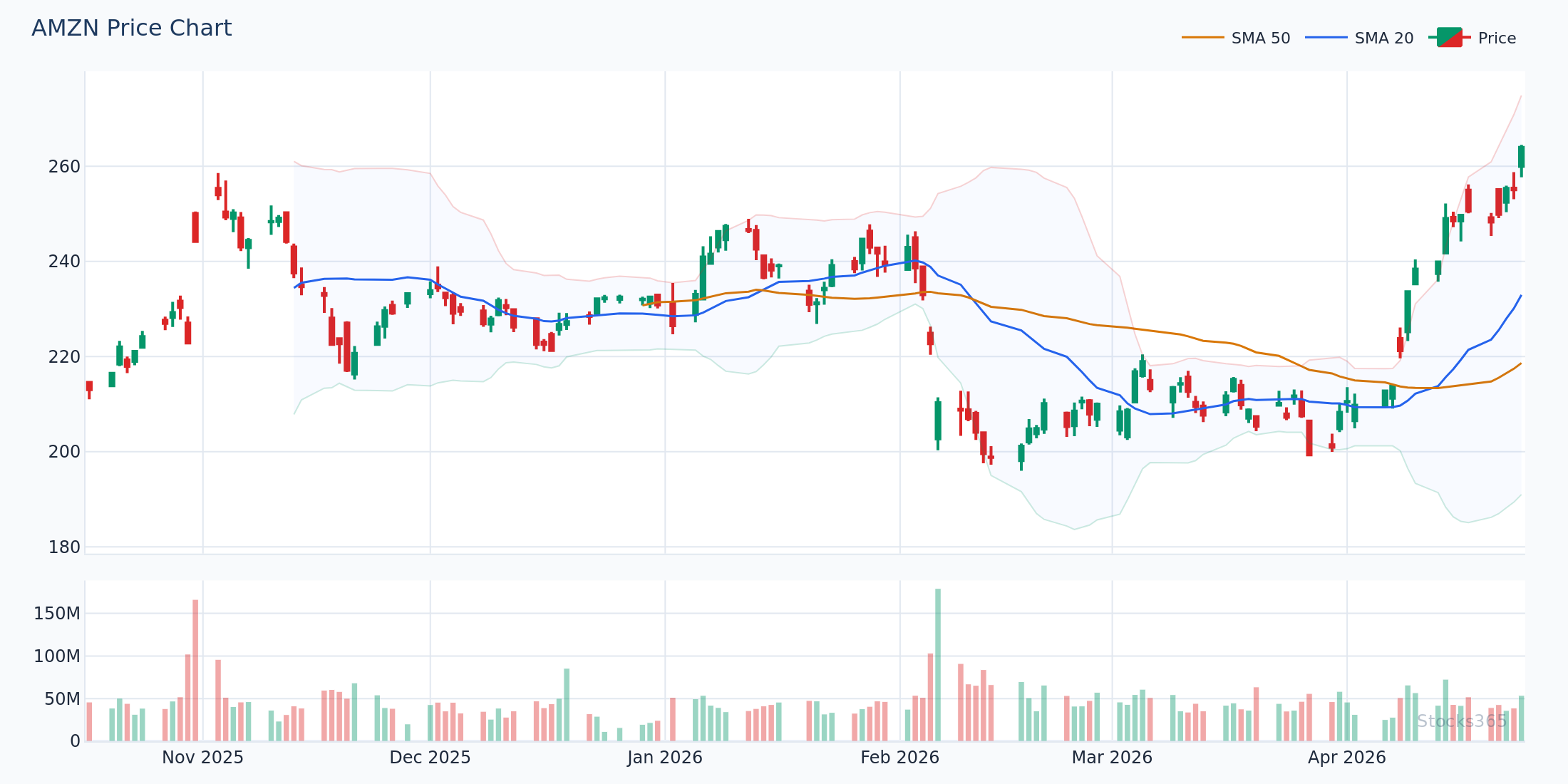
Our proprietary model carries a BUY signal on Amazon (AMZN) at a trust score of 69%, with the stock closing today at $263.99, up 3.5% on the session. The regime classification is currently flagged as normal volatility — not a breakout regime, not a stress regime. That is a calibrated read: the Meta partnership is a meaningful demand signal for AWS, but it is one contract announcement in a week that also carries geopolitical noise from the Iran ceasefire situation. A 69% trust score on a BUY is constructive but not a high-conviction flush — it means the model sees asymmetric upside relative to current positioning, but is not pricing in a runaway move. Worth noting that Amazon (AMZN)'s own Form 4 filings with the SEC on April 16 and April 21 are in the public record; insider transaction timing relative to a major partnership announcement is always worth tracking for regime confirmation, though no specific transaction details from those filings are reflected in the signal here.
On Meta (META), the picture is structurally more interesting. The stock is up only 3.8% year-to-date and sits 14.5% below its 52-week high of $790. For a company that eMarketer projected would overtake Google as the world's top digital-ad seller by net revenue — with ad sales expected to reach $243 billion — that gap to the high represents residual skepticism that an earnings print four days away could resolve or deepen in one session. The combination of the AWS deal announcement and the April 29 report creates a binary optionality setup: if the ad revenue growth materializes near the 30% estimate, the stock has a defined path back toward its prior high. If the margin narrative disappoints despite the efficiency messaging, the gap widens and the AWS deal reads as defensive positioning rather than offensive scaling.
The SAP-Driven Enterprise Rebound Has Happened Before — and the Sequel Was Uneven
The dynamic playing out in Atlassian (TEAM) today carries a specific historical echo worth contextualizing. In early 2023, following a stretch of aggressive multiple compression across cloud software, a series of earnings beats from legacy enterprise vendors — SAP included — triggered sharp sympathy rallies in high-growth adjacent names. Those moves were frequently faded within two to three weeks, because the underlying fundamental deterioration in the high-multiple names had not resolved; sentiment had simply bounced off an oversold floor. Atlassian's year-to-date decline of 53.8% and its distance from the 52-week high suggest the stock is operating in a similar regime today — a "valuation reset" narrative, as the source material describes it, where halo-effect rallies can be real but may not be durable without company-specific catalysts to anchor them.
The NESR setup has a parallel of its own. The stock has produced 30 moves greater than 5% over the past year — an extreme volatility profile that cuts both ways. The last time we saw oilfield services names run this hard on a combination of sector beats and geopolitical supply-risk pricing was in early 2022, when Brent and WTI moved sharply on supply uncertainty. Stocks near 52-week highs in high-volatility names during geopolitically-driven oil rallies have historically been prone to sharp mean-reversion once the geopolitical premium unwinds. NESR at $24.44 versus its 52-week high of $26.36 is a ceiling worth respecting, not ignoring.
Four Days to Meta's Print, and a Resistance Level That Will Define the NESR Story
The single most important event on the near-term calendar is Meta's (META) April 29 earnings report. The AWS partnership sets a constructive pre-earnings tone, but the market has already moved 2.4% on the announcement alone. If the print confirms the 30% ad revenue growth estimate and management speaks constructively about the margin impact of the AWS deal's compute efficiency, the path toward the $790 52-week high becomes a realistic multi-week target. If the margin story disappoints — if capex commentary overshadows the Efficiency 2.0 narrative — then the current price reflects a premature re-rating, and the stock gives back both today's gain and more. For Amazon (AMZN), the question is whether the Meta partnership is priced in at $263.99 or whether the market will revisit the AWS demand thesis on Amazon's own earnings. Our BUY signal with a 69% trust score suggests the model sees more upside than downside from current levels, but the normal-volatility regime flag means this is not a momentum chase — it is a measured position in a name with confirmed fundamental tailwinds.
Watch NESR against the $26.36 52-week high as the defining technical test. If the geopolitical premium in crude sustains — and the Iran situation remains unresolved per the source material — that ceiling could break to the upside and establish new range. If oil softens on any ceasefire clarity or demand-side deterioration, NESR's sympathy-driven gains unwind faster than they accumulated. For Atlassian (TEAM), the harder question is whether today's move is the beginning of a fundamental reappraisal or simply the latest in a series of sharp intraday swings — the stock has logged 32 moves greater than 5% over the past year, and by that measure, today's session does not yet distinguish itself from noise. The divergence between NESR's year-to-date strength and Atlassian's year-to-date collapse, both rallying on the same Saturday, captures exactly the kind of regime ambiguity that makes this tape difficult to read in aggregate and essential to contextualize name by name.