

While Microsoft (MSFT) shares are sliding 3.3% to $418.47 in midday trading — one of the sharper single-session drawdowns for the name this quarter — CEO Satya Nadella is on the other side of the planet, standing in Sydney to announce a A$25 billion commitment to AI and cloud infrastructure in Australia through 2029. The timing is not coincidental — it is a masterclass in narrative management. When your stock is getting hit at home, you plant a flag abroad. But the bigger macro story here is not about one company's PR calendar. It is about where the global AI infrastructure buildout is landing geographically, and what that means for cross-asset flows in Asia-Pacific.
A$25 Billion Down Under — The Architecture of Microsoft's Largest Australian Bet
The numbers are striking by any measure. Microsoft (MSFT) is committing A$25 billion to expand its Azure AI supercomputing and cloud infrastructure footprint across Australia — its largest single country commitment on record. The plan targets more than 140% growth in infrastructure capacity by 2029, layering data centers, cybersecurity investments, and workforce training programs on top of an earlier A$5 billion investment announced in October 2023 that already expanded the company's presence to 29 sites across three Azure regions. The company has also signed a memorandum of understanding with the Australian government, aligned with recently introduced AI infrastructure guidelines, and will collaborate with the newly established Australian Artificial Intelligence Safety Institute.
The workforce angle deserves attention. Microsoft (MSFT) is targeting the training of an additional 3 million Australians in AI skills by the end of 2028, on top of more than 1 million already targeted across Australia and New Zealand. Prime Minister Anthony Albanese has framed the initiative as a potential strengthener of cyber defenses and economic opportunity. That sovereign endorsement matters: it signals that Western governments are actively competing to attract AI infrastructure, with Australia positioning itself as a stable, English-speaking, Five Eyes-aligned node in a world where data sovereignty is increasingly a geopolitical variable. This is not just a real estate and power deal. It is a diplomatic one.
Zoom out further and the competitive context sharpens. Microsoft (MSFT) and its hyperscaler peers — including Amazon.com (AMZN), Meta Platforms (META), and Alphabet (GOOGL) — are expected to collectively spend around $650 billion this year on data center expansion. The logic is classic capacity-race economics: build ahead of the demand curve, lock in land and power contracts, and defend your position before the market matures. Australia, with its stable regulatory environment and proximity to Southeast Asian markets, fits that calculus. Meanwhile, Microsoft is also sharpening its AI monetization strategy, doubling down on its Copilot product for enterprise use and integrating consumer and enterprise offerings into a more unified platform — with competition heating up from OpenAI's ChatGPT and Google's Gemini.
What the Stocks365 Signal Says About MSFT's Intraday Positioning
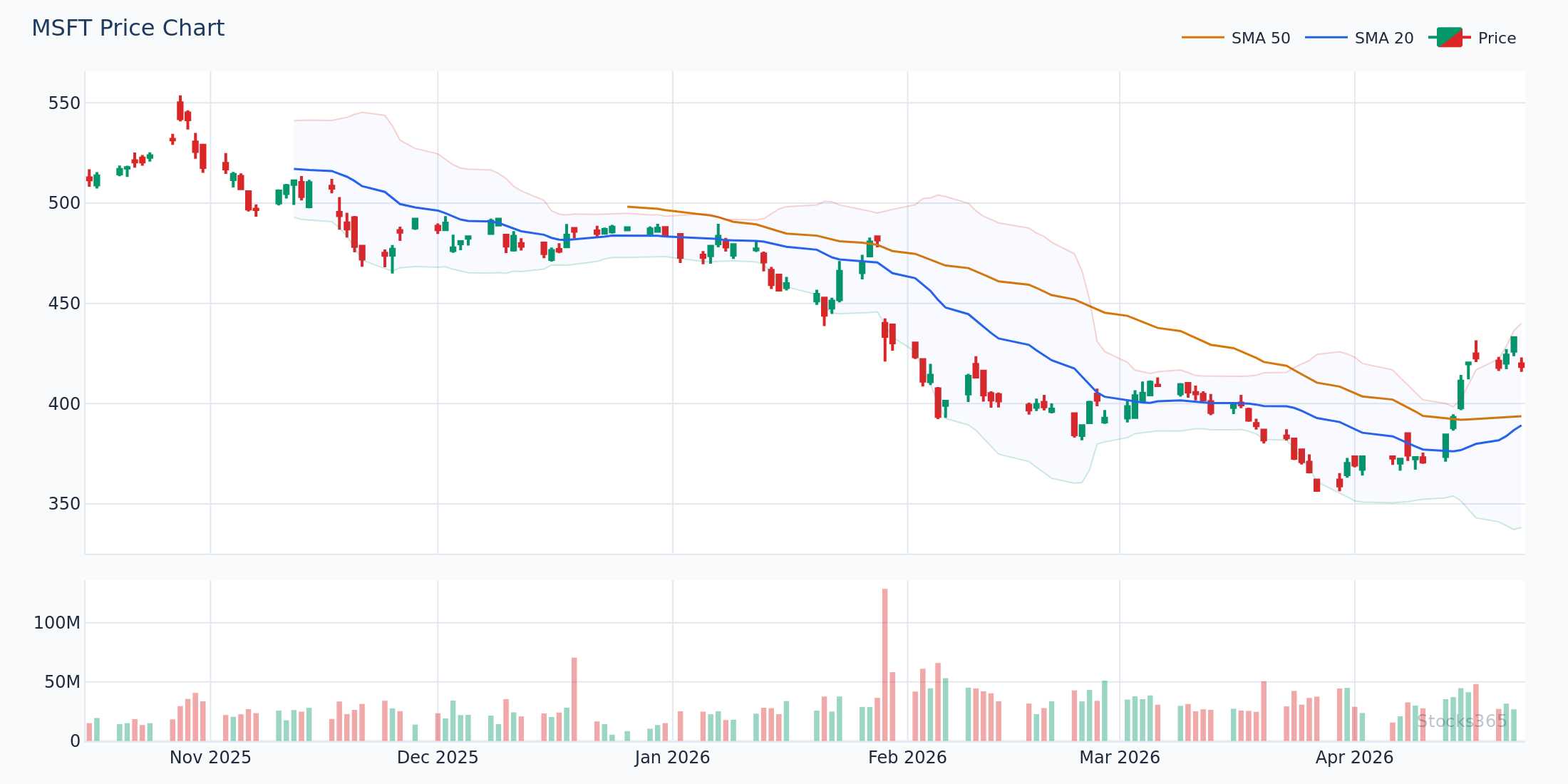
Here is the tension the market is sitting with right now. Microsoft (MSFT) is printing a 3.3% decline to $418.47 in today's session — a move that, in the context of normal volatility, represents the kind of selling that tends to flush out short-duration momentum holders while leaving the fundamental thesis intact. Stocks365's market regime reading for MSFT currently flags normal volatility, which means this drawdown is not yet triggering the kind of stress indicators that would suggest a regime shift in the name. It is a dip, not a break.
The macro read here is about dispersion — the divergence between a company's strategic narrative and its near-term price action. Megacap tech has been navigating a difficult cross-asset backdrop: the dollar's trajectory, rate uncertainty, and lingering questions about whether AI capex translates into near-term earnings accretion or is simply being pulled forward into a multi-year investment cycle. The A$25 billion announcement does nothing to resolve that near-term earnings question. What it does is extend the duration of Microsoft's investment thesis, which is both a strength and a liability when markets are discounting long-duration assets with skepticism.
The 2018 Hyperscaler Land Rush — And Why This Time the Map Is Bigger
The closest historical parallel to what is unfolding is the 2017–2018 hyperscaler infrastructure buildout, when Amazon (AMZN), Microsoft (MSFT), and Alphabet (GOOGL) accelerated data center investments globally at a pace that left analysts debating whether the capex cycle would ever produce commensurate returns. At the time, the consensus viewed the spending as excessive — a potential destroyer of free cash flow that the market would eventually punish. What happened instead was that cloud adoption outran even the most aggressive demand projections, and those who built first captured durable market share. The 2018 hyperscaler cohort that leaned into capacity while peers hesitated ended up with multi-year pricing power and margin expansion that compounded across subsequent earnings cycles.
The key difference today is geographic and geopolitical. In 2018, the buildout was largely concentrated in the United States and Western Europe. The current wave is explicitly designed to distribute infrastructure across sovereign jurisdictions — Australia, Southeast Asia, the Middle East — in a way that reflects both demand expansion and a deliberate hedge against concentrated single-country regulatory risk. The A$25 billion Australian commitment is part of that hedge. It also signals that the carry trade in AI infrastructure is no longer purely a U.S. dollar story — it is a multi-currency, multi-sovereign regime play that has implications for AUD flows, local construction and energy markets, and the broader Asia-Pacific risk appetite.
From Sydney to the S&P: The Levels That Will Define MSFT's Next Move
The forward-looking question for macro-aware equity investors is whether today's 3.3% drawdown in Microsoft (MSFT) at $418.47 is an entry point or a warning. The Stocks365 regime flag — normal volatility — suggests the former, at least on a duration-adjusted basis. But the setup depends heavily on what rates do next. If the 10-year yield stabilizes or pulls back, long-duration AI capex narratives like this one regain their relative value appeal against the broader market. If yields push higher, the market will continue to discount the 2029 capacity payoff with increasing skepticism, and names carrying heavy forward investment burdens will face multiple compression regardless of the strategic logic on the ground in Sydney.
Watch the Copilot monetization narrative heading into the next earnings print. The A$25 billion build is a supply-side story. What the market needs to see is demand-side confirmation — enterprise adoption rates, Copilot seat penetration, and margin signals that suggest the AI infrastructure spending is translating into pricing power, not just market share defense. If those signals materialize alongside a stable rate backdrop, the setup for Microsoft (MSFT) — and the broader hyperscaler complex — improves materially. If the demand-side data disappoints while capex commitments like this one keep growing, the divergence between strategic ambition and near-term earnings reality becomes the trade. The question hanging over this market into tomorrow's open: at what point does the world's largest AI investment cycle stop being a growth story and start being a balance-sheet conversation?