

VeriSign (VRSN) reported a combined .com and .net domain name base of 176.1 million names at the end of Q1 — a record — while new registrations reached 11.5 million, the strongest single-quarter print since the first half of 2021, per management commentary on Thursday's earnings call. Simultaneously, Carlisle Companies (CSL) reported adjusted EPS of $3.63 — up 1% year-over-year — even as Q1 revenue fell 4% to $1.1 billion, a result management attributed to winter weather delays and the absence of roughly $15 million in tariff-related Canadian order pull-forward that boosted the year-ago comparison. Across Thursday's after-hours slate, the throughline was the same: volume headwinds absorbed, margins defended or extended.
VeriSign's Domain Surge and the AI Tailwind That Defies Easy Measurement
VeriSign's Executive Chairman, President, and CEO Jim Bidzos described new registrations of 11.5 million in Q1 as the company's strongest since the first half of 2021 — compared with 10.7 million in the prior quarter and 10.1 million in the year-ago quarter, per call commentary. The expected Q1 renewal rate of 76.3% compares favorably with 75.5% a year earlier — a directional improvement that management said reflected both registrar engagement with VeriSign's marketing programs and AI-related tailwinds. Revenue grew 6.6% year-over-year, and diluted EPS expanded 11.4% — a spread that reflects operating leverage on a near-fixed-cost infrastructure model.
The AI attribution is worth scrutinizing. Bidzos told Baird analyst Rob Oliver that it was difficult to disentangle registrar-driven engagement from AI tools that, as he put it, make content and website creation faster and easier — per call transcript. That ambiguity matters: if the domain surge is primarily registrar-program-driven, it may normalize. If AI-assisted site creation has structurally lowered the activation cost for new web presences, the renewal cohort entering the base now could sustain elevated rates for several quarters. Management raised its full-year 2026 domain-base growth guidance, citing both factors without assigning weights. Investors would be wise to watch the Q2 renewal read-through carefully — the 76.3% Q1 rate sets a new baseline that either validates or complicates that raised outlook.
Capital return mechanics at VeriSign were notable. The company returned over 100% of free cash flow over the trailing twelve months, per management commentary, and retained meaningful remaining buyback authorization — details that, at these levels, signal a management team comfortable leaning hard into the repurchase program. The announcement of a .com wholesale price increase effective November 1, 2026, adds a visible revenue catalyst for the back half of the year — one that requires no volume assumption to model.
Carlisle's Margin Defense Is the Story Beneath the Revenue Miss
The headline revenue number at Carlisle (CSL) — down 4% year-over-year to $1.1 billion — reads as a miss in isolation. The read-through is more nuanced. Per the Q1 earnings call transcript, CEO D. Christian Koch identified two discrete, timing-related causes: weather delays across North American regions, and the absence of approximately $15 million in Canadian order pull-forward that inflated Q1 2025 comparisons. Strip those out, and the underlying volume picture aligns with management's stated expectations. More consequential for the longer-term thesis: adjusted EBITDA margin expanded 50 basis points to 22.3%, even as volumes were under pressure.
That 50-basis-point gain in a quarter of volume headwinds is the number that demands attention. Koch described it as the result of systematic productivity work, manufacturing efficiency improvements, and cost discipline running through the Carlisle Operating System — work he said has been underway for several quarters and will compound under the company's Vision 2030 margin goals. This is not a one-quarter adjustment story. It is a structural efficiency program delivering measurable results in a quarter specifically designed to stress-test it. Adjusted EPS of $3.63, up 1% year-over-year, confirms that the earnings line held even as the revenue line contracted — a combination that only works when cost discipline is genuine rather than cosmetic.
Elsewhere on Thursday's slate, Newmont (NEM) reported Q1 results alongside an operational update on the Cadia mine following what management described as a magnitude seismic event. Safety protocols moved all underground personnel to safe locations within minutes, per CEO Natascha Viljoen's prepared remarks — no injuries were reported. Underground rehabilitation at Cadia is expected to be completed within five weeks, enabling return to 80% operating capacity, with full recovery targeted by end of Q2. The incident introduces a near-term production headwind that management is quantifying but has not yet fully disclosed. Meanwhile, Betterware de México (BWMX) posted revenue growth of 0.3% year-over-year and EBITDA growth of 14%, with EBITDA margin expanding from 15.3% to 17.4% — margin expansion while top-line growth was essentially flat, the same pattern showing up repeatedly across Thursday's prints.
Where Our Signals Stand on Boeing and Apple Into Friday
Two names on the Stocks365 radar heading into Friday's open: Boeing (BA) closed at $234.15, up 1.2% on the session, per Stocks365 proprietary data — our market regime classification currently reads normal volatility. The Boeing 10-Q filed with the SEC on April 22, 2026, per SEC EDGAR, provides the most current financial snapshot; the company's 8-K filed the same date adds event-level disclosure that traders monitoring the production recovery story should review directly at the source. At these levels, the 1.2% single-session move in a normal-volatility regime is consistent with institutional accumulation rather than momentum chasing — but the 10-Q details will set the tone for how the buy-side re-models the quarter.
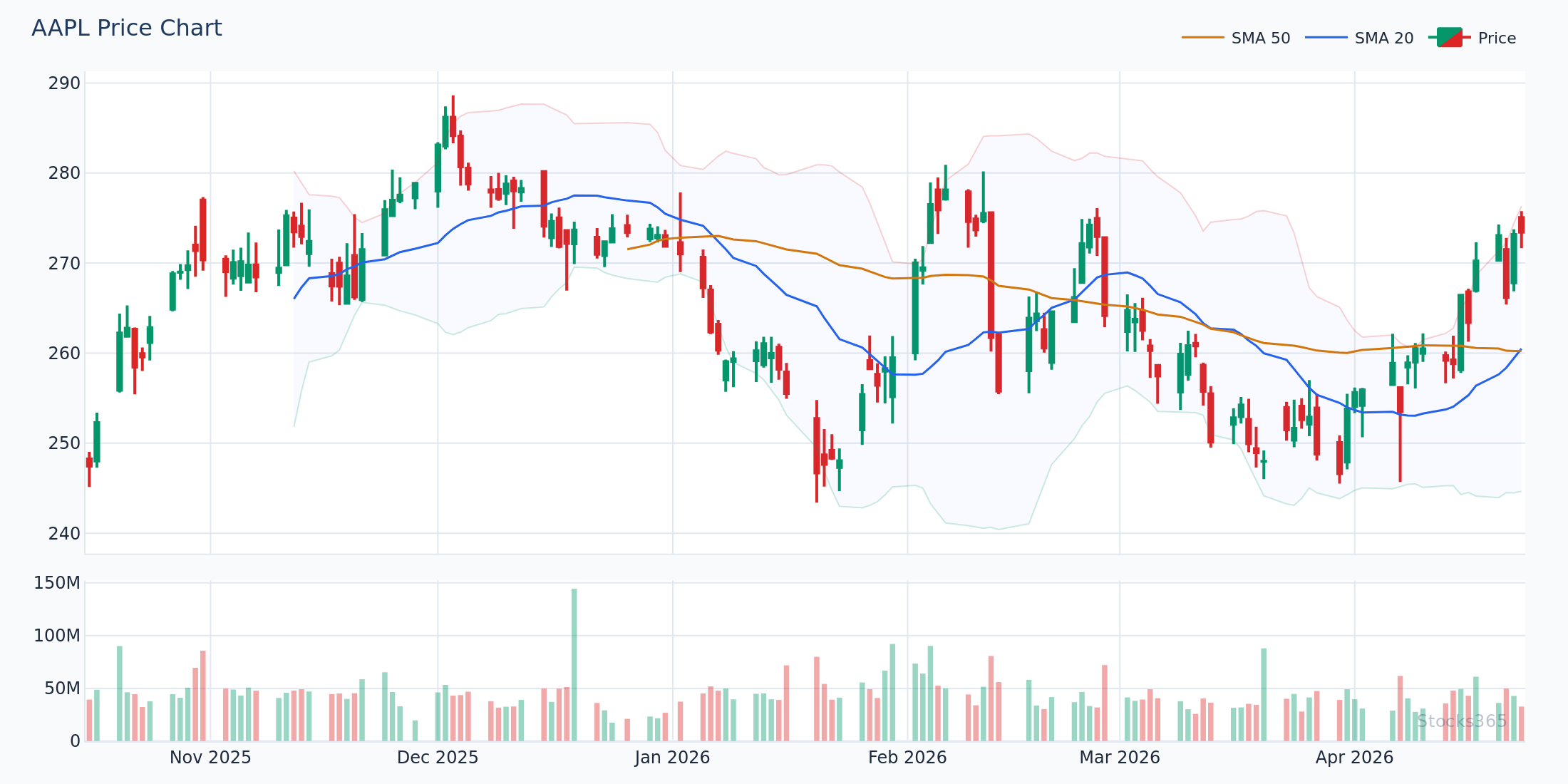
Apple (AAPL) ended Thursday at $273.43, essentially unchanged at +0.1%, per Stocks365 proprietary data — also classified in a normal-volatility regime. Apple's 8-K filed April 20, 2026, per SEC EDGAR, is the most recent material filing, and the Form 4 filed April 17, 2026, reflects insider transaction activity. At $273.43 with near-zero daily movement in a normal-volatility classification, AAPL is coiling rather than trending. The setup is one of compression — the kind that tends to resolve sharply on a catalyst. Apple's earnings date will be the logical detonator. Until then, the signal is neutral drift. The Nasdaq (^IXIC) remains the broader context; the index's direction heading into next week will amplify or dampen whichever way Apple resolves.
The Last Time Margin Held While Revenue Fell: A 2019 Parallel Worth Revisiting
The pattern Carlisle is executing — EPS growth and margin expansion in a revenue-down quarter — echoes what a cohort of industrial companies demonstrated in the second half of 2019, when slowing global manufacturing demand compressed top lines while companies that had spent 2017-2018 investing in lean manufacturing and process automation held margins substantially better than consensus expected. The parallel is not perfect: tariff dynamics in 2019 were a global overhang rather than a bilateral Canadian-specific timing artifact. But the mechanism is identical. Companies that had front-loaded operational investment before the volume pressure arrived harvested the margin benefit precisely when skeptics assumed the income statement would crack. Carlisle's COS-driven productivity work, described by Koch as running for several quarters before Q1's test, fits that same template.
The VeriSign domain surge also has a historical echo — specifically the 2020-2021 surge in domain registrations that accompanied the shift to remote work and the proliferation of new online ventures. That prior wave ultimately saw renewal rates soften as speculative registrations lapsed. The critical difference in the current setup is the AI-creation tailwind: if AI tools are genuinely lowering the cost and complexity of building functional websites, the marginal registrant today may be more intentional than the 2020-2021 cohort — and therefore more likely to renew. That hypothesis won't be confirmed until the cohort ages into its first renewal window, which lands later this year and into 2027.
Five Weeks at Cadia and a November Price Hike: The Calendars That Matter Next
Two forward-looking timelines deserve a place in every active investor's calendar after Thursday's prints. First, Newmont's five-week Cadia rehabilitation window — with full recovery targeted by end of Q2 — means a key data point lands before the Q2 earnings call. Any slip in that timeline, or any revision to the 80% interim capacity figure, becomes a material Q2 production variable. Gold prices remain the macro backdrop; Viljoen's prepared remarks explicitly cited the ability to capture higher commodity prices even amid operational headwinds, which implies the Cadia disruption is manageable at current gold levels but becomes more consequential if spot prices soften during the repair window.
Second, VeriSign's November 1, 2026 .com wholesale price increase is now a locked catalyst — one that requires no modeling assumption about volume. The question for traders is whether the market has fully priced the back-half revenue uplift or whether the raise in domain-base growth guidance, combined with the price hike, creates a second leg of multiple expansion as analysts revise full-year estimates in the coming weeks. Meanwhile, AerSale (ASLE) is scheduled to report Q1 results on May 7, 2026, per the company's press release — the aviation aftermarket name adds a read-through on commercial aircraft utilization trends that will either confirm or complicate what Boeing (BA)'s own 10-Q implies about fleet activity. Friday's open brings no scheduled major catalysts from this group — but the overnight digestion of four simultaneous earnings prints, each with a margin-defense story at its core, sets the analytical frame for a week that increasingly looks like a referendum on operational discipline over volume growth.