

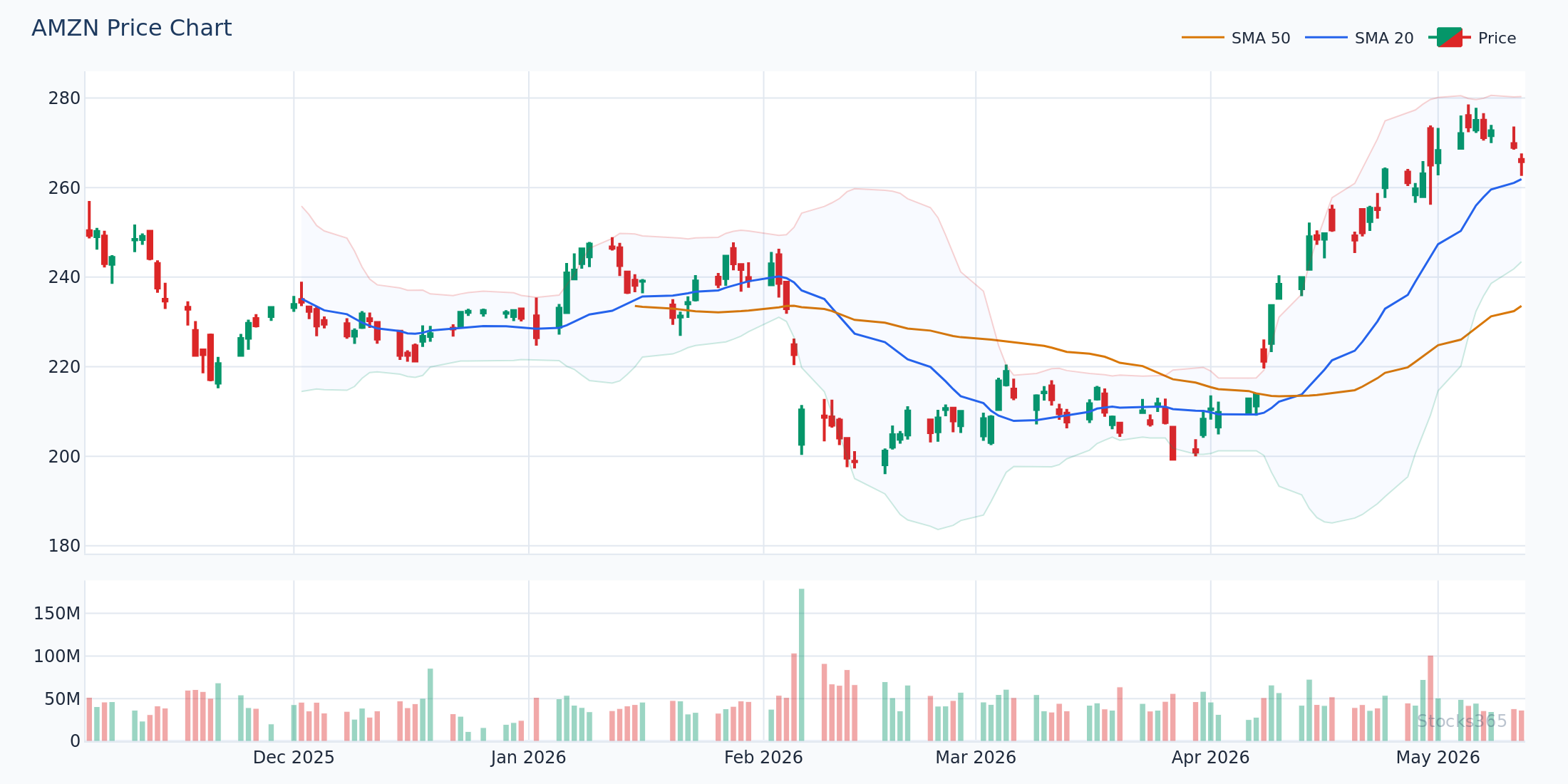
Three companies reported after the bell on Tuesday, May 12 — and the numbers, taken together, tell a story about platform economics that is more coherent than the individual headlines suggest. Figure Technology Solutions Inc (FIGR) posted consumer loan marketplace volume growth above 110% year-over-year. eToro Group Ltd (ETOR) reported assets under administration of $17 billion, up 15% from the prior year. These are not marginal beats. They are structural data points about what happens when a capital-light marketplace model reaches operating leverage inflection — and they arrive at a moment when the broader fintech tape has been under pressure from rate-environment uncertainty and credit-cycle skepticism. Our Stocks365 signal on Amazon.com Inc (AMZN) — which closed at $265.82, down 1.2% today — sits at BUY with a 68% trust score, a reminder that even in a softening session, the platform-commerce thesis still has institutional backing at these levels.
110%: Figure Technology's Loan Marketplace Volume and What It Says About Capital-Light Credit
The headline number from FIGR's Q1 2026 earnings call — published May 12 per the company's release — is a consumer loan marketplace volume figure of approximately $2.9 billion, representing growth of over 110% year-over-year. That print is not a rounding-error beat. It is a doubling of throughput in a single year, in a credit product category — home equity — that most traditional lenders have treated as a slow-moving, balance-sheet-heavy business.
The read-through here is structural. FIGR is not warehousing that volume on its own balance sheet in any dominant way. Figure Connect — the company's capital-light, off-balance-sheet marketplace mechanism — accounted for 56% of overall Q1 volume, per the earnings call. That means more than half of $2.9 billion in originations moved through a channel that does not require FIGR to deploy its own capital dollar-for-dollar against each loan. The company added 80 new partners in the quarter, including, per management's disclosure, the seventh-largest lender in the country. Partner density at that level is a defensible moat — not a marketing claim.

First lien volume — a higher-quality, larger-ticket product — now accounts for 20% of total volume, up from 14% in Q1 of the prior year, per the filing. Management flagged that the take rate on first lien is lower than on home equity line products, which is a legitimate margin headwind to monitor. But the strategic logic is sound: larger principal balances mean more absolute revenue per transaction even at a compressed rate, and first lien borrowers carry lower default risk on average. The Q2 2026 consumer loan marketplace volume guidance of $3.8 billion to $4. If that range holds, FIGR will have tripled its annualized run-rate from where it stood twelve months ago.
For context, the 2021–2023 period saw a generation of fintech lenders — many of them balance-sheet-heavy originators — struggle violently as rate hikes compressed net interest margins and credit losses mounted. The companies that survived and scaled through that cycle were disproportionately marketplace models: platforms that earn fees on volume rather than spread on held loans. Our May 7 note on five after-hours prints made the same observation from a different angle — the companies beating numbers this earnings season are largely those with fee-based or platform revenue streams rather than spread-dependent ones. FIGR's 110% volume growth is the most emphatic single-quarter data point in that argument so far.
50%: The Adjusted EBITDA Margin That Defines an Inflection Point
Revenue at FIGR reached $167 million in Q1 2026 — a 92% year-over-year increase per the company's earnings call — but the more important number for long-term investors is the margin. Adjusted EBITDA margin came in at 50%, compared with 33% in the prior-year period. That is a 1,700-basis-point expansion in twelve months. At these levels of revenue scale, that kind of margin movement is not the result of one-time items or accounting choices. It is the signature of operating leverage becoming visible.
The mechanics are worth spelling out. A marketplace business has largely fixed technology infrastructure costs once the platform is built. As volume scales, the incremental cost of processing an additional loan through the marketplace is a fraction of the revenue it generates. FIGR's cash and cash equivalents stood at approximately $1.5 billion at quarter end per the filing, with net income of $45 million — which includes a $7 million tax benefit, so the underlying operating print is closer to $45 million on an adjusted basis. The GAAP net income figure benefits from that tax item, and readers should weight the adjusted EBITDA line more heavily when assessing recurring profitability. The take rate — the percentage of volume that converts to net revenue — came in at 3.8%, in line with management's stated guidance range of 3.5% to 4%. That consistency matters: take rate stability at scale suggests FIGR is not buying volume through price concessions.
The caution embedded in the bull case is the first lien mix shift. As first lien volume rises as a share of total, and as the take rate on that product is lower than on home equity lines, there is a structural pull on blended take rate over time. 8% blended take rate could drift toward the lower end of guidance even with strong volume growth. That is the number to watch in the Q2 print. Margin expansion at 50% is remarkable; the question is whether 110% volume growth can offset any take-rate compression in the next two quarters.
$17 Billion: eToro's AuA Figure and the Commodity Rotation Nobody Predicted
The most structurally interesting number from Tuesday's after-hours session may not be from FIGR at all. eToro's assets under administration reached $17 billion at quarter end, up 15% year-over-year per the company's Q1 2026 earnings call. Funded accounts grew 12% year-over-year to over 4 million. Those are durable platform metrics — the kind of numbers that tell you a user base is deepening, not just widening.

But the compositional story inside those numbers is where the real surprise sits. Commodities accounted for 60% of trading commissions in Q1, per the earnings call — a figure that reflects a sharp rotation away from crypto, which had been a dominant driver of eToro's revenue in prior periods. Crypto net trading contribution came in at $13 million for the quarter, alongside a $5 million negative valuation impact on the company's own corporate crypto holdings. The platform's multi-asset architecture — the ability to route user activity across crypto, equities, and commodities within a single account — is functioning exactly as designed: when one asset class cools, the platform captures the rotation rather than losing the customer.
Net interest income decreased 5% year-over-year, per the filing, reflecting both a lower rate environment and user deleveraging amid market volatility. That is a real headwind. Adjusted operating expenses rose 7% quarter-on-quarter, driven by higher customer acquisition costs. eToro is spending to grow funded accounts, and the cost of that acquisition is rising. The sustainability question — whether $17 billion in AuA and 4 million funded accounts can be monetized efficiently enough to justify the customer acquisition spend — is the central one heading into Q2. The acquisition of ZenGo, referenced by CEO Yoni Assia in the earnings call, accelerates eToro's path toward a crypto-native custody offering and on-chain capital deployment. That is a long-cycle bet, not a Q2 catalyst.
The parallel worth anchoring here is the 2018–2019 period for retail brokerage platforms, when Robinhood and similar services built massive funded-account bases but faced persistent questions about revenue-per-account monetization. The platforms that survived and scaled were the ones that successfully layered on additional revenue streams — margin lending, premium subscriptions, payment for order flow, and eventually cryptocurrency trading — rather than relying on a single commission driver. eToro's commodity-driven Q1 is, in miniature, the same story: the platform is demonstrating it can monetize across asset classes, but the mix is volatile by nature. A commodity-driven quarter followed by a crypto resurgence followed by an equity boom is not a business model — it is a platform with options. The valuation question is how the market prices those options.
Also worth noting in the broader Tuesday print: Tuya Inc (TUYA) reported Q1 2026 total revenue of $80.9 million, up 8.3% year-over-year per its earnings call, with a GAAP operating margin of 9.2% — a meaningful year-over-year improvement for a company that has historically operated near breakeven. AI application and others revenue grew 16.9% year-over-year to $11.6 million, while the Smart Home and Robot Products segment declined 6.9% to $10.2 million. The chipset shortage commentary from CFO Yi Yang is worth flagging: Tuya is managing supply constraints through strategic purchasing leverage, but the cost and pricing implications of that shortage are not yet fully visible in the margin line. Cash and equivalents exceeded $1 billion per the filing, providing a meaningful buffer. Separately, TON Strategy Co (TONX) reported approximately $3 million in staking revenue for Q1, against a net loss before income taxes of $91 million — the latter driven almost entirely by an $87.9 million unrealized loss on Toncoin holdings due to fair value changes. The staking revenue is real; the loss is largely a mark-to-market artifact. Whether investors treat it that way is a different question.
Taken together, the three anchor numbers from Tuesday — 110% volume growth at FIGR, a 50% adjusted EBITDA margin at FIGR, and $17 billion in AuA at eToro — do not tell a single story. They tell three overlapping ones: that capital-light marketplace models are hitting their operating leverage point faster than the rate bears expected; that platform businesses with multi-asset diversification are capturing rotation rather than losing it; and that the margin trajectory in fintech, at least for the platforms with structural competitive advantages, is moving in the right direction. Our note from earlier Tuesday flagged that consensus cases on newly reporting names tend to be shakier than they look — and FIGR's 92% revenue growth against a 50% EBITDA margin is exactly the kind of print that forces a consensus reset. When markets reopen Thursday, watch FIGR's Q2 volume guidance range — $3.8 billion to $4.1 billion — as the specific level the market will be repricing against. If management reaffirms or tightens that range on any subsequent commentary, the operating leverage thesis has another leg. If volume softens toward the low end of the range, the take-rate compression risk becomes the story instead.