

Five companies reported after Wednesday's close. Taken individually, each print is a single data point. Taken together — Coherent (COHR), DoubleVerify (DV), Dutch Bros (BROS), Evertec (EVTC), and Advantage Solutions (ADV) — they form a pattern worth sitting with after hours. The through-line: companies executing on multi-year structural bets are posting accelerating numbers, while the macro backdrop — a 10-Year Treasury yield at 4.43% and a fed funds effective rate at 3.64% per FRED — continues to demand that growth justify its valuation. Tonight, it largely did.
The aggregate read-through is this: AI infrastructure demand is not softening at the component level, digital ad verification is expanding faster than the ad market itself, and beverage-and-food concepts with genuine unit economics are still finding ways to grow traffic. The cautious case — that earnings season would expose cracks in the "AI everything" trade — did not materialize cleanly in this batch. But that doesn't mean the risks have evaporated. It means they've been deferred to the next datapoint.

Where the Bull Case Has the Most Structural Support Right Now
Start with Coherent, because the numbers there are the hardest to dismiss. Revenue increased 9% sequentially and 27% year over year on a pro forma basis in Q3 fiscal 2026, per the company's conference call transcript. Non-GAAP EPS grew 55% year over year — profitability expanding more than twice as fast as revenue, which is exactly the operating leverage profile that justifies premium multiples at these levels. More notable: the backlog has reached a record, with orders now extending into calendar 2028 and long-term agreements stretching to the end of the decade, per management's prepared remarks. That's not demand speculation — that's contracted visibility, a meaningful distinction.
The company's framing is explicit about the driver: photonic technology as foundational infrastructure for AI data centers. The logic dovetails with a pattern we've tracked closely — our earlier note on the flaw in AI earnings euphoria argued that the component layer of AI infrastructure was where durable margin expansion was most likely to emerge, and Coherent's 55% EPS growth this quarter is consistent with that thesis. The question at these levels is always duration — how long does the demand curve stay ahead of capacity? Management's answer, per the transcript: they expect fiscal 2027 growth to exceed fiscal 2026's growth rate. That's a directional commitment, not a hedge.
DoubleVerify adds a different flavor of structural strength. Revenue grew 10% year over year in Q1, with social measurement up 23% year over year and social activation — the company's fastest-growing solution set — up 92% year over year, accelerating from 62% in the prior quarter, per the earnings call transcript. The EBITDA margin printed at 31%, ahead of internal expectations, with management attributing the beat explicitly to AI-fueled operational efficiency. The company also repurchased $100 million worth of shares year to date, per the transcript — a capital allocation signal that management views the current price as attractive relative to intrinsic value.
Dutch Bros rounds out the growth story. Total revenues increased 31% in Q1 2026, per the earnings transcript, and the company raised full-year guidance on the back of performance both within Q1 and into Q2. That guidance revision is significant: it means the outperformance wasn't quarter-end noise, it was sustained into the new period. At a 10-Year yield of 4.43%, growth stocks need to demonstrate that their earnings are real and recurring. Dutch Bros, at least for this quarter, delivered that evidence.
The Data Points That Complicate the Optimism
The bull case above is real. So is the friction underneath it. Advantage Solutions reported total net revenues of $723 million, up 4% year over year — solid, not spectacular — with adjusted EBITDA of $68 million, up over 16%, per the Q1 transcript. The EBITDA improvement is encouraging, but the segment-level detail is less clean: Branded Services continued to face headwinds, per management's prepared remarks. In a business that sits directly in the consumer goods supply chain — between brands and retailers — Branded Services softness is a data point on end-market demand, not just an execution story. When brand owners are pulling back on in-store promotional spend, they're typically responding to something: inventory dynamics, consumer confidence, or margin pressure at the retailer level.
The macro context matters here. The 10-Year Treasury at 4.43% and the 2-Year at 3.93% — per FRED — produce a 10Y-2Y spread of as of May 6. That spread has been normalizing from inversion, which historically precedes a broadening of economic activity. But normalization through a rising long end — rather than a falling short end — carries a different implication: the cost of capital is staying elevated for longer, and companies carrying significant debt loads face a persistent headwind on refinancing. Advantage Solutions ended Q1 with $144 million in cash after a meaningful debt paydown in March, per the transcript — the paydown itself signals management is prioritizing the balance sheet, which is the right call, but also a constraint on aggressive reinvestment.

Evertec's story is structurally distinct — the company is scaling through M&A in Latin American financial infrastructure, with the Dimensa acquisition now closed, per the Q1 transcript. The thesis is compelling: recurring and volume-based revenue, regional expansion, margin leverage through integration. The risk is execution tempo. Each acquisition — Dimensa, Sinqia, Technobank — is at a different phase of integration, per management's framing. That's a lot of integration surface area running simultaneously. The read-through for investors: the growth opportunity is credible, but the near-term P&L will reflect integration costs before it reflects integration benefits. Patience is priced in. Whether that patience is rewarded depends on Latin American macro conditions that remain sensitive to U.S. dollar strength and regional political risk — neither of which is fully controllable.
There's also a broader observation worth making. Four of these five companies explicitly cited AI — either as a demand driver (Coherent), an efficiency tool (DoubleVerify, Advantage Solutions), or a product layer (DoubleVerify's ad-platform navigation suite). That's not a coincidence, and it's not necessarily a problem. But when we examined Microsoft's AI run rate against its stock's reaction, the takeaway was that the market has become selective about which AI narratives it rewards. The companies that can attach a margin outcome to the AI claim — as DoubleVerify did with its 31% EBITDA margin beat — are being differentiated from those for whom AI remains a cost center or a future promise. That distinction is increasingly the one that matters at these valuation levels.
A Historical Parallel That Puts This Earnings Cluster in Context
The configuration of this earnings wave — accelerating growth at the infrastructure layer, solid-but-uneven results at the consumer-facing layer, and M&A-driven expansion stories in emerging markets — has a rough analog in the mid-2018 technology earnings cycle. In Q1 2018, optical and semiconductor component companies reported order books extending 12-18 months forward as data center buildout accelerated ahead of hyperscaler capex commitments. Consumer-adjacent services showed similar bifurcation: companies with proprietary engagement loops outperformed those dependent on advertiser budgets tied to macro conditions. The parallel isn't exact — the rate environment in 2018 was tightening from a lower base — but the structural dynamic of infrastructure demand outpacing end-demand is consistent.
What's different today is the rate ceiling. Today it sits at 3.64% per FRED — already above that level — with the 10-Year at 4.43%. That means the discount rate applied to long-duration earnings streams is materially higher. Coherent's orders extending to 2028 are worth less in present-value terms than an equivalent 2028 order book would have been in 2018, all else equal. The growth is real; the multiple it commands is a separate and contested question.
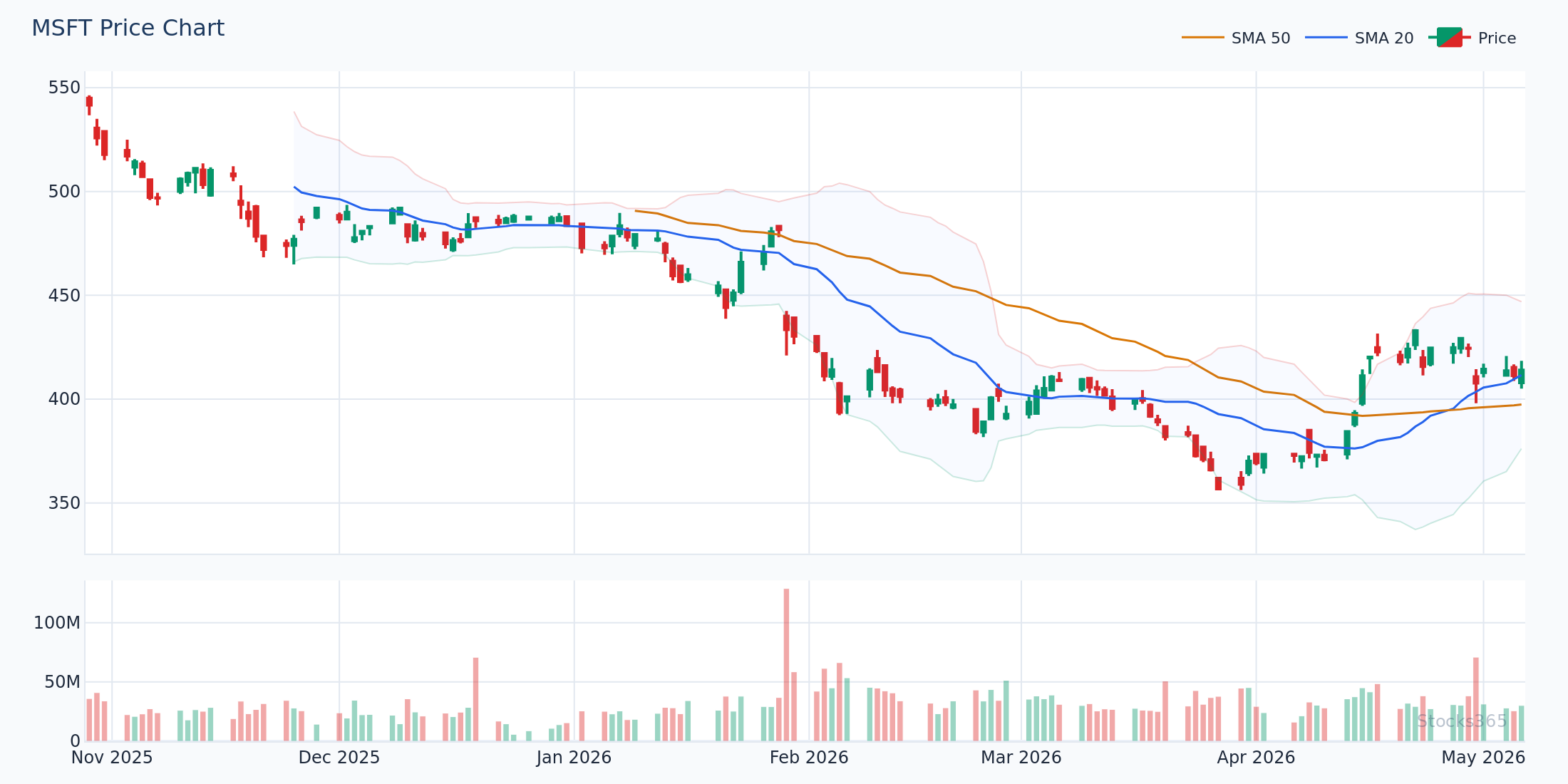
Our proprietary data shows Microsoft (MSFT) at $413.96, up 0.6% on the session — a proxy for large-cap tech sentiment heading into Thursday. The Stocks365 regime model currently flags normal volatility for MSFT, which is consistent with a market digesting earnings data methodically rather than reactively. That calm is itself informative: after-hours prints of this quality, in prior high-volatility regimes, would have produced sharper futures moves. The muted response suggests the market had already partially priced the beat — or is waiting for a larger catalyst to re-rate.
One Number to Watch When Markets Reopen Thursday Morning
The single most actionable datapoint Thursday is whether Coherent's after-hours move holds into the regular session. The company's claim — that fiscal 2027 growth will exceed fiscal 2026's growth rate — is a forward commitment that, if taken at face value, implies an accelerating revenue trajectory against a record backlog base. If the regular-session print validates the after-hours reaction, it signals that the market is treating the 2028 order visibility as credible, not aspirational. If it fades, the read-through is that investors are discounting the forward guidance against execution risk or macro sensitivity — and that caution would likely compress multiples across the photonics and optical networking space more broadly.
Beyond individual names: watch the 10-Year yield. At 4.43%, it's sitting at a level that has historically served as a friction point for growth multiple expansion. A move above 4.50% Thursday — driven by macro data or Fed commentary — would reframe the entire earnings tape. The beats you saw tonight don't change the denominator in the discounted cash flow equation. A rising long end does. That's the variable the earnings transcripts can't control, and it remains the dominant risk into the back half of Q2.
Five solid reports after the bell. The bull case has numbers behind it. So does the caution. As we've noted before, the most important signals often run counter to the headline narrative — and tonight, the headline is optimism. The question for Thursday is whether the rate backdrop gives it room to run, or whether 4.43% on the long end is the ceiling that keeps every beat from becoming a breakout.