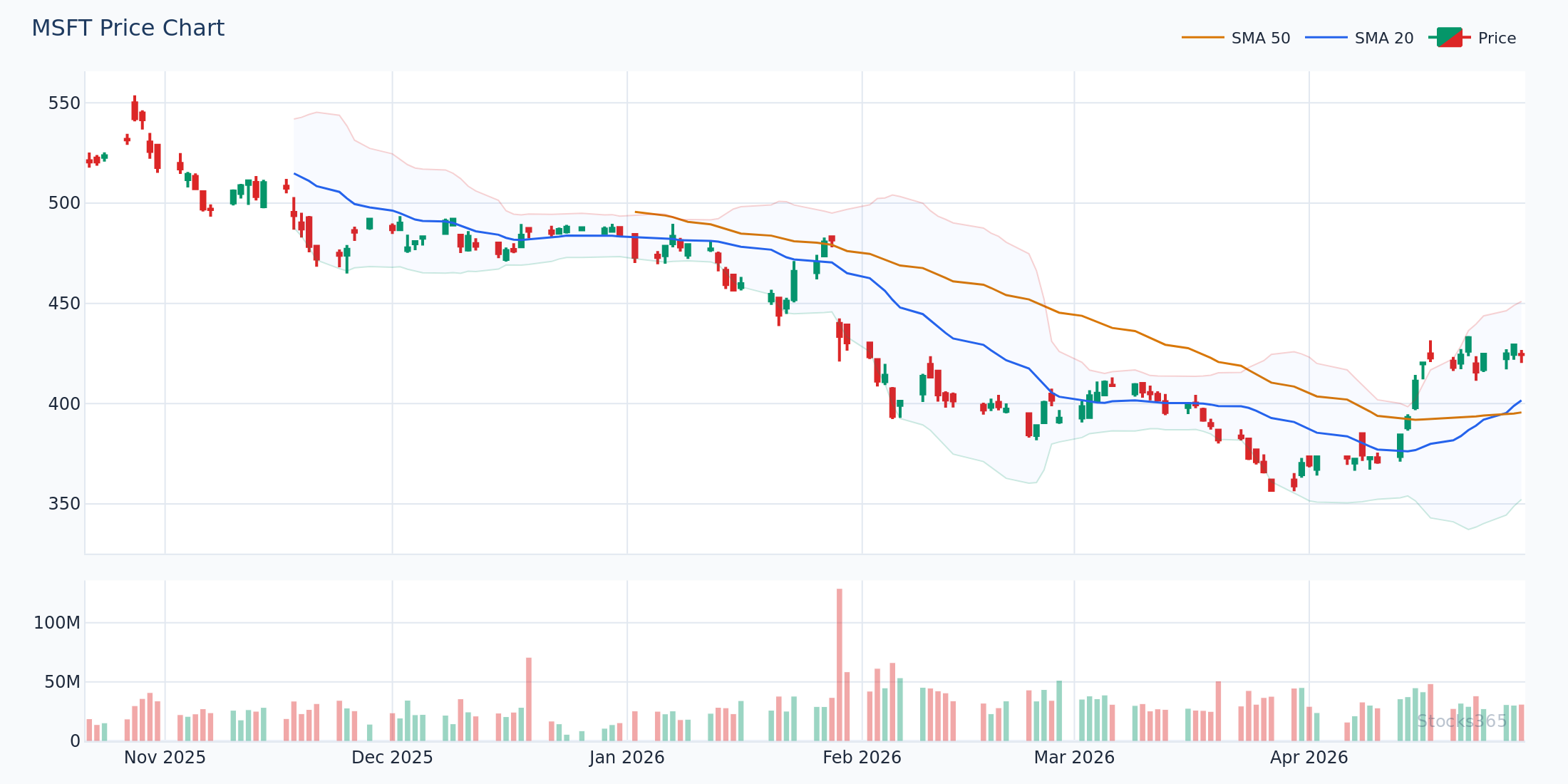
Microsoft (MSFT) reported one of the most operationally impressive quarters in its history after Wednesday's bell — and the stock finished the day down 1.1% at $424.46. That gap between fundamental momentum and price action is worth examining carefully, because it is not a contradiction. It is the setup.
What just happened, and why does the price reaction feel wrong?
The numbers from Microsoft's Q3 earnings call were, by any reasonable standard, extraordinary. Microsoft Cloud revenue exceeded $54 billion in the quarter, up 29% year-over-year. The company's AI business surpassed a $37 billion annual revenue run rate, up 123%. Microsoft 365 Copilot paid seat additions were up 250% year-over-year. These are not rounding-error improvements — they represent a genuine inflection in monetization of AI infrastructure that the company has been building toward for several years.
Yet MSFT pulled back on the session. The most charitable read is that positioning was already stretched going into print — when consensus expects perfection, perfection gets sold. The more macro-aware read is that the stock is being dragged by the rate and dollar regime rather than its own fundamentals. In a world where the yield curve has been steepening — a theme that surfaced explicitly in TRTX's call this morning, where management flagged that curve steepening has put modest pressure on new acquisition activity — long-duration growth assets face a structural headwind regardless of earnings quality. Duration risk (the sensitivity of long-dated cash-flow streams to changes in discount rates) is not a MSFT-specific problem. It is a regime problem.

What does the AI run-rate number actually mean in a cross-asset context?
A $37 billion AI annual revenue run rate growing at 123% is not just a software metric — it is a capital expenditure signal that reverberates through semis, power infrastructure, and real assets. Microsoft's management explicitly noted that demand continues to exceed capacity, that GPU deployment times in its largest regions have been cut by nearly 20% since the start of the year, and that its Fairwater, Wisconsin data center came online six weeks ahead of schedule. Q4 CapEx guidance came in at over a further gigawatt of capacity build. That spending lands directly inside the semiconductor supply chain.
Which brings us to KLA. KLA Corporation (KLAC) reported Q3 revenue of $3.415 billion, up 4% sequentially and 11% year-over-year, with management explicitly citing increased investment in leading-edge foundry logic and high bandwidth memory as the primary drivers. KLA's business — process control equipment for advanced chip fabrication — is a direct read on how aggressively the hyperscaler and memory supply chain is investing in capacity. When MSFT says it is adding GPUs faster than ever, KLA's order book is where that ambition shows up months earlier. These two companies are, in the macro sense, the same trade expressed at different points in the value chain.
Our proprietary signal data shows MSFT in a normal-volatility regime today, which matters for how you size any tactical position around this print. A 1.1% post-earnings dip in a capacity-constrained AI compounder is not the same as a broken thesis. It is noise around a regime that remains structurally intact.
Where does Moelis fit — and what is the M&A pipeline actually signaling?
Moelis (MC) reported record first-quarter revenues of $320 million and record Q1 announced transaction activity. The deal list was striking in its diversity: Clear Channel Outdoors' $6.2 billion sale to Mubadala Capital, Tri Pointe Homes' $4.5 billion sale to Sumitomo Forestry, and Kennedy Wilson's $9.5 billion take-private. An advisory role on X-energy's $1.2 billion IPO — a nuclear energy company — rounds out a quarter that spans real estate, homebuilding, sovereign wealth, and power infrastructure.
From a macro strategy lens, the Moelis pipeline is a leading indicator for capital reallocation. Management described sponsor M&A revenues growing double digits and a pipeline near all-time highs. But they also flagged disruptions in private credit and geopolitical friction as near-term headwinds in parts of the transactional environment — language that tracks almost perfectly with what we have been watching across credit spreads and cross-border deal flow. The take-private angle is particularly telling: public equity dislocations are driving boards to explore private ownership, which means the implied volatility premium being paid in the public market is high enough that strategic buyers see value in removing it. That is a risk-off signal dressed in M&A clothes.
What is the TRTX read telling us about the real estate credit regime?
TPG RE Finance Trust (TRTX) is an overlooked earnings report for most equity investors, but for anyone tracking the intersection of commercial real estate, private credit, and the yield curve, it carries outsized informational value. The company reported a 100% performing loan portfolio at quarter end, zero negative credit migration, and CECL reserves essentially flat — CECL being the Current Expected Credit Loss accounting standard that forces banks and lenders to front-load loss provisions. The fact that CECL reserves did not move is a credit-stability signal in a sector where the consensus fear has been rolling office and retail distress.
The more structurally interesting data point: TRTX's office exposure dropped to less than 5% of the balance sheet following the full repayment of 575 Fifth Avenue — their largest single office exposure — and a material partial repayment on a second office loan, both occurring in April. That is active balance sheet management in the right direction. Management also noted that 67% of the current balance sheet is comprised of 2023 and newer loan originations, meaning the vintage risk that plagued the sector during the 2022–2023 rate shock cycle is being systematically retired. The yield curve steepening comment is the caveat: new origination margins widen, but new acquisition activity by borrowers slows. The setup for TRTX is improving credit quality on legacy book, with volume growth as the open question.

Is there a historical parallel for what happens when a record AI quarter still gets sold?
The closest analogue in recent memory is the January 2018 episode around Alphabet and Amazon — both companies reported earnings that significantly exceeded consensus estimates, and both stocks pulled back into the print or immediately after, before resuming uptrends over the following quarter as the rate environment clarified. The mechanism was the same: rate expectations were shifting faster than earnings estimates could reprice valuation multiples, creating a brief but uncomfortable divergence between fundamentals and price. That divergence resolved in favor of fundamentals once the rate path stabilized.
The difference today is the magnitude of AI capital intensity. In 2018, cloud was a margin story. In 2026, AI infrastructure is a CapEx story — and CapEx stories, by definition, compress near-term free cash flow even as they expand long-term earnings power. Microsoft's own guidance pointing to continued heavy infrastructure investment through the remainder of calendar 2026 means the market is being asked to stay patient through a period of peak spending. Patience is expensive when the risk-free rate is not trivially low. made a similar point in late April — the infrastructure buildout is real, but the market is repeatedly asking whether the return timeline justifies current multiples at prevailing discount rates.
A separate but related divergence worth watching: last week's cross-earnings read flagged that the spread between price targets and current trading levels in Nasdaq-listed tech was unusually wide, which is itself a form of dispersion — dispersion being the degree to which individual securities deviate from index behavior. Wide dispersion in a rising-rate environment typically favors active selection over passive index exposure. Today's four-company earnings slate — MSFT, KLAC, MC, TRTX — cuts across software, semis, advisory, and real estate credit in a way that reinforces exactly that theme.
What is the one thing to track when markets reopen Thursday?
Watch the 10-year Treasury yield at the open. Microsoft's post-earnings price action will tell you very little about Microsoft's business — that much is clear from the $37 billion AI run rate. What the price action will tell you is how much of the residual selling pressure is rate-driven versus position-driven. If the 10-year holds steady or pulls back from recent highs, MSFT's dip looks tactical and potentially reverting — the VWAP mean-reversion signal edge, while modest, points in that direction with a profit factor above 1.5. If the 10-year breaks higher on any macro catalyst — whether a strong jobs print, a hawkish Fed comment, or a further widening in term premium — then the duration headwind reasserts itself and the MSFT dip becomes something that needs more time to resolve.
Beyond rates, the secondary signal is KLA's forward guidance and whether the semiconductor process control order book confirms that hyperscaler AI spending is durable into the second half of the calendar year. If KLAC holds its post-earnings level while MSFT recovers, that convergence trade — owning the picks-and-shovels alongside the platform — is the one regime-consistent positioning that Wednesday's full earnings slate supports. If they diverge, the question becomes whether the infrastructure buildout is running ahead of the monetization timeline. That answer won't come from one day's price action. But the yield on the 10-year at Thursday's open will give you the first chapter.