

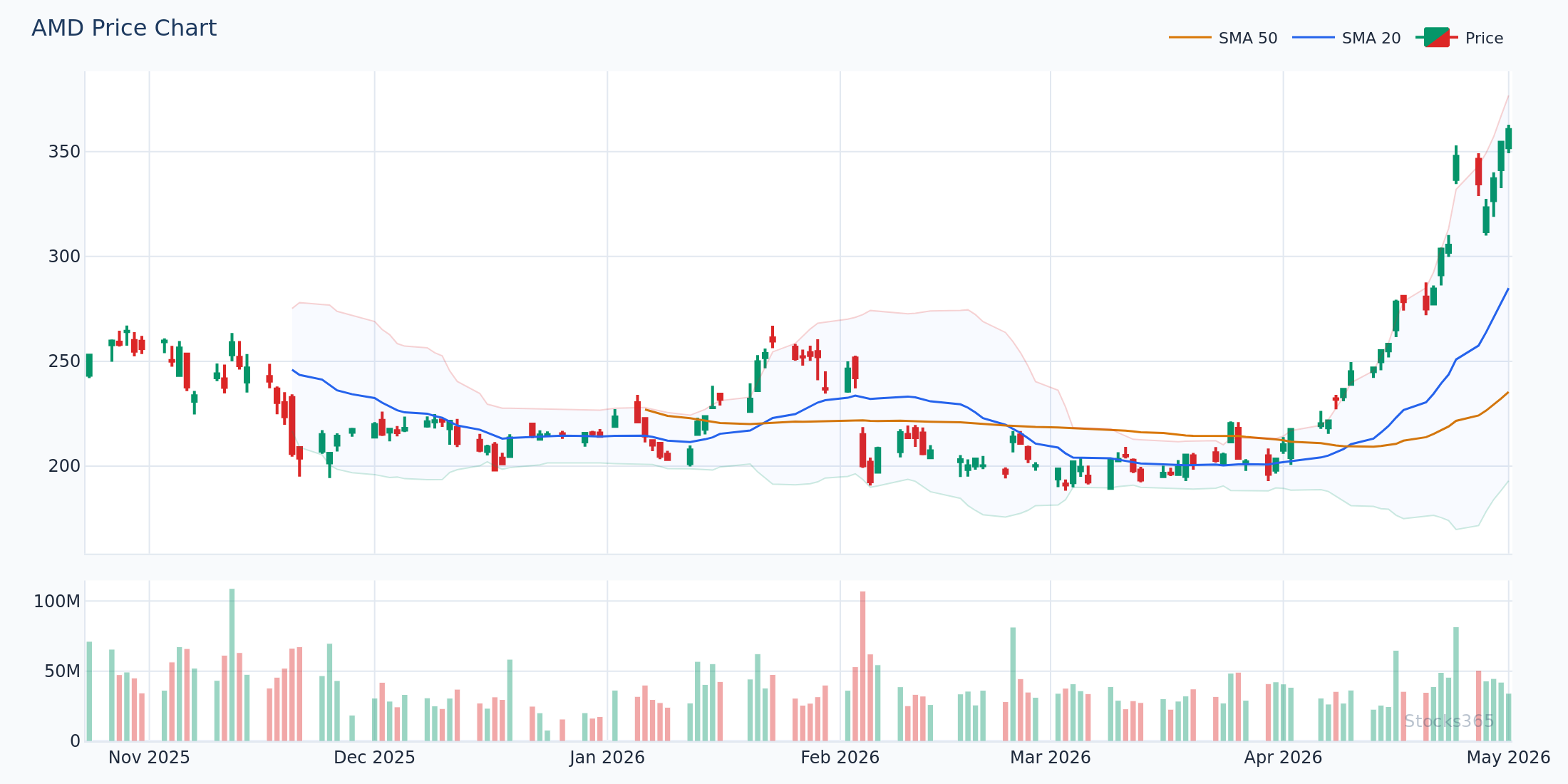
Advanced Micro Devices (AMD) is trading at $360.54, up 1.7% intraday on Stocks365 data, with Tuesday's earnings report looming as the week's most anticipated read-through for the AI chip complex. That move isn't happening in a vacuum — it's arriving alongside a macro calendar that could reset rate expectations, a labor market print that economists are flagging as potentially the softest in months, and an analyst community that just delivered one of the more striking price-target revisions of the quarter.
Wall Street heads into this stretch with its eyes on three converging data streams: corporate earnings, the Federal Reserve's Senior Loan Officer Opinion Survey — which drops early in the week and will offer a live read on credit conditions — and Friday's April jobs report. Economists surveyed expect approximately 49,000 job additions for April, with the unemployment rate forecast to hold at 4.3%, per the Seeking Alpha macro calendar. That 49K figure, if it prints anywhere close, would represent a notably subdued labor market backdrop — and would sharpen the debate over when the Fed might resume cutting.
For AMD specifically, Tuesday's report arrives with the stock already rewarded. As our April 25 coverage of the Intel and AMD tape-split noted
TD Cowen's $850 Seagate Target and What It Implies for the Broader Storage Trade
Seagate Technology (STX) is the week's most data-dense analyst story. TD Cowen's Krish Sankar — ranked No. 16 among more than 12,200 analysts tracked by TipRanks, with a 69% profitable rating rate and an average return of 49.4% per that platform's methodology — reiterated a buy and lifted his price target to $850 from $500 following what he characterized as a "flawless" Q3 fiscal 2026 quarter. That's a 70% target increase in a single revision cycle.

The print that drove the revision: Seagate's Q4 fiscal 2026 earnings-per-share outlook of $5 — a figure Sankar says surpassed Street consensus by 25%, per his published note. He has now set his fiscal 2027 EPS estimate at $34 — conservatively, he stresses — while flagging a bull case range of $35 to $40 for that year. The mechanics underpinning that bull case are specific: 60% gross margin based on 9% average selling price growth and a 25% rise in exabyte shipments.
The June quarter gross margin guidance implies roughly 50%, with Sankar projecting 7% year-over-year ASP growth following a 4% rise in the March quarter. The more provocative data point in his note, however, is the NAND pricing read-through: NAND is up 200% this year by his research, and he argues that hard disk drives are currently in shorter supply than NAND — which leads him to conclude the market is too conservative in assuming HDD manufacturers can only raise prices by high single digits. If that supply-demand asymmetry holds, the upside to pricing estimates is real, not theoretical.
The read-through for AMD and other compute-adjacent names is worth tracking: if storage demand is structurally tightening because of AI workload growth, the same inference engine that is straining exabyte capacity is almost certainly expanding AMD's data-center TAM. These aren't separate narratives — they're the same infrastructure build, measured at different layers of the stack.

The AMD Setup Into Tuesday — Signals, Insider Filings, and What the Backtest Says
At $360.54 with the stock up 1.7% on the session, AMD is printing above where many positioning models would flag neutrality — and two recent Form 4 filings with the SEC are worth noting as context. AMD insiders filed a Form 4 on April 28, 2026 and a prior one on April 17, 2026, per SEC EDGAR records. The filings themselves don't speak to direction, but their timing — both within the pre-earnings quiet window — is the kind of footnote that institutional desks flag when sizing into a print.
On the quantitative side, Stocks365's two-year strategy sweep across 4,786 signals shows the Trend + Momentum Long setup carries a with a profit factor of . That's a modest edge — not a conviction trade — but it's directionally consistent with the intraday bid AMD is showing ahead of a catalyst. It's not noise.
Historically, the closest analog to AMD's current setup is the chip complex in the second quarter of 2023, when Nvidia's first blowout AI-demand quarter reset the entire semiconductor earnings expectations ladder within a single reporting cycle. AMD didn't match that print at the time, but the subsequent read-through re-rated every name in the sector regardless. Tuesday's report carries similar implications — not because AMD is Nvidia, but because any data point on AI infrastructure spending is now a sector-wide input.
Friday's Apple and Riot prints added another data layer here: Apple That backdrop — strong balance sheets, accelerating AI capex, a Fed that hasn't moved in months — is the exact environment in which AMD's data-center narrative gets the benefit of the doubt from the buy side.
Friday's Jobs Number Is the Macro Anchor the Whole Week Trades Around
The 49,000 April payrolls estimate is the number that will either validate or complicate everything else this week. For context: that figure, sourced from the Seeking Alpha macro calendar, sits well below the twelve-month trailing average pace that characterized the labor market through most of the post-pandemic cycle. An unemployment rate holding at 4.3% alongside sub-50K job growth would represent a labor market that is softening at the margin — the kind of read that historically opens space for Fed rate-cut speculation to re-enter the narrative.
The Fed's Senior Loan Officer Opinion Survey, expected earlier in the week, will provide the credit-conditions lens. If lending standards are tightening — as they were during the March 2023 regional banking stress, when the SLOOS data showed a sharp pullback in commercial and industrial loan availability — the combination with a soft jobs print could accelerate rate-cut pricing in the front end. That would matter for AMD at these levels: lower discount rates mechanically expand the multiple on high-growth tech names, and AMD is trading on multiple, not current earnings.
Beyond AMD, Palantir (PLTR) reports Monday, Disney (DIS) Wednesday, and Coinbase (COIN) Thursday — a slate broad enough that the kind of cross-asset volatility we saw when COIN dropped 4% on geopolitical headlines in late April could re-emerge on any one of those days. The week's tape is not a single-ticker story. It's a five-day stress test of the market's appetite for growth at these valuations.
The one number to anchor to by Friday: if April payrolls print below 49,000, watch the two-year Treasury yield for an immediate reaction — that move will tell you more about AMD's multiple six weeks from now than Tuesday's earnings beat or miss will on its own.