

Oracle (ORCL) snapped back more than 7% by midday Friday after OpenAI CFO Sarah Friar publicly rebutted a Wall Street Journal report claiming the AI company was missing internal growth targets. The relief rally was swift and mechanical — a direct reversal of the drawdown that followed the original report earlier this week. But closing the tab on that headline doesn't close the underlying question: how much of Oracle's forward valuation is a bet on a single counterparty hitting numbers Oracle itself cannot control?
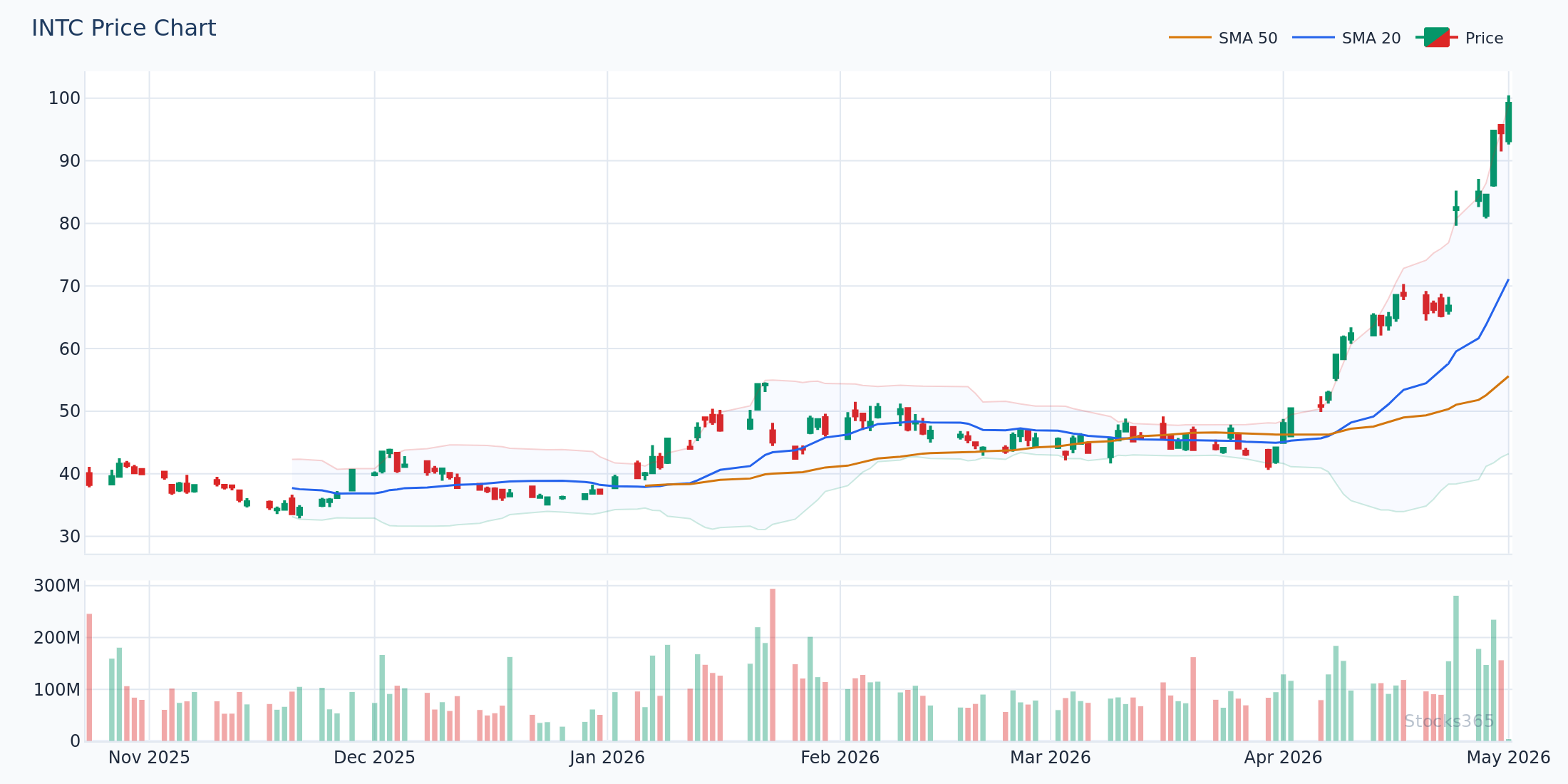
Intel (INTC), for context, also traded higher Friday — up 4.9% to $99.08 per Stocks365 pricing data — as the broader technology complex caught a bid alongside the Oracle move. The two names are structurally different stories, but the session underscored a recurring theme this earnings season: AI-adjacent infrastructure names are trading as much on sentiment signals as on their own reported fundamentals.
Why Friar's Rebuttal Moved the Stock More Than an Earnings Beat Would Have
The mechanism here is worth unpacking. Oracle's 7%-plus intraday gain wasn't triggered by a filing, a revenue print, or a margin revision — it was triggered by a single public statement from an executive at a different company. That asymmetry tells you something important about where Oracle's risk lives right now.
The two companies are bound by what the source material describes as a $300 billion deal in which Oracle will build out AI infrastructure to service demand from OpenAI. At that scale, OpenAI's internal trajectory isn't a secondary data point for Oracle investors — it is the primary data point. Wall Street consensus data, per S&P Global Market Intelligence, projects Oracle's EBITDA and capital spending commitments through 2028 in a trajectory that implies the company doesn't reach meaningful free cash flow generation until 2029. That math only works if the demand side of the equation — OpenAI — keeps scaling.

OpenAI's recent $122 billion funding round, cited in the source material, is the market's clearest signal that institutional capital still believes in that demand curve. Friar's comments Friday were consistent with that posture. But a CFO rebutting a press report — however credible — is not the same as an audited revenue figure. The market treated it like one. That gap is worth flagging.
As we noted in our breakdown of Wednesday's mega-cap earnings split, the AI infrastructure trade is increasingly bifurcated between companies with direct revenue visibility and those whose numbers are downstream of a longer, less predictable buildout cycle. Oracle sits firmly in the second camp.
The Case That Today's Move Reflects Genuine De-Risking
The optimistic read is straightforward: the original selloff was an overreaction to a speculative report, and Friday's rebound is the market correcting that overshoot. If Friar's characterization is accurate — that OpenAI is outperforming internal expectations, not missing them — then the fundamental thesis for Oracle's infrastructure contract is intact, and the prior drawdown created a temporary mispricing.
The $122 billion funding round is a hard number worth anchoring to. That is not seed-stage capital. Investors committing at that scale have access to granular operational data that public markets don't. The fact that the round closed — and closed at that size — is a reasonable proxy for institutional confidence in OpenAI's trajectory, even if the internal target debate remains unresolved in public disclosures.
For Oracle specifically, the bull case rests on the argument that a $300 billion infrastructure commitment, paired with a counterparty that just raised $122 billion, represents a revenue runway with unusually long visibility. If OpenAI scales as projected, Oracle's path to positive free cash flow in 2029 — per the S&P Global Market Intelligence consensus — is a credible, if distant, destination. At these levels, the market appears to be pricing in that the destination is still reachable.
Friday's Oracle move fits that pattern structurally, though the sample covers broad market conditions and is not specific to single-name AI infrastructure names.
The Dependency Risk the Rally Hasn't Priced Out
Here is what didn't change today: Oracle's capital expenditure trajectory through 2028 remains intact, and the company's path to free cash flow generation still runs directly through OpenAI's ability to meet its own targets and secure continued funding. Friar's comments are reassuring. They are not binding. A CFO's public statement is not a contract amendment, and it carries none of the disclosure obligations of an SEC filing.

The bear case is structural, not cyclical. Oracle has made massive investment commitments — commitments that, per the S&P Global Market Intelligence data cited in the source material, create sustained cash burn through 2028. That cash burn is acceptable only if the revenue engine on the other side is running. One counterparty. One deal. One dependency chain that extends years into the future. When a Wall Street Journal report raises questions about that counterparty's internal performance, the stock falls 7%. When the counterparty's CFO pushes back, the stock rises 7%. That kind of binary sensitivity to a single data source is not a trait typically associated with a de-risked position.
The concern raised internally at OpenAI — per the original report, including by Friar herself — about spending levels adds a layer of texture that a single public rebuttal doesn't fully resolve. Management teams expressing caution about burn rates and then publicly reassuring markets isn't a contradiction, exactly, but it does suggest the internal picture is more complex than either the negative headline or the positive rebuttal fully captures.
This pattern echoes what we flagged in our earlier analysis of the AI earnings euphoria narrative — specifically, the tendency for markets to assign high conviction to sentiment signals in infrastructure names where the actual revenue inflection is still multiple years out. The structural flaw in that approach doesn't disappear because the sentiment signal was positive today.
A historical anchor worth noting: in early 2021, cloud infrastructure names with long-duration revenue commitments traded at elevated multiples on partner-driven demand assumptions, only to face significant compression through 2022 when rate conditions changed and long-duration cash flow assumptions were repriced. Oracle's situation is distinct — the contract structure and funding backdrop differ meaningfully — but the underlying dynamic of markets pricing distant cash flows on near-term sentiment signals has precedent, and that precedent isn't uniformly encouraging.
Which Side Has Stronger Footing Into Next Week
Friday's close looks like a sentiment normalization, not a fundamental rerating. The 7%-plus gain retraces the damage done by the original report, but it doesn't add new information about Oracle's own operating metrics, its EBITDA trajectory, or the pace of infrastructure deployment. The stock is, roughly, back to where it was before the negative headline landed — which means investors are back to the same underlying question they were sitting with before this week's noise cycle began.
The bull side has the stronger near-term footing, for a simple reason: the original catalyst for the selloff — the report of OpenAI missing targets — has been publicly rebutted by the executive most directly positioned to know. Absent a new data point that contradicts Friar's characterization, the path of least resistance is sideways-to-up as the news cycle moves on.
But the bear case has the stronger structural footing for anyone with a horizon beyond the next two weeks. The dependency on a single counterparty, the cash burn profile through 2028, and the binary sensitivity to OpenAI-related headlines are features of Oracle's current positioning — not bugs that get resolved by a Friday rebound. Intel's concurrent 4.9% gain, per Stocks365 data, as detailed in our earlier note on Intel's single-session surge, is a reminder that the AI infrastructure complex moves in clusters — which cuts both ways when sentiment reverses.
The specific thing to watch next week: any follow-on commentary from OpenAI — in press, filings, or partner communications — that either corroborates or complicates Friar's Friday rebuttal. If the rebuttal holds, Oracle's relief rally has a foundation. If new detail surfaces that reopens the internal-target debate, Friday's move will look like a one-session overreaction to a single data point — which, technically, is exactly what it was.