

Thirteen billion dollars. That's the size of the financing package Meta Platforms (META) is assembling this morning — with JPMorgan and Morgan Stanley arranging the debt and equity split — for a planned AI data center in El Paso, Texas targeting 1 gigawatt of capacity by 2028. META is up 0.3% on the session as of midday, trading at $610.41, which tells you everything about how the market is reading this news: a confident giant making a confident move.
The consensus case is easy to steelman. Meta is flush with cash, AI infrastructure is the defining capital expenditure of this decade, and securing 1 GW of compute capacity before competitors do is exactly what a platform-scale company should be doing. The El Paso project — already revised upward to roughly $10 billion in planned investment before today's financing news — signals execution speed. Morgan Stanley and JPMorgan don't take on deal lead roles for troubled credits. The market is nodding along.
But here's what the consensus is skipping past: Meta is choosing debt to fund its own strategic priority. That's not a minor footnote. That's the story.
When Hyperscalers Start Leaning on Wall Street's Balance Sheet
The real story here isn't the data center. It's the financing architecture. Meta — a company that generated substantial free cash flow over recent quarters — is structuring this deal with most of the $13 billion as debt, per the wire this morning. The equity slice fills the rest. That ratio matters.
There's a broader pattern in motion that the headline number obscures. According to the source reporting, Meta and Amazon collectively are expected to spend more than $630 billion on AI infrastructure this year alone. Read that again. Six hundred and thirty billion dollars. Even for the largest technology companies on earth, that kind of capital demand doesn't fit neatly inside operating cash flow. So they're turning to syndicated financing — and Wall Street is happy to oblige, for now.
This is a structural shift, not a one-off transaction. The model being built here looks less like a technology company deploying retained earnings and more like a utility or real estate investment trust: capital-intensive, leveraged, and increasingly dependent on debt markets staying cooperative. That's a tail risk the current price of META at $610.41 does not appear to be pricing in.

The appointment this morning of Sonali Garg — former Meta data center leader, now COO of Allianca Group — to the advisory board of Core AI Holdings (CHAI) adds an interesting dimension. Garg's track record at Meta includes scaling a data center portfolio from $2 billion to $10 billion over five years, per Core AI's press release. That's the exact execution playbook Meta is now trying to run at El Paso. What it also tells you: the talent that built Meta's last infrastructure cycle is now advising competitors and adjacent plays. The knowledge diffusion is already happening.
The Complacency Hidden Inside a Clean Headline
What nobody's talking about is the compounding capital expenditure pressure this creates on margins — and whether the revenue side of the equation can keep pace. Our earlier note on Microsoft's margin math made this point in a different context: beating revenue numbers means nothing if the cost structure underneath is quietly shifting. Meta's situation has similar geometry.
More capacity in 2028 is a bet on AI monetization remaining robust two-plus years from now. The consensus assumes that trajectory holds. But the financing structure Meta is building today — heavy debt, external syndication — introduces an interest cost layer that will sit on the income statement regardless of whether AI revenue scales as projected. If monetization timelines slip, or if the competitive environment compresses pricing on AI-driven advertising and services, that debt doesn't flex. It stays fixed.
There's historical precedent worth anchoring here. In the 2014-2016 period, cable and telecom operators made analogous moves: massive leveraged infrastructure bets justified by subscriber growth assumptions that looked unimpeachable at the time. Several of those bets proved correct. Several did not. The ones that didn't weren't wrong about infrastructure demand — they were wrong about the pace of return. Meta is making a similar timing bet, just with AI instead of fiber.
The Stocks365 data this morning shows META in a normal volatility regime — no unusual options flow signaling near-term stress. That's consistent with a market that has fully digested the bullish read and moved on. It also means the convexity here sits to the downside: if the debt structure or capex pace becomes a concern in a future quarter, there's limited buffer built into the current price. At $610.41, META is trading on a continuation thesis, not a stress-test scenario.

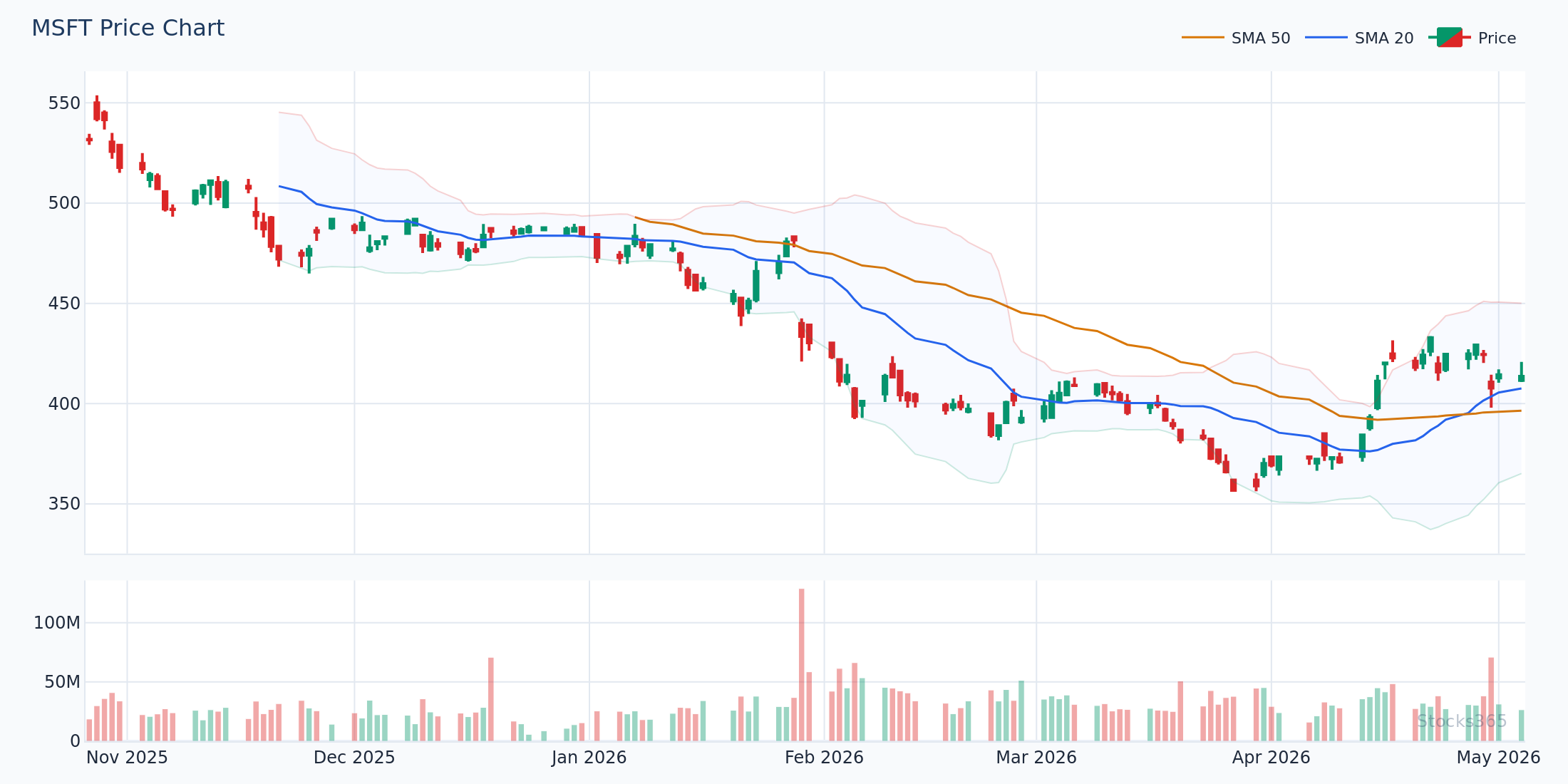
Microsoft (MSFT), down 0.2% on the session at $413.62, provides a useful adjacent data point. As we noted in , the market is increasingly differentiating between companies that can fund AI infrastructure from operations and those stretching toward external capital. MSFT's modest pullback today against META's modest gain might partly reflect that distinction being quietly repriced at the margin — though with both moves inside 0.5%, it would be overreading to call it a definitive signal.
What the $630 Billion Buildout Actually Requires to Work
Step back to the macro frame. The source material this morning puts a number on the collective ambition: Big Tech's AI infrastructure spend — Meta, Amazon, Alphabet, Microsoft — is running in the hundreds of billions annually. That spending requires three things to justify itself: sustained demand for AI compute, stable debt markets willing to absorb the financing, and AI revenue models that actually convert infrastructure into cash flow at scale.
The first condition looks durable. The second is the underappreciated variable. The syndicated loan and bond markets that Morgan Stanley and JPMorgan are tapping for Meta's El Paso deal are currently cooperative — spreads are not flashing stress, and institutional appetite for investment-grade tech paper remains strong. But debt markets are procyclical. They tighten when you need them most. A scenario where AI capex cycles collide with a credit tightening cycle is not in the consensus model. It should be at least in the risk register.
The third condition — AI monetization at scale — is the one Meta's management is most directly betting on. The El Paso facility isn't scheduled to open until 2028. Between now and then, Meta needs its current AI integrations across Facebook, Instagram, WhatsApp, and the Ray-Ban smart glasses ecosystem to generate sufficient evidence of monetization that the market maintains patience with the capital allocation. That's a long runway to hold investor confidence on a leveraged bet.
None of this means the trade is wrong. Meta has executed large infrastructure builds before — Garg's track record at the company proves the operational muscle exists. The El Paso project could deliver exactly the compute advantage Meta's AI ambitions require, and the debt could look cheap in retrospect if AI revenue scales faster than the interest burden grows. The consensus case rests on execution continuity and market stability — and both of those assumptions have held for long enough that challenging them feels contrarian for its own sake. It isn't. It's just honest accounting of what has to remain true for the thesis to work.
The One Number to Watch Before This Story Resolves
The forward-looking tell here isn't the data center — it's Meta's next quarterly report and the line items underneath revenue. Specifically: what the operating margin trajectory looks like as capital expenditure compounds, and whether management provides any color on how the El Paso debt service integrates into forward guidance. The recent analyst split on META — with Stifel taking a differentiated view — suggests the Street is not uniformly convinced the capex pace is priced correctly at current levels.
Watch whether META can sustain the $610 level into the close today. Midday calm can mask late-session repositioning when a news item reframes a structural question rather than a tactical one. The $13 billion headline has been absorbed bullishly. Whether the debt structure underneath it gets the same warm reception when analysts run it through their models is a different question — and that answer tends to arrive on a subsequent earnings call, not in a morning wire.
The consensus is bullish on Meta's AI buildout. The evidence for that bullishness is real. But the financing mechanism chosen to execute it introduces a leverage variable that deserves more than a 0.3% uptick and a nod.