

The number that matters most in tonight's Microsoft earnings story is not $82.89 billion in quarterly revenue, up 18% year-over-year and ahead of every major estimate. It is not even the 40% Azure growth print that a lot of cloud bulls would have taken before the bell. The number that moved the stock — and the one that should be anchoring tonight's cross-asset read — is the margin guide. Cloud segment margins expected around 64%, with the company explicitly flagging heavier AI investment and rising usage of tools like GitHub Copilot as the drivers of that pressure. Growth at a cost. That is the sentence the market read. And the reaction told you everything about where we are in the AI-investment regime.
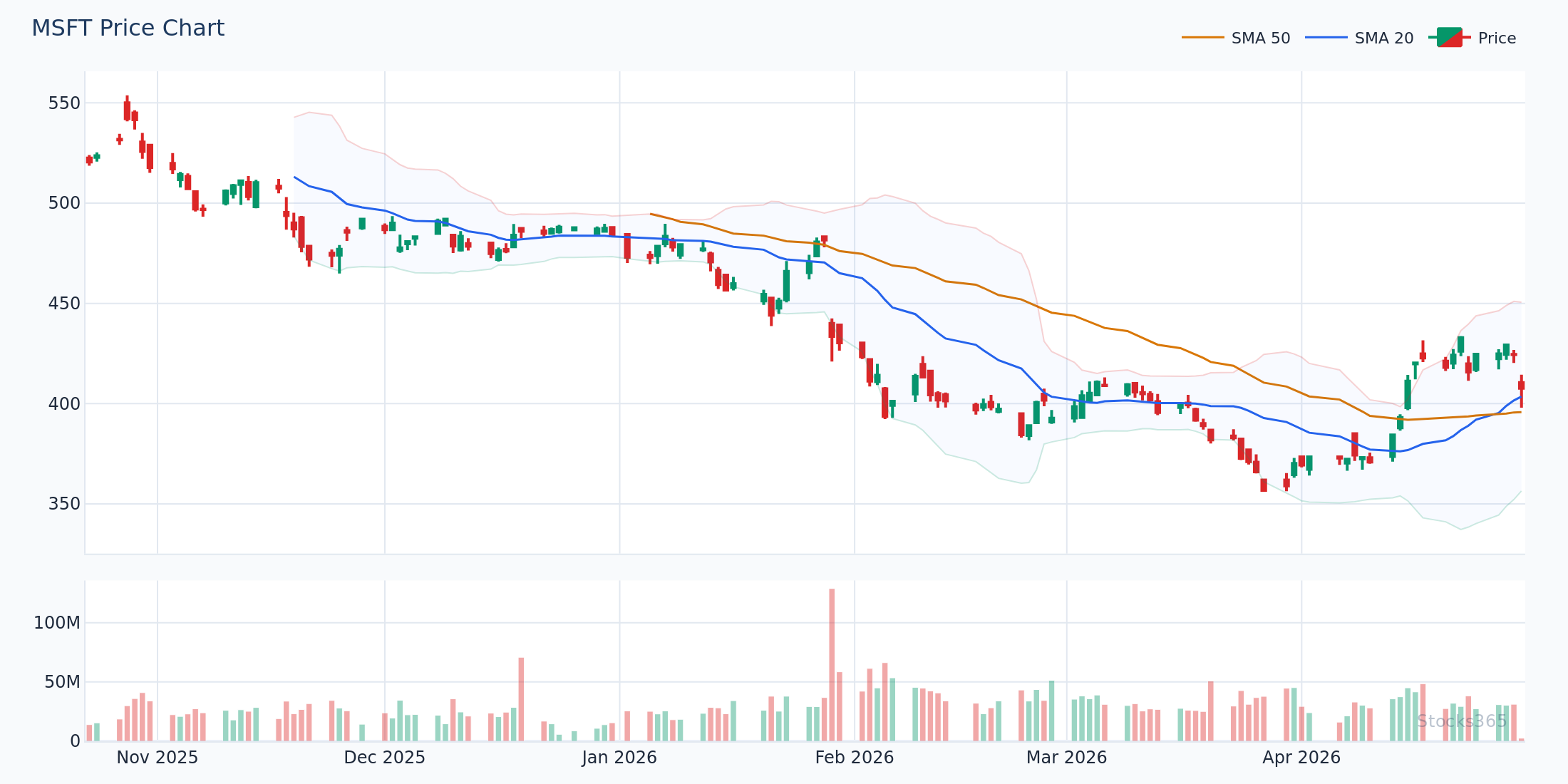
Microsoft (MSFT) closed at $407.68, down 4.0% on the session, according to Stocks365 pricing data — a move that, in isolation, looks like a mismatch with the headline beat. But zoom out from the ticker, and the reaction is coherent. The market is not punishing Microsoft for growing. It is repricing the cost of that growth into a rate environment where 64%-margin cloud is no longer a free pass.
Good Earnings, Wrong Regime for the Old Valuation Model
There is a framework shift underway that every earnings reaction this week has been stress-testing. For most of the post-pandemic cycle, the market gave high-growth technology platforms the benefit of the doubt on spending — if you were building moat, you could compress near-term margins and the multiple held. It works differently when the .
At 4.42% on the long end and a — a yield curve that has re-steepened meaningfully off its inverted lows — the discount rate applied to long-duration cash flows is no longer theoretical. Duration risk (the sensitivity of an asset's price to changes in interest rates, amplified the further out those cash flows sit) is real and being actively priced. Microsoft's AI build-out is, by its nature, a long-duration bet: capital expenditure heavy today, margin recovery promised later. The setup we are watching is precisely this tension: Azure demand is unambiguously robust, but the financing cost of the infrastructure required to meet that demand is rising — in both rate terms and absolute capital-expenditure terms.
The Fed funds effective rate at tells you the Fed is not in panic-cut mode. With the 2-year at , the front end is pricing modest easing over the next year — but nothing that would dramatically reprice the long end lower. That means the margin-compression story at Microsoft is not resolved by the next FOMC meeting. It is a multi-quarter overhang.

The Divergence Between Azure and the Stock Is a Cross-Asset Signal
Strip away the equity reaction and look at what the Microsoft numbers are actually telling the broader market. According to the company's 8-K filing, the Intelligent Cloud segment brought in $34.7 billion, with management guiding for continued 40%-range Azure growth into the next quarter. Revenue guidance for the upcoming period came in at $86.7 billion to $87.8 billion — not a number that suggests demand destruction. Demand is not the problem. Supply of margin is.
This is a meaningful macro data point beyond MSFT itself. Azure's 40% growth rate tells you that enterprise AI adoption is accelerating, that corporates are spending through uncertainty, and that the capital-expenditure cycle tied to hyperscaler infrastructure is far from over. That last piece connects directly to the broader rates and commodities complex — power demand, data-center construction, and the energy intensity of large-language-model inference are all real-economy stories, not just software narratives. Our earlier look at Applied Digital's hyperscaler deal made this point: the AI capex wave is landing in physical infrastructure markets in ways that equity multiples alone do not capture.
Meanwhile, tonight we also have Imperial Oil's earnings lifted by an oil rally — energy assets sitting alongside a tech giant's margin squeeze in the same after-hours tape. That juxtaposition is not incidental. It reflects a broader cross-asset dispersion (the widening of return differences across asset classes and sectors) that has characterized Q2: commodity-linked cash flows improving while long-duration growth equities get squeezed on the same rate backdrop. The two stories are not contradictory. They are the same macro regime expressing itself differently across the capital structure.
Stocks365's proprietary data shows MSFT operating in a normal-volatility market regime, which makes the 4% single-session move notable but not extreme. But the word "tactical" is doing real work there. A mean-reversion bounce and a structural re-rating are very different theses, and in this rate environment, you want to be precise about which trade you are in.
What History Suggests About Selling Off on a Beat
The pattern of a dominant technology platform selling off on unambiguous earnings beats is not new, but the specific mechanism matters. In July 2018, when Facebook (now Meta The market was not wrong. It was identifying a regime shift: from margin expansion to margin investment. The stock took roughly 18 months to fully recover that ground.
The parallel to today's Microsoft reaction is imperfect but instructive. The revenue growth is not decelerating — it is accelerating. But the margin trajectory is the new stress point. If Azure is growing 40% and cloud margins are still being compressed, the market wants to understand the endpoint of that compression. Management's answer — that AI revenue is scaling in a big way and demand continues to outpace supply — is genuinely positive. But it does not solve the near-term margin math. And as we flagged in our earlier note on what cost-cut signals often mask, markets sometimes buy the restructuring story before the operating leverage materializes. The inverse applies here: they are selling the investment story before the AI revenue fully lands in the income statement.
There is also the question of what happens to the broader mega-cap technology cohort's multiple when the best-in-class name — the one with the cleanest cloud story and the most credible AI monetization path — sells off on a beat. The dispersion trade that has dominated Q2 gets more complicated. If MSFT cannot hold its multiple on a 40%-Azure-growth quarter, what does that imply for peers with slower cloud adoption or thinner AI revenue streams? That question will be asked at the open on Friday.

Meanwhile, Clorox Cuts Its Earnings Outlook — and That Is Also Part of the Read
It would be a mistake to let the Microsoft story crowd out a quieter but equally diagnostic data point from tonight's tape. The earnings dispersion theme we have been tracking this quarter got another data point when Clorox lowered its full-year earnings-per-share outlook to a range of $4.78 to $4.98, down from prior guidance of $5.60 to $5.95 — a meaningful cut even as the company reported higher profit on the quarter. That gap between current-period strength and forward-period guidance is a classic margin-squeeze signal in consumer staples: input costs or volume assumptions are deteriorating faster than the current-quarter income statement reveals.
The macro read here is about breadth. When a staples company cuts guidance at the same time a hyperscaler flags rising AI infrastructure costs, you are seeing cost-push pressure manifesting across two very different parts of the economy simultaneously. That is not sector-specific noise. It is a regime characteristic — an environment where real input costs (energy, compute, labor) are running hotter than companies' ability to offset through pricing or productivity. The 10-year at 4.42% is not creating that cost pressure, but it is making the capital markets' tolerance for it lower. Multiples compress when margin visibility shrinks and the risk-free rate is not trivial.
The oil story threading through Imperial Oil's results adds one more layer. An oil rally lifting profit outlooks in the energy sector is, in a different rate world, a straightforward risk-on signal. In this one, it is also a cost input for everything else — including the data centers that Microsoft is building at scale. The cross-asset feedback loop is tighter than it looks from any single earnings report.
What to watch when markets reopen: If Thursday's economic data — or any Fed communication — pushes the 10-year above that threshold, expect further rotation out of long-duration growth equities and into energy, financials, and shorter-duration quality names. Microsoft's reaction tonight has already priced in some of that logic. That is a story for Q3 at the earliest. Tonight, the setup favors patience over conviction.