
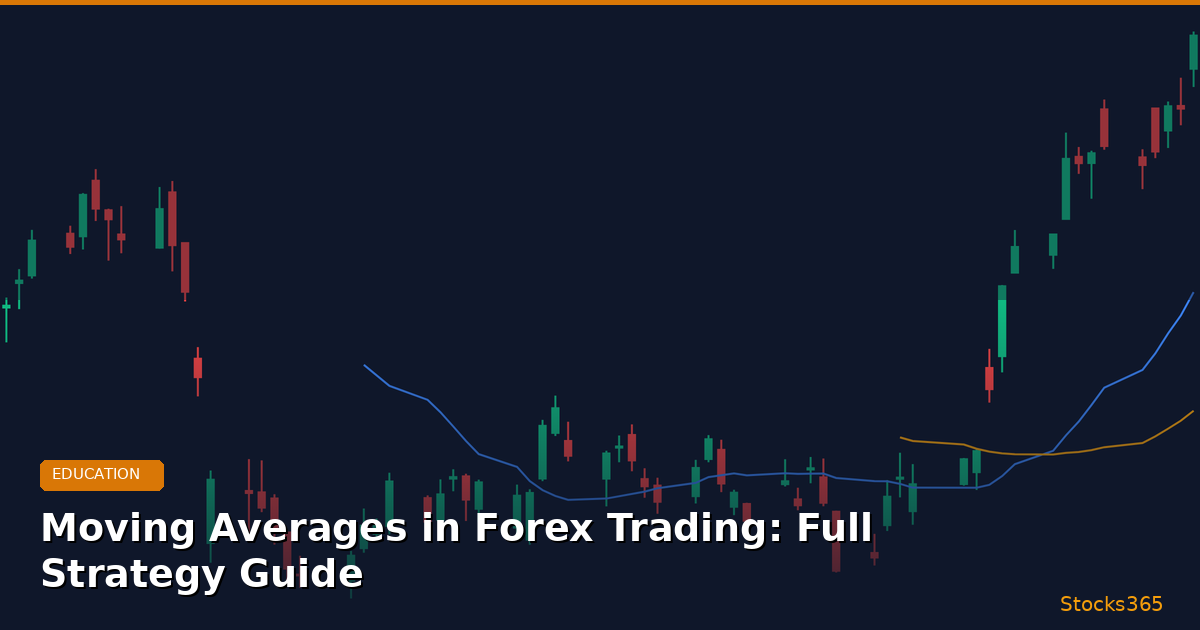
Moving Averages in Forex Trading: The Complete Strategy Guide
Moving averages are the backbone of forex technical analysis. Simple. Powerful. Massively misunderstood.
Every professional forex trader has at least one moving average on their chart. Not because it's tradition — because it works. Moving averages strip away the noise, reveal the trend direction, and give you objective entry and exit signals in a market that never sleeps.
This guide covers everything: how each type of moving average works, which setups actually produce edge, how to combine them with other indicators, and what separates profitable MA traders from the ones who keep getting whipsawed.
What Are Moving Averages in Forex Trading?
A moving average is a continuously updated line that plots the average closing price of a currency pair over a defined number of periods. As each new candle closes, the oldest data point drops off and the newest one joins — the average moves with the market.
In forex, this matters because currency pairs trend. EUR/USD, GBP/JPY, USD/JPY — they all go through extended directional moves. Moving averages help you identify those moves early, stay in them longer, and exit before the reversal eats your profits.
The Three Types of Moving Averages Forex Traders Use
Simple Moving Average (SMA) — Adds up the closing prices over N periods and divides by N. Every period gets equal weight. Clean, straightforward, and widely followed. Because so many traders watch the same SMAs (20, 50, 200), they become self-fulfilling at key levels.
Exponential Moving Average (EMA) — Applies more weight to recent prices, making it faster to react to current price action. Preferred by short-term and intraday forex traders who need quicker signals. The 8 EMA, 21 EMA, and 50 EMA are particularly popular in forex.
Weighted Moving Average (WMA) — Similar to EMA in that it weights recent data more heavily, but uses a linear rather than exponential weighting formula. Less common but used by systematic traders building algo strategies.
Most forex traders gravitate toward EMAs on lower timeframes and SMAs on daily and weekly charts. That combination gives you responsiveness where you need it and stability where stability matters.
[CHART:sma_cross:EURUSD:20 EMA vs 50 EMA Crossover on Major Forex Pair]This chart shows the classic 20/50 EMA crossover setup — when the faster 20 EMA crosses above the slower 50 EMA, it signals a potential bullish trend shift. Watch for the crossover to occur with price already trading above both MAs for the highest-probability entries. A failed cross — where price reclaims the MAs immediately — invalidates the signal and warns of a choppy, ranging environment ahead.
The Most Effective Moving Average Strategies for Forex
1. The Moving Average Crossover Strategy
The crossover is the most widely taught moving average forex strategy. When a shorter-period MA crosses above a longer-period MA, it signals potential upward momentum. When it crosses below, downward momentum may be building.
The most popular crossover combinations in forex:
- 20/50 EMA — Medium-term trend signals, works well on 1H and 4H charts
- 50/200 SMA (Golden/Death Cross) — Major trend shifts, high-value signals on daily charts
- 8/21 EMA — Faster signals for day traders, best used on 15M and 1H charts
Here's what most traders get wrong: they treat every crossover as a trade signal. In ranging markets, crossovers fire constantly — giving you whipsaw after whipsaw. The real edge isn't taking every cross. It's filtering crosses to take only those that occur during confirmed trending conditions. Use the 200 SMA as your regime filter. If price is above the 200 SMA, take long crossover signals. Below it? Short signals only.
2. Moving Average as Dynamic Support and Resistance
This is where moving averages become genuinely powerful in forex. In a trending market, price doesn't move in a straight line — it pulses. It moves in the trend direction, pulls back to a key MA, and launches again.
The 20 EMA and 50 EMA act as dynamic support in uptrends and dynamic resistance in downtrends. The setup is clean:
- Identify the trend direction using the 200 SMA
- Wait for price to pull back to the 20 or 50 EMA
- Watch for a rejection candle — a hammer, bullish engulfing, or pin bar — at the MA level
- Enter in the direction of the trend on the next candle open
- Place stop below the MA (for longs) or above it (for shorts)
This setup works because the trend remains intact until the MA is clearly broken. You're not guessing — you're following the market's own structure.
[CHART:candlestick:GBPUSD:Price Pullback to 50 EMA in Uptrend — Dynamic Support Setup]The chart illustrates a textbook pullback-to-MA setup: price in a clear uptrend pulls back to touch the 50 EMA, then produces a strong rejection candle. What happens next is typically a resumption of the uptrend, often reaching or exceeding the previous swing high. The setup is invalidated if price closes a full daily candle below the 50 EMA with momentum — that signals the trend has shifted, not just paused.
3. The 200 SMA Trend Filter
Nothing fancy. Price above the 200 SMA = bullish bias. Price below = bearish bias. This single rule eliminates dozens of bad trades per month.
The 200 SMA is the most watched moving average in the world. Central banks watch it. Hedge funds watch it. When EUR/USD reclaims its 200-day SMA after weeks below it, that's not a coincidence — it's institutional buying. Use that information.
4. Moving Average Ribbon Strategy
An MA ribbon uses multiple moving averages of increasing periods plotted together — for example, the 10, 20, 30, 40, 50 EMAs all on one chart. When the ribbon fans out in order (shorter MAs above longer ones in an uptrend), trend momentum is strong. When the ribbon converges or tangles, the market is in consolidation.
Trend strength is everything in forex. The ribbon makes it visual.
[CHART:sma_cross:USDJPY:EMA Ribbon Showing Trend Expansion and Compression Phases]This setup shows the EMA ribbon expanding during a strong trending phase — all averages moving in parallel, well-separated from each other. When the ribbon begins to compress (averages tangling together), it's a warning that trend momentum is fading. Traders use ribbon compression as a signal to tighten stops or reduce position size, not necessarily exit immediately.
Moving Averages Combined With Other Indicators
Moving averages alone are powerful. Combined with momentum indicators, they become exceptional.
Moving Averages + RSI
This is one of the most reliable combinations in forex trading. Use moving averages to define the trend and direction, then use RSI to time your entry within that trend.
The setup: Price pulls back to the 50 EMA in an uptrend. At the same time, RSI drops to the 40-50 zone (not oversold, just cooled off). When RSI turns back up from that zone and price holds above the 50 EMA, that's your entry signal. You're entering a trending market during a healthy correction — exactly the kind of setup that produces strong risk/reward ratios.
For a deeper understanding of how RSI complements moving average strategies, the guide on how to use RSI in trading walks through step-by-step integration with trend-following setups. And if you want to take it further, RSI divergence at a moving average level is one of the highest-probability reversal setups in the forex market.
Moving Averages + Volume
Volume confirms conviction. When price breaks above a key MA with volume surging 2x or more above average, the breakout has institutional backing. When price tags the MA on thin volume, it's likely to bounce — or fail quietly. In forex, since true volume data is fragmented across brokers, tick volume is used as a proxy — and it's surprisingly effective for confirming MA interactions.
Moving Averages + RSI Overbought/Oversold Levels
In ranging markets, RSI overbought and oversold signals at key MAs produce excellent mean-reversion trades. When price is at the upper Bollinger Band, RSI is above 70, and price hits a declining 20 SMA from below — that's a confluence short setup. Multiple signals agreeing at the same level dramatically improves reliability. For a full breakdown of these levels, see the article on RSI overbought and oversold levels.
Choosing the Right Moving Average Period for Forex
Period selection depends entirely on your trading timeframe and style. There's no universal "best" period — only best for your specific approach.
- Scalpers (1M-5M charts): 8 EMA, 21 EMA — fast response, tight signals
- Day traders (15M-1H charts): 20 EMA, 50 EMA — balance of speed and stability
- Swing traders (4H-Daily charts): 50 SMA, 200 SMA — major trend structure
- Position traders (Weekly charts): 20 SMA, 40 SMA, 200 SMA — long-term regime identification
If you're experimenting with periods, the article on RSI settings and period optimization covers the same optimization logic that applies directly to MA period selection — the principles transfer cleanly.
Start with the standard periods. Master them before customizing.
[CHART:candlestick:EURUSD:Daily Chart With 20/50/200 SMA Showing Multi-Timeframe Confluence]This multi-MA chart shows how the 20, 50, and 200 SMAs stack in a clean uptrend — shorter averages above longer ones, all sloping upward. When all three are aligned and price is above all of them, trend quality is highest and pullback-to-MA trades carry the most conviction. If price drops below the 20 SMA but holds the 50 SMA, the trend remains intact. A close below the 200 SMA changes the macro bias entirely.
Common Moving Average Mistakes in Forex
Using Too Many Moving Averages
Three MAs maximum on any chart. Beyond that, you're not gaining information — you're creating confusion. Each new line competes for your attention and dilutes your decision-making. More lines don't mean better analysis. They mean paralysis.
Ignoring Market Regime
Moving averages are trend-following tools. In ranging, choppy markets, they produce constant false signals. Before entering any MA-based trade, classify the market: is it trending or ranging? ATR (Average True Range) expanding signals trending conditions. ATR contracting signals range. Only run MA crossover strategies when ATR confirms trending behavior.
Treating the MA as an Exact Price Level
The 50 EMA isn't a wall. It's a zone. Price can pierce through it by a few pips and still be a valid bounce. Mechanical traders who put stop losses exactly at the MA get hunted. Give the MA a buffer — use the low of the rejection candle as your actual stop, not the MA line itself.
Our analysis of 3,332 signals across multiple asset classes found that Price Crosses Below SMA 20 produces only a 42.5% win rate in forex specifically — the worst-performing asset class for this signal. That's not a failure of the signal; it's a regime issue. Forex pairs spend significant time in range-bound conditions where the 20 SMA cross generates noise, not signal. Filter with trend context and that number improves dramatically. See the full dataset at Stocks365 Insights.
Advanced Moving Average Concepts for Forex
Multiple Timeframe Moving Average Analysis
The most professional application of moving averages in forex uses multiple timeframes together. Check the weekly chart first — is the 200 SMA sloping up or down? That's your macro bias. Drop to the daily — is price above or below the 50 SMA? That's your intermediate bias. Then use the 4H chart with a 20 EMA to time your entry.
When all three timeframes agree, your trades carry significantly more conviction. This is called timeframe confluence, and it's how institutional forex desks filter their signals.
Moving Average Slope as Momentum Indicator
Don't just look at where the MA is — look at its angle. A steeply rising 50 EMA signals strong momentum. A flattening 50 EMA signals that momentum is fading, even if price is still above it. As the MA flattens, tighten your stops. Don't wait for the cross — by then, much of the move is already gone.
Hidden Divergence With Moving Averages
When price makes a higher low during a pullback to a key MA, but a momentum oscillator like RSI makes a lower low at the same point — that's hidden bullish divergence. It signals trend continuation, not reversal. This is one of the most powerful confirmation signals available. For a full breakdown of how hidden divergence works, the article on hidden RSI divergence covers it in precise detail.
What to Watch For
- Golden Cross setups on major pairs with trend alignment: When the 50 SMA crosses above the 200 SMA on the daily chart while price is already trading well above both, the next pullback to the 50 SMA often provides a high-quality continuation entry rather than a reversal.
- EMA ribbon compression followed by directional expansion: When the 8, 21, and 50 EMAs converge tightly — indicating a squeeze — watch for the first strong directional candle to determine which way the ribbon expands. The first 3-5 candles after a ribbon expansion often define the new short-term trend.
- RSI divergence at the 50 or 200 SMA: When price retests a major moving average and RSI shows bullish or bearish divergence at that level simultaneously, the confluence dramatically increases the probability of a meaningful bounce or rejection.
- Death Cross rejection patterns: When the 50 SMA crosses below the 200 SMA but price immediately reclaims both averages within a few candles, the failed Death Cross often triggers an aggressive squeeze higher — bears who shorted the cross get trapped and cover rapidly.
- Slope divergence warning: When price makes a new high but the 20 EMA begins to flatten rather than steepen, trend momentum is deteriorating before price shows it. Reduce position size on the next long entry until the MA slope confirms fresh momentum.
How Stocks365 Uses This
Moving Averages in the Stocks365 Trust Score System
Stocks365 integrates moving average analysis as one of 12+ indicators within its proprietary trust score system. Specifically, MA positioning contributes to the trend regime scoring component — helping classify whether a given instrument is in a trending or mean-reverting state at the time a signal fires.
When a signal appears on the Stocks365 signals dashboard, the trust score reflects whether that signal aligns with the prevailing MA-defined trend on multiple timeframes. A breakout signal that occurs while price is above the 50 and 200 SMA receives higher agreement weighting than one firing against the trend. This multi-indicator agreement approach means you're never relying on a single MA crossover alone — you're seeing whether the broader technical picture confirms or contradicts it.
Stocks365 research across 3,289 Price Crosses Above SMA 20 signals found a win rate of only 48.3% with a profit factor of 0.88 across the full dataset — a reminder that raw MA signals without regime context underperform. With trust score filtering applied, that picture changes significantly. Explore the full data at Stocks365 Insights.
Key Takeaways
- EMAs react faster than SMAs — use EMAs for intraday and swing entries, SMAs for macro trend structure.
- The 200 SMA is non-negotiable — it's your primary trend filter for any forex pair, any timeframe.
- Crossovers alone aren't enough — filter by trend regime, volume, and momentum confirmation to avoid whipsaws.
- MAs work best as dynamic support/resistance in trending markets — wait for pullbacks to key MAs, not breakouts.
- Combine with RSI for entry timing — RSI divergence at a major MA is one of the highest-probability setups in forex.
- Slope matters — a flattening MA warns of trend deterioration before price confirms it.
- Multiple timeframe confluence separates professional MA analysis from amateur signal-chasing.
Frequently Asked Questions
What is the best moving average for forex trading?
There's no single "best" moving average — the right choice depends on your trading style. Day traders typically favor the 8 and 21 EMA for quick signals. Swing traders rely on the 50 EMA and 50 SMA for pullback entries. The 200 SMA is universally used across all styles as the primary trend filter. Start with the 20/50/200 combination and adjust from there based on your specific timeframe and strategy.
Do moving averages work in forex?
Yes — with conditions. Moving averages work well in trending forex markets and poorly in ranging, choppy conditions. The key is regime identification: only apply trend-following MA strategies when ATR confirms expanding volatility and directional movement. Used correctly with a trend filter like the 200 SMA, MA-based strategies produce consistent edge in forex.
What is the difference between SMA and EMA in forex?
The Simple Moving Average (SMA) gives equal weight to all periods in the calculation, making it slower and smoother. The Exponential Moving Average (EMA) weights recent price data more heavily, making it faster to respond to current price action. In forex, EMAs are preferred for short-term trading because they react more quickly to momentum shifts. SMAs are preferred on higher timeframes because their smoothness reduces noise around major structural levels.
How do you use moving average crossovers in forex?
The crossover strategy uses two MAs of different periods — when the faster MA crosses above the slower MA, it signals potential bullish momentum; a cross below signals bearish momentum. The most reliable approach is to use the 200 SMA as a trend filter first: only take bullish crossovers when price is above the 200 SMA, and bearish crossovers when price is below it. Combining crossover signals with RSI confirmation — as covered in the RSI trading guide — significantly improves accuracy.
What moving average period should I use for day trading forex?
For forex day trading on 15-minute and 1-hour charts, the 8 EMA and 21 EMA combination is widely used for fast signal generation, while the 50 EMA serves as a dynamic support/resistance reference. On 5-minute charts, the 20 EMA and 50 EMA work well together. Avoid using very long-period MAs like the 200 on sub-hourly charts — they lag too far behind price action to be useful for intraday timing.