
Why Backtesting a Moving Average Strategy Changes Everything
Most traders pick a moving average, slap it on a chart, and call it a strategy. Then they lose money and blame the indicator. The real problem? They never tested it.
Backtesting a moving average strategy means running your rules against historical price data to see what actually works — before real capital is on the line. It separates conviction from guesswork. And in 2026, with algorithmic competition at every price level, guesswork is expensive.
Stocks365 backtested over 6,600 moving average crossover signals across multiple asset classes and found results that will surprise most retail traders. The edge isn't where beginners expect it to be — and the asset class you choose matters more than the specific parameters you use. We'll walk through exactly what that data reveals, and how to structure your own backtesting process from scratch.
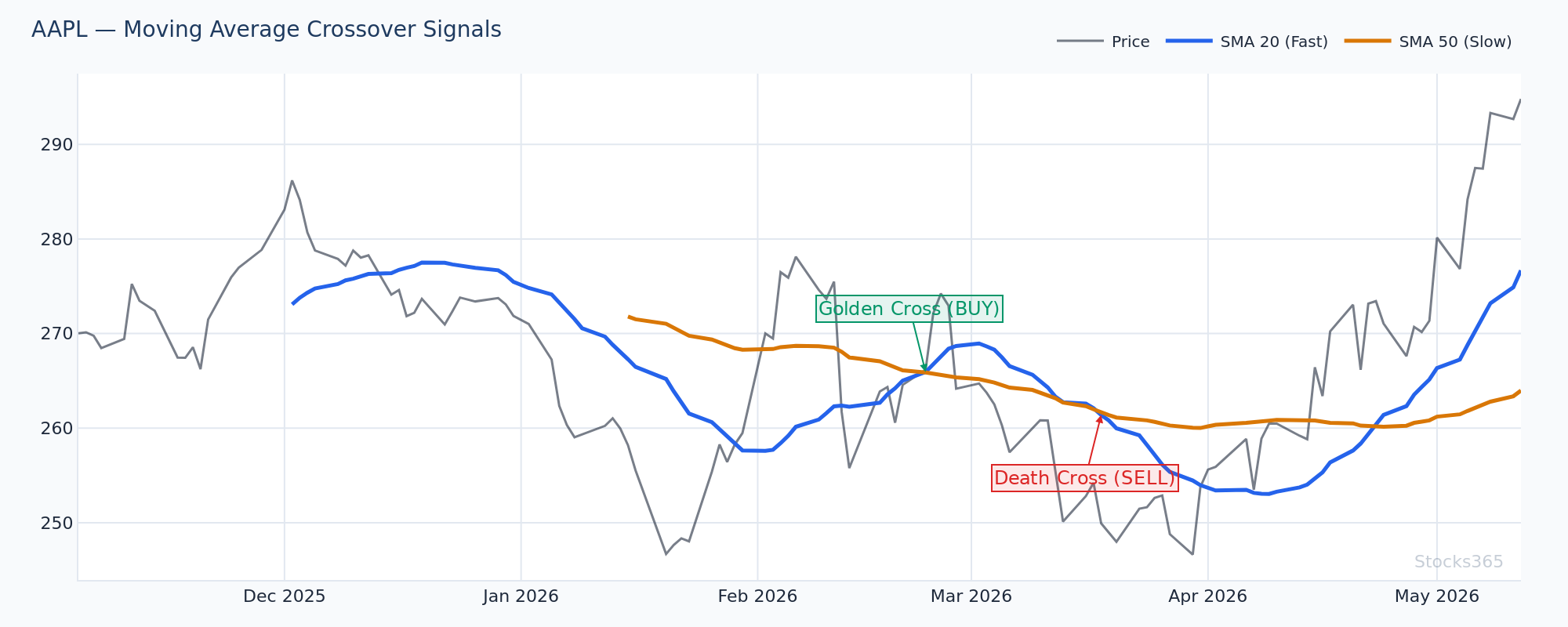
This chart highlights how price interacts with the 20-SMA over multiple cycles. Notice how clean crossovers during trending phases produce follow-through, while crossovers during sideways consolidation generate noise. What confirms the setup: a close above the SMA with expanding volume. What invalidates it: price crossing back below within one to two candles.
What Backtesting a Moving Average Strategy Actually Means
Let's define this precisely. Backtesting means applying a fixed set of rules to historical data and measuring every trade outcome that would have occurred. For a moving average strategy, that typically means:
- Entry rule: Price crosses above or below a moving average (e.g., 20-SMA, 50-EMA)
- Exit rule: A fixed holding period, a reverse crossover, or a trailing stop
- Universe: Which assets — stocks, forex, crypto, futures
- Timeframe: Daily, hourly, 15-minute
- Metric targets: Win rate, profit factor, max drawdown, Sharpe ratio
Every one of these choices changes the results dramatically. This is the part beginners skip. They test one combination, see a mediocre result, and abandon the strategy entirely — or worse, see a strong result on a single stock and assume it works everywhere.
The Metrics That Actually Matter
Win rate is seductive but misleading. A strategy with a 40% win rate and a 3:1 reward-to-risk ratio outperforms a 70% win rate strategy with a 0.5:1 ratio every single time. Focus on these four metrics together:
- Win Rate: Percentage of trades that close profitable
- Profit Factor: Gross profit divided by gross loss — above 1.5 is solid, above 2.0 is exceptional
- Max Drawdown: Largest peak-to-trough equity decline — this is what tests your psychology
- Expectancy: Average dollar gained or lost per trade — the real bottom line
Ignore any one of these and your backtest will mislead you.
Step-by-Step: How to Backtest a Moving Average Strategy
Step 1 — Define Your Rules with Zero Ambiguity
Vague rules produce meaningless results. "Buy when price is above the moving average" is not a rule. This is a rule: "Enter long on the daily close when price crosses above the 20-SMA, provided the 20-SMA is itself sloping upward over the past five sessions. Exit after 10 trading days or when price closes below the 20-SMA, whichever comes first."
Write your rules in plain language. Then translate them into a checklist. If a human can't apply them consistently without judgment calls, an algorithm definitely can't.
Step 2 — Choose Your Data Source and Timeframe
Bad data produces bad backtests. Use adjusted price data that accounts for dividends and splits — otherwise your crossover signals will be distorted by artificial price gaps. For forex, use bid/ask spread data if available; the spread matters significantly at shorter timeframes.
The daily timeframe is the best starting point for most moving average strategies. It's liquid, well-documented, and avoids the microstructure noise that corrupts intraday backtests. Once you validate a concept on daily data, you can explore lower timeframes with realistic expectations.
Step 3 — Select Your Moving Average Type and Period
There are three primary types worth testing:
- Simple Moving Average (SMA): Equal weight to all periods. Slower to react, fewer false signals in ranging markets.
- Exponential Moving Average (EMA): More weight on recent prices. Faster signals, more whipsaws in choppy conditions.
- Weighted Moving Average (WMA): Linear weighting toward recent data. Sits between SMA and EMA in responsiveness.
For a deep dive into combining multiple moving averages to filter signals, the Triple Moving Average Strategy for Trend Confirmation outlines a structured approach that significantly reduces noise compared to single-MA systems.
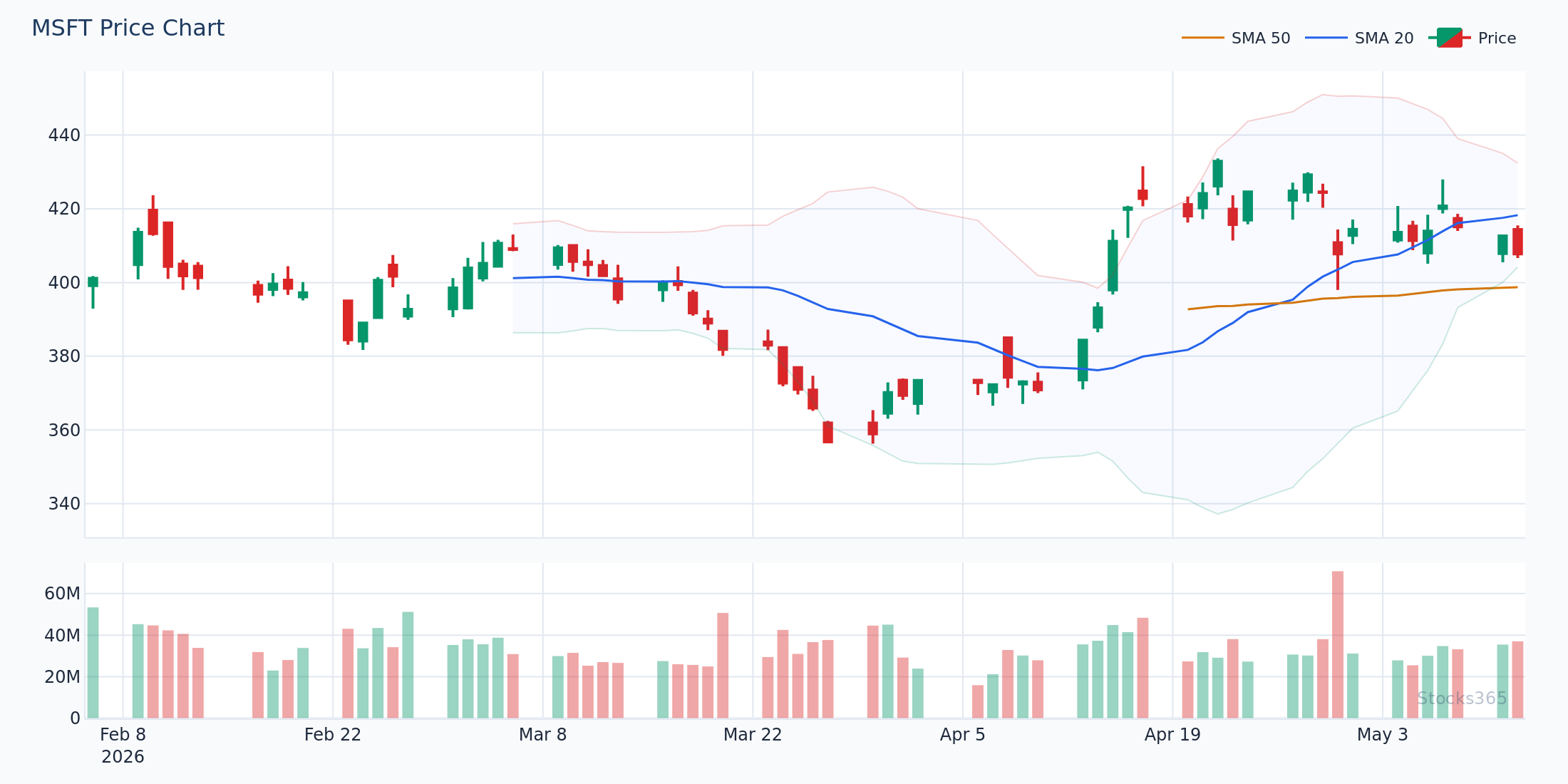
This side-by-side view shows how EMA reacts faster during the early stages of a trend move, generating earlier entries. However, during the consolidation phase in the middle of the chart, the EMA produces two false crossovers where the SMA holds clean. The confirmation signal: a second candle closing beyond the crossover level with volume above the 20-day average. Invalidation: immediate reversal back inside the prior candle's body.
Step 4 — Run the Backtest Across Sufficient Sample Size
Thirty trades is not a backtest. It's a coin flip with extra steps. You need at minimum 200 to 300 signals to draw statistically meaningful conclusions — and ideally 1,000 or more across multiple market regimes (trending up, trending down, ranging, high volatility, low volatility).
This is exactly why our research dashboard runs systematic sweeps across thousands of signals rather than cherry-picked examples. Patterns that work on 50 trades often collapse at scale.
Our analysis of 3,332 signals for the Price Crosses Below SMA 20 setup shows a 50.9% win rate with a profit factor of 1.06 over a 10-day holding period. That's a real edge — small, but real. The asset class breakdown is where it gets interesting: crypto delivered a 66.8% win rate on that same signal, while forex came in at just 42.5%. Same indicator, same rule, wildly different results depending on where you apply it.
Step 5 — Analyze Results and Identify Failure Conditions
A backtest isn't done when you get a win rate. It starts there. Dig into the losing trades. Are they clustered in specific market conditions? Do they occur predominantly during earnings seasons, low-volume periods, or news events? Are the losses larger than the wins on average?
Pattern recognition in your losers is as valuable as pattern recognition on your chart.
Here's What Most Traders Get Wrong
Most traders treat a moving average crossover as a complete strategy. It isn't. A crossover is a signal. A strategy is a crossover plus defined context, plus an entry trigger, plus a position size rule, plus an exit plan. When traders backtest just the crossover and see a mediocre profit factor of 1.0 or 1.1, they assume moving averages don't work. But our data tells a more specific story: the SMA 20 crossover below has a 50.9% win rate overall — and a 66.8% win rate in crypto specifically. The failure isn't the indicator. It's the lack of asset-class filtering.
Apply your rules everywhere and the edge dissolves. Apply them where the data says they work, and the edge sharpens dramatically.
Common Moving Average Strategies Worth Backtesting
The Golden Cross and Death Cross
The 50-SMA crossing above the 200-SMA (Golden Cross) or below it (Death Cross) is one of the most widely followed signals in markets. Because it's so widely watched, it often becomes self-fulfilling on major indices. On individual stocks or smaller crypto assets, the signal tends to lag significantly — by the time the cross occurs, much of the move has already happened.
Backtest it. Don't assume it works because financial media covers it.
Price vs. Single SMA as Trend Filter
One of the cleanest applications: use the 20-SMA or 50-SMA purely as a trend filter, not a direct trade signal. Only take long setups from other indicators when price is above the SMA. Only take short setups when price is below. This combines well with momentum indicators — the RSI step-by-step guide covers exactly how to layer RSI signals with trend-defining moving averages for higher-probability entries.
Moving Average Envelope Strategies
Envelopes plot percentage bands above and below a moving average. When price reaches the upper envelope after extended trending, it can signal overextension. When it tags the lower envelope during an uptrend, it often marks a pullback entry. These work best in trending markets with clear directional bias — in ranging environments, price oscillates between the bands without follow-through.
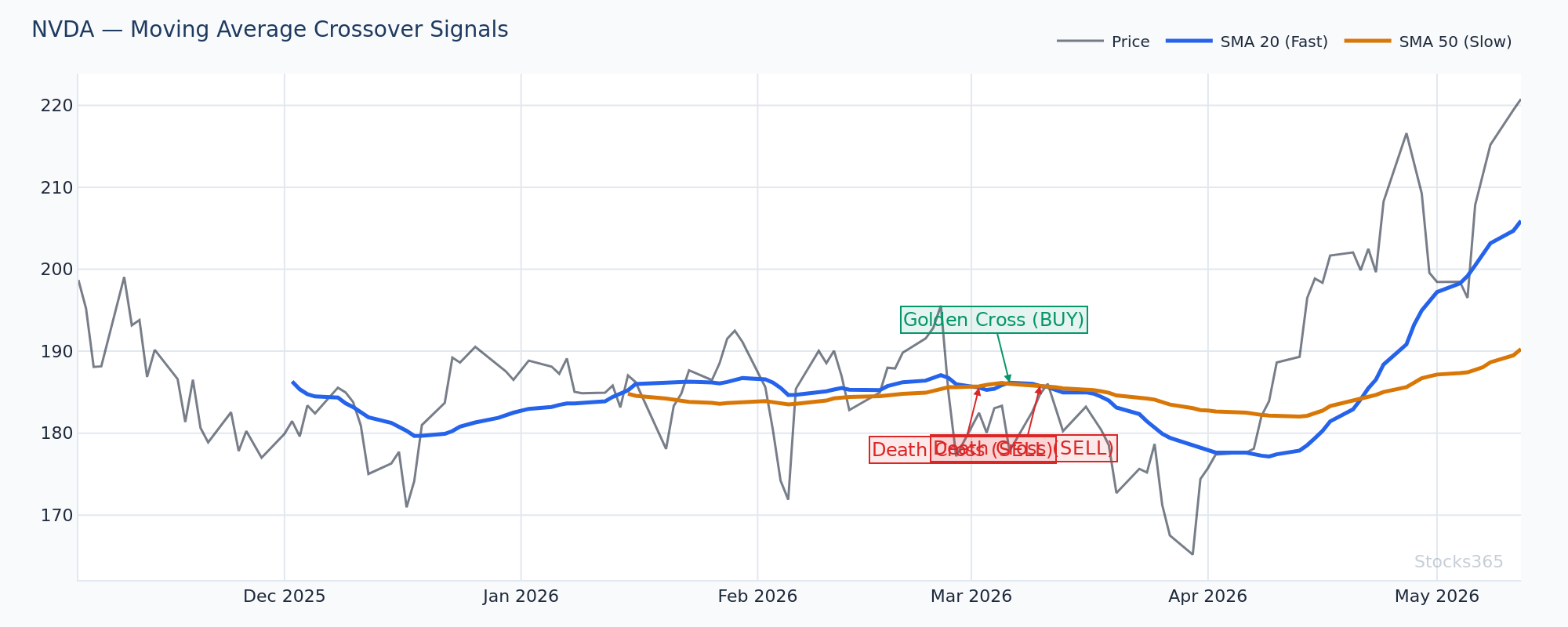
This chart demonstrates how NVDA interacts with both the 20-SMA and 50-SMA during trend phases. When both averages slope upward and price pulls back to touch the 20-SMA without breaking the 50-SMA, that's the highest-probability long re-entry zone in the backtest data. Confirmation: price bounces off the 20-SMA and closes the next candle above it. Invalidation: a daily close below the 50-SMA on above-average volume.
Moving Average Crossover With Momentum Confirmation
Raw crossovers generate noise. Adding a momentum filter cuts false signals dramatically. The approach: require the MACD histogram to be positive (or turning positive) at the time of a bullish SMA crossover before entering. For forex traders specifically, MACD in Forex Trading breaks down how this confirmation layer performs across major currency pairs — the results differ significantly from equities.
Optimizing Without Overfitting
This is the trap that ruins more backtests than any other mistake. Curve fitting — tuning parameters until historical results look perfect — produces strategies that fail immediately on live data. The backtest looks incredible. The live account bleeds.
Two disciplines prevent this:
- Out-of-sample testing: Backtest on 70% of your data. Test the "optimized" parameters on the remaining 30% without touching them. If performance collapses, you've overfit.
- Walk-forward analysis: Roll your optimization window forward in time, re-optimizing periodically. This simulates how a real strategy degrades and requires maintenance.
Robust strategies show consistent (if imperfect) results across different periods and different asset classes. Fragile strategies look perfect on the data you trained them on and nowhere else.
The Role of Market Regime in Moving Average Performance
Moving averages are trend-following tools. They are designed to perform in trending markets and designed to struggle in ranging markets. This is not a flaw — it's physics. A tool optimized for one condition will underperform in another.
The practical application: identify the current market regime before deploying a moving average strategy. Volatility-based regime filters (like the VIX for equities, or ATR percentile ranking) help determine whether conditions favor trend-following or mean-reversion approaches. When ATR is in the bottom quartile of its historical range, moving average crossovers produce significantly more false signals.
For a perspective on how RSI divergence can help identify regime shifts before they're obvious in price, Hidden RSI Divergence is worth reading alongside your moving average backtest work.
Backtesting Tools Available in 2026
The good news: backtesting is more accessible than ever. The bad news: accessible tools make it easy to get convincing-looking wrong answers.
- Python with pandas/backtrader/vectorbt: Full control, requires coding knowledge, handles large datasets efficiently
- TradingView Pine Script: Fast iteration, good for rule-based strategies, limited portfolio-level analysis
- Dedicated platforms (Amibroker, TradeStation, QuantConnect): Professional-grade, realistic fill simulation, walk-forward optimization built in
- Stocks365 signal tracking: The Stocks365 signals dashboard provides real-time signal performance data that complements your own backtesting, showing how signals perform across live market conditions — not just historical simulations
Choose your tool based on what you'll actually use consistently. The best backtesting tool is the one that doesn't collect dust.
Integrating Backtesting Into a Complete Trading Process
A backtest is the beginning of strategy development, not the end. After a robust backtest, the process continues:
- Paper trading: Validate the strategy in real-time conditions without financial risk for at least 30 signals
- Small live testing: Deploy minimum position sizes to experience execution, slippage, and psychology in real conditions
- Performance monitoring: Track live results against backtest expectations — significant deviation signals either regime change or implementation errors
- Periodic re-evaluation: Markets evolve. A moving average strategy that worked on a specific asset for three years may stop working as market structure changes
For traders building a complete technical toolkit around moving averages, understanding how complementary indicators like RSI are calculated from the ground up strengthens your ability to combine them intelligently. The RSI formula explained provides that foundation. Similarly, RSI settings optimization mirrors the same parameter-selection discipline you apply when choosing MA periods.
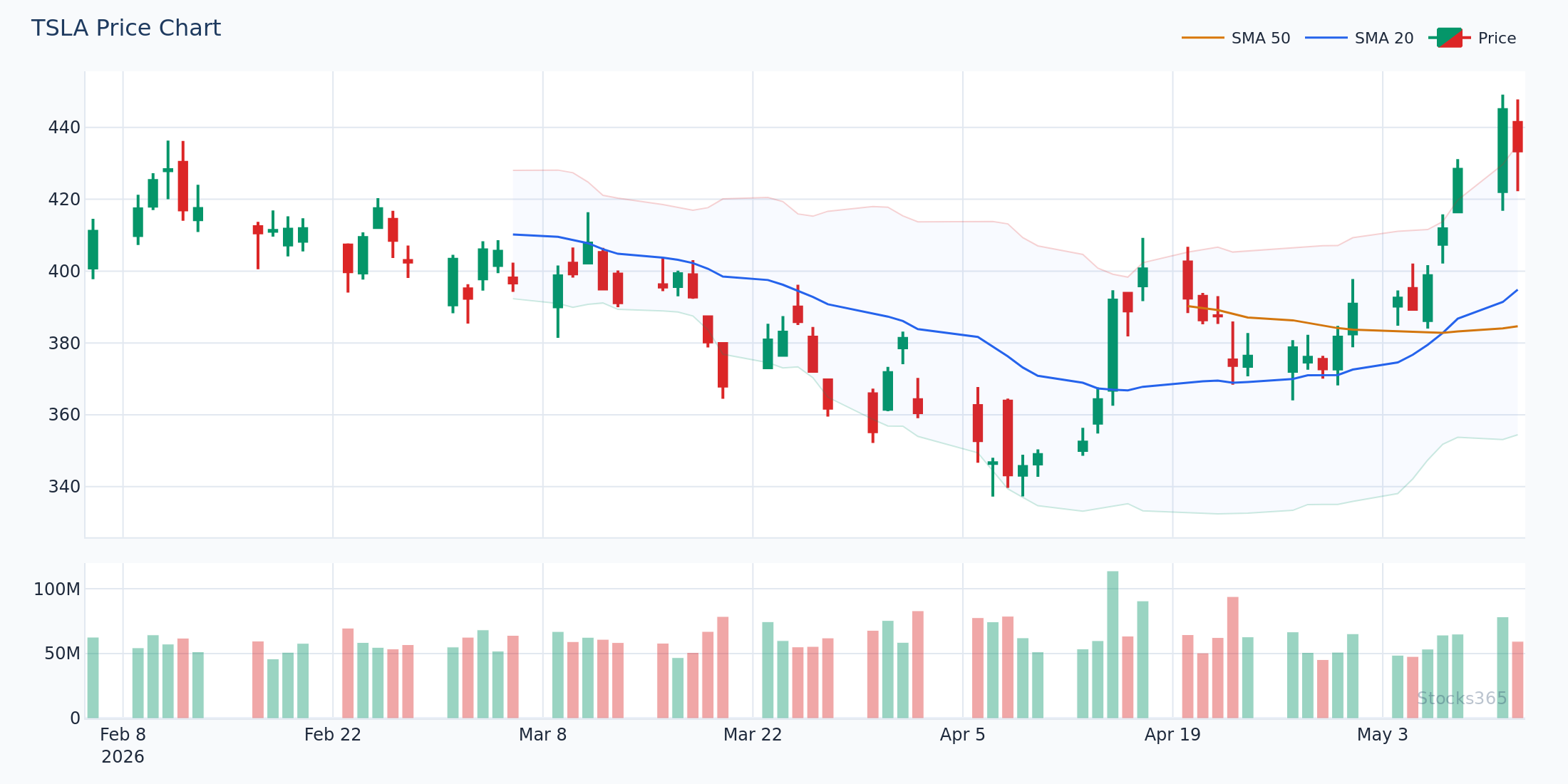
This chart maps TSLA's price through distinct trending and ranging phases, with 20-SMA crossover entry points marked. The clustering of profitable signals in the clearly trending phases (identifiable by sustained SMA slope and price staying consistently above or below the line) versus the losing signals during the choppy middle periods illustrates the regime-dependency of this strategy type. The takeaway: regime identification before entry, not after, is what separates a backtest that works in theory from a strategy that works in practice.
What to Watch For
- Watch for price reclaiming the 20-SMA after a multi-week downtrend in crypto assets — our backtest data shows this setup produces a 66.8% win rate on a 10-day forward-looking basis, significantly outperforming the same signal applied to forex pairs where the win rate drops to 42.5%.
- Watch for SMA slope direction alignment across multiple timeframes — when the 20-SMA on the daily and the 50-SMA on the weekly both slope in the same direction, moving average crossover signals on the daily have historically shown higher follow-through rates than when the timeframes are in conflict.
- Watch for moving average crossovers occurring alongside volume expansion of 1.5x or greater than the 20-day average — crossovers on below-average volume produce a disproportionate share of false breakouts in backtests across equities and crypto.
- Watch for the 20-SMA and 50-SMA compressing (narrowing gap between the two) — this squeeze pattern often precedes an accelerated directional move, and the subsequent crossover tends to generate stronger follow-through than a crossover during a period of already-wide separation between the averages.
- Watch for moving average crossover signals that align with RSI trendline breaks — the RSI Trendline Strategy outlines how combining these two signals significantly reduces false positives compared to either signal used in isolation.
How Stocks365 Uses This
How Stocks365 Integrates Moving Average Analysis Into Its Trust Score System
Moving average positioning is one of 12+ technical factors that feed into the Stocks365 Trust Score for every signal on the platform. Specifically, the MA component contributes to the trend regime score — a sub-index that assesses whether a given asset is in a trending or mean-reverting environment at the time a signal fires.
When a signal on AAPL or any other tracked asset appears on the signals dashboard, the trust score reflects whether price is above or below key moving averages, whether those averages are sloping in the direction of the trade, and whether multiple timeframe MA alignment supports or contradicts the signal direction. A signal that fires with full MA alignment across timeframes receives a higher regime contribution to its trust score than the same signal firing in a choppy, MA-conflicted environment.
Stocks365 backtested 3,332 Price Crosses Below SMA 20 setups and found a 50.9% win rate overall — but that aggregate number masks significant asset-class variation. The trust score system uses this kind of conditional performance data to weight signals differently based on the asset type and current market regime, giving traders a smarter filter than raw signal counts alone.
Key Takeaways
Summary: Backtesting Moving Average Strategies
- Backtesting transforms a moving average from a visual tool into a validated edge — or reveals it has no edge in your specific context
- Win rate alone is meaningless; profit factor, max drawdown, and expectancy together tell the real story
- Asset class selection matters more than parameter optimization: the same SMA 20 crossover produces 66.8% win rate in crypto and 42.5% in forex in Stocks365 backtested data
- Overfitting is the silent killer of backtests — always validate on out-of-sample data before trusting any result
- Market regime determines whether a moving average strategy will thrive or struggle; identify the regime first
- A backtest is the starting point, not the finish line — paper trading and small live testing complete the validation process
- Combining moving average signals with momentum indicators like RSI or MACD consistently reduces false signals in backtested data