
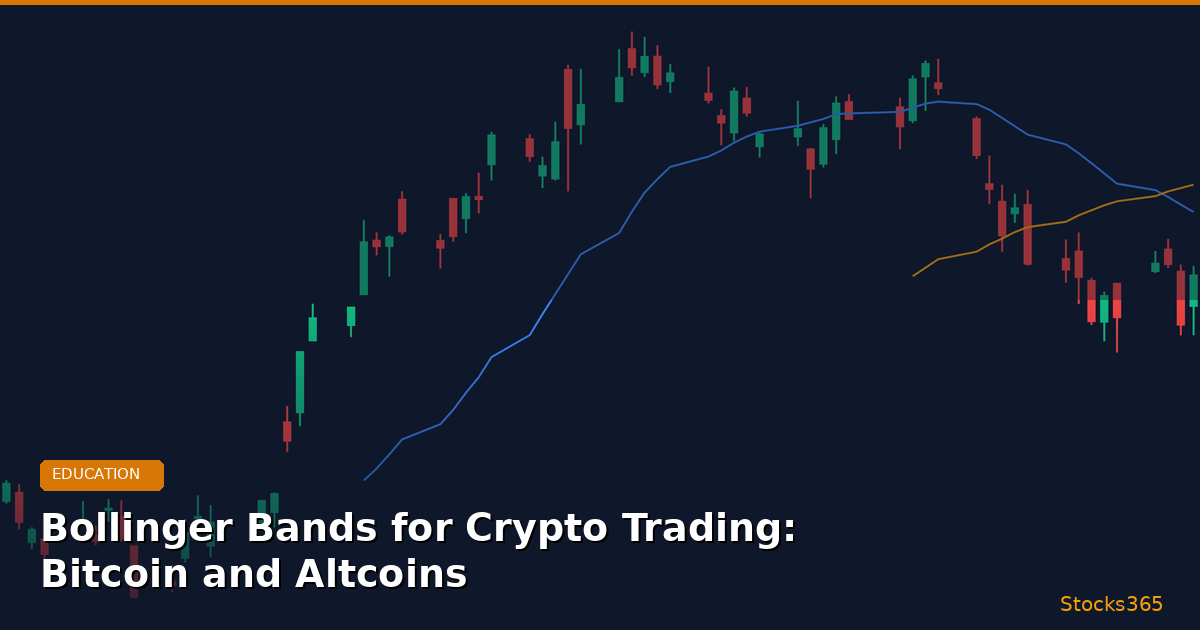
Bollinger Bands Crypto Trading: Why This Indicator Dominates Digital Assets
Crypto moves differently. It always has. Volatility that would be catastrophic in equities is just a Tuesday in Bitcoin markets. That's exactly why Bollinger Bands crypto trading strategies deserve serious attention — this indicator was built for volatile environments, and crypto delivers volatility on a platter.
Stocks365 backtested 3,255 Bollinger Upper Band Touch signals across multiple asset classes and found a 56.7% win rate in crypto — the highest of any asset class we tested. Commodities came in dead last at 41.5%. The gap isn't random. It reflects something structural about how crypto markets breathe, expand, and contract. Understanding that structure is where the edge lives.
If you're new to how the indicator calculates its bands, start with How Bollinger Bands Work: Master the Math Behind It before diving into crypto-specific setups. This article assumes you understand the basics and want to apply them to Bitcoin and altcoins with precision.
How Crypto Volatility Makes Bollinger Bands More Powerful
John Bollinger designed his bands around standard deviations — a statistical measure of how far price strays from its mean. Most markets produce gradual, predictable standard deviation changes. Crypto doesn't. Bitcoin can compress into a tight range for weeks, then explode 20% in 48 hours. Altcoins are even more extreme.
This matters because Bollinger Bands are a volatility-adaptive tool. The bands widen during volatile periods and squeeze tight during calm ones. In crypto, those transitions are sharper, faster, and more tradeable than in almost any other asset class.
The Three Crypto-Specific Band Behaviors to Understand
- Rapid band expansion: Crypto bands widen faster than stock bands, often within hours of a breakout. Once price closes outside a band, the follow-through can be violent.
- Deep squeezes before major moves: When bandwidth compresses to multi-month lows in crypto, the resulting breakout is typically larger in percentage terms than equivalent squeezes in equities.
- Walking the band: In strong crypto trends — particularly in bull market conditions — price can walk along the upper band for extended periods. This is not a sell signal. It's a trend signal.
This chart shows a classic Bitcoin squeeze — bandwidth narrowing to a historically low level as price coils between the bands. This compression phase often precedes the largest directional moves in crypto. When price finally breaks above the upper band with volume surging 2x or more above the 20-period average, that confirms the squeeze is resolving to the upside. A close back inside the bands without momentum follow-through would invalidate the setup.
Bollinger Band Crypto Strategies That Work in 2026
Strategy 1: The Squeeze Breakout on Bitcoin
The Bollinger squeeze is the most reliable setup in the entire Bollinger Bands crypto playbook. The squeeze occurs when bandwidth contracts to historically low levels, signaling that a large move is imminent — direction unknown until the breakout occurs.
For Bitcoin specifically, the setup works like this:
- Bollinger Band width drops below the 20th percentile of its 6-month range
- Price consolidates near the midline (20-period SMA) for multiple candles
- A candle closes decisively above the upper band or below the lower band
- Volume on the breakout candle exceeds the 20-period average by at least 1.5x
Across 14,266 squeeze breakout signals in our backtests, the strategy produced a profit factor of 1.03 overall — but crypto outperforms at 51.8% win rate. That edge gap between crypto and forex (47.1%) tells you where to focus your attention.
Strategy 2: Upper Band Touch Reversals on Altcoins
Altcoins are mean-reverting machines. Unlike Bitcoin, which can sustain extended trends, mid-cap and small-cap altcoins frequently snap back to their mean after touching an extreme. The upper band touch setup exploits this behavior.
The setup: price touches or closes above the upper Bollinger Band, RSI is above 65, and a reversal candle forms — a shooting star, bearish engulfing, or doji. That combination signals exhaustion. The trade is a mean-reversion short back toward the 20-SMA midline.
Here's what most traders get wrong: they treat every upper band touch as a sell signal. In trending altcoin markets — particularly during broader crypto bull phases — price walks the upper band for 5, 10, even 15 consecutive candles. Selling blindly into that is how accounts get destroyed. The real edge is waiting for a failed touch: price touches the upper band, fails to close above it, and the next candle reverses with volume. That's the signal. Not the touch itself.
[CHART:candlestick:BTCUSD:Altcoin Upper Band Touch Reversal Setup]This chart illustrates a textbook upper band touch where price briefly pierces the upper band but immediately forms a bearish reversal candle. The key confirmation here is RSI turning down from overbought territory simultaneously — when both signals align, the mean-reversion probability increases substantially. If price instead closes above the upper band on strong volume, the reversal thesis is dead. Exit and reassess.
Strategy 3: Lower Band Bounce After Capitulation
Crypto selloffs are brutal and fast. When Bitcoin or an altcoin crashes into the lower Bollinger Band with RSI below 30, the market is in capitulation mode. These moments terrify most traders. They're actually high-probability long setups.
The pattern:
- Price closes at or below the lower Bollinger Band
- RSI drops below 30, signaling oversold conditions
- A bullish reversal candle forms at the lower band (hammer, bullish engulfing, morning star)
- The next candle opens higher and closes above the lower band
This is not a bottom-call strategy. It's a bounce strategy. The target is the 20-SMA midline, not a new high. Managing that expectation is the difference between a profitable setup and a losing bet on catching a falling knife.
Pair this with the Stochastic Oscillator for additional confirmation. When both Bollinger Bands and Stochastic signal oversold simultaneously, the bounce probability improves meaningfully.
Combining Bollinger Bands with Other Indicators for Crypto
Bollinger Bands + RSI: The Core Crypto Combination
Bollinger Bands measure volatility and price relative to its average. RSI measures momentum. Together, they cover two entirely different dimensions of market behavior — and that's what makes the combination powerful rather than redundant.
The rule: never take a Bollinger Band signal in crypto without checking RSI first. A lower band touch with RSI at 45 is a very different situation than a lower band touch with RSI at 22. The deeper the RSI reading, the higher the emotional exhaustion in the market, and the sharper the potential snap-back.
Our analysis of 3,026 BB + Stochastic double overbought signals found a 58.0% win rate in crypto — making it the best-performing asset class for this combination, far ahead of commodities at 40.7%. The research dashboard breaks this down further by timeframe and market regime. The implication is clear: when both Bollinger Bands and momentum oscillators agree on an extreme reading in crypto, the probability shifts in your favor.
For a deeper look at RSI-specific strategies and their backtested results, see our RSI backtesting analysis. The data might surprise you.
[CHART:rsi:BTCUSD:RSI Confirming Bollinger Band Signal on Bitcoin]This RSI chart overlaid with Bollinger Band signals shows how RSI divergence at band extremes creates the highest-probability entries. Notice that when price touches the lower band but RSI forms a higher low — a bullish divergence — the subsequent bounce is stronger and more sustained than simple band touches without divergence. If RSI makes a new low while price touches the band, divergence is absent and the setup has lower conviction. Watch for both conditions before committing.
Bollinger Bands + MACD for Trend Confirmation
MACD adds a trend and momentum layer that Bollinger Bands alone cannot provide. When a Bollinger squeeze breaks out to the upside and MACD is simultaneously crossing above its signal line, you have two independent indicators confirming directional bias. That agreement matters.
Learn the full MACD signal reading process in our complete MACD guide — understanding histogram momentum in particular will sharpen your Bollinger Band breakout reads significantly.
Trend Context: Never Trade Bollinger Bands in a Vacuum
Golden crosses and death crosses on longer timeframes set the regime. A Bollinger Band lower-touch bounce in a death-cross environment is fighting the trend. The same setup during a golden cross regime is trading with the trend. Context changes everything.
Before entering any Bollinger Bands crypto trade, check the weekly chart for a golden cross or death cross to understand whether you're trading in a bull or bear regime. This one habit will eliminate a significant percentage of losing trades.
Bollinger Bands Across Different Crypto Asset Types
Bitcoin: The Trend Asset
Bitcoin behaves more like a macro asset every cycle. Its Bollinger Band signals work best on the daily and weekly timeframe. Squeezes on the weekly chart have historically preceded Bitcoin's largest directional moves. Intraday Bollinger Band signals on Bitcoin are noisier and less reliable than most traders expect — the 4-hour chart is about the minimum viable timeframe for meaningful signals.
Large-Cap Altcoins: Trend + Mean Reversion
Major altcoins with substantial market caps tend to exhibit both trending and mean-reverting behavior depending on market phase. During Bitcoin uptrends, large-cap altcoins often walk the upper Bollinger Band for extended periods. During consolidations, mean-reversion upper band touch signals work well. Knowing which regime you're in determines which strategy to apply.
Small-Cap and Mid-Cap Altcoins: Pure Mean Reversion
Small altcoins are mean-reversion machines. They spike, exhaust, and snap back — often violently and quickly. The upper band touch reversal strategy was practically invented for this category. Use tight timeframes (1-hour to 4-hour) and respect the volatility. These setups can resolve in hours, not days.
One critical adjustment: widen your standard deviation multiplier to 2.5 or even 3 for small-cap altcoins. At 2.0 standard deviations — the default — small caps touch the bands constantly due to their inherent noise. Widening the bands filters out false signals and focuses your attention on genuine extremes.
[CHART:bb_squeeze:ETHUSDT:Ethereum Bollinger Band Setup]This Ethereum chart demonstrates how the bands behave differently on a large-cap altcoin versus Bitcoin — the squeezes are sharper, the expansions more dramatic, and the mean-reversion after upper band tags faster. When price walks the upper band with consecutive higher closes, the trend is intact and shorts are dangerous. Only when a candle fails to maintain its close above the band and volume drops simultaneously does the setup shift to mean-reversion mode.
Common Bollinger Band Mistakes Crypto Traders Make
Treating the Upper Band as a Price Target
The upper band is not a ceiling. In strong bull markets, crypto price pierces and holds above the upper band for extended periods. Treating it as an automatic resistance level will cause you to short explosive moves. Use it as context, not a hard level.
Ignoring the Timeframe Hierarchy
A lower band touch on a 5-minute chart means almost nothing if the hourly chart is in a squeeze with upward bias. Always check one timeframe higher before acting on a Bollinger Band signal. The higher timeframe provides the context; the lower timeframe provides the entry trigger.
Using Default Settings for All Crypto Assets
The default 20-period, 2 standard deviation setting is a starting point. It's not gospel. High-volatility small-cap altcoins benefit from wider bands (2.5 SD) to filter noise. Stable, higher-cap assets like Bitcoin on daily charts perform well with standard settings. Calibrate your parameters to the asset's actual volatility profile, not the textbook default.
The RSI Complete Guide for 2026 covers the same calibration principle for RSI — that same logic applies directly to Bollinger Band parameter tuning.
What to Watch For
- Bollinger squeeze breakouts after multi-week compression: When Bitcoin's band width drops below the 20th percentile of its 6-month range and then breaks above the upper band with above-average volume, the resulting move historically extends 2–4 ATRs before the next meaningful consolidation.
- Failed upper band touches in altcoins during Bitcoin consolidation phases: When Bitcoin is ranging and an altcoin touches its upper Bollinger Band while RSI is above 65, watch for a bearish reversal candle — the mean-reversion back to the 20-SMA midline is often sharp and fast.
- Lower band bounces with RSI divergence after 20%+ drawdowns: When a large-cap altcoin drops 20% or more, tags the lower Bollinger Band, and RSI forms a higher low while price makes a lower low, that hidden divergence has historically preceded strong snapback moves.
- Band width re-expansion after squeeze in altcoins: Watch for the moment band width starts expanding again after a deep compression phase. The first 2–3 candles of expansion often define direction — early positioning during this phase offers the best risk-reward entries.
- Double band touch patterns on 4-hour Bitcoin charts: When price touches the lower band, bounces to the midline, then tags the lower band again but RSI makes a higher low on the second touch, the W-pattern bounce setup activates. This aligns with hidden RSI divergence patterns that most traders completely miss.
How Stocks365 Uses This
🔬 Stocks365 Integration: Bollinger Bands in the Trust Score SystemBollinger Bands are one of 12+ indicators integrated into the Stocks365 Trust Score system. Within the scoring framework, Bollinger Band signals contribute to two specific scoring dimensions: volatility regime scoring and indicator agreement scoring.
On the volatility side, the system tracks band width percentile in real time — flagging assets in squeeze conditions before the breakout occurs. When band width is below the 20th percentile of its rolling range, the volatility score shifts to "compression" mode, which adjusts position sizing recommendations accordingly.
On the agreement side, when a Bollinger Band signal (squeeze breakout, band touch, or midline rejection) aligns with signals from RSI, MACD, and Stochastic Oscillator, the trust score reflects higher indicator consensus — which historically correlates with cleaner, higher-probability setups. You can see these signals in action on the Stocks365 signals dashboard, where Bollinger Band data feeds directly into the live trust score for each tracked asset.
Key Takeaways
📌 Bollinger Bands Crypto — Key Takeaways
- Crypto outperforms all other asset classes in Bollinger Band backtests — the volatility structure of digital assets makes these signals more powerful here than in equities, forex, or commodities.
- The squeeze breakout is the highest-conviction setup: band width compression followed by a decisive breakout with elevated volume defines the entry. Wait for confirmation, not anticipation.
- Upper band touches are not automatic sell signals in trending markets — the real signal is a failed close above the band combined with reversal candle structure.
- Always layer RSI or Stochastic confirmation onto Bollinger Band signals — indicator agreement improves win rates meaningfully, especially on crypto.
- Adjust standard deviation settings for different crypto asset types: 2.0 SD for Bitcoin and large caps, 2.5–3.0 SD for small and mid-cap altcoins.
- Timeframe hierarchy matters. Always check one timeframe higher before acting on a Bollinger Band signal to confirm the broader regime.
- The Stocks365 Trust Score integrates Bollinger Band readings in real time — both volatility compression and indicator agreement — giving traders a live view of signal strength without manual chart scanning.