
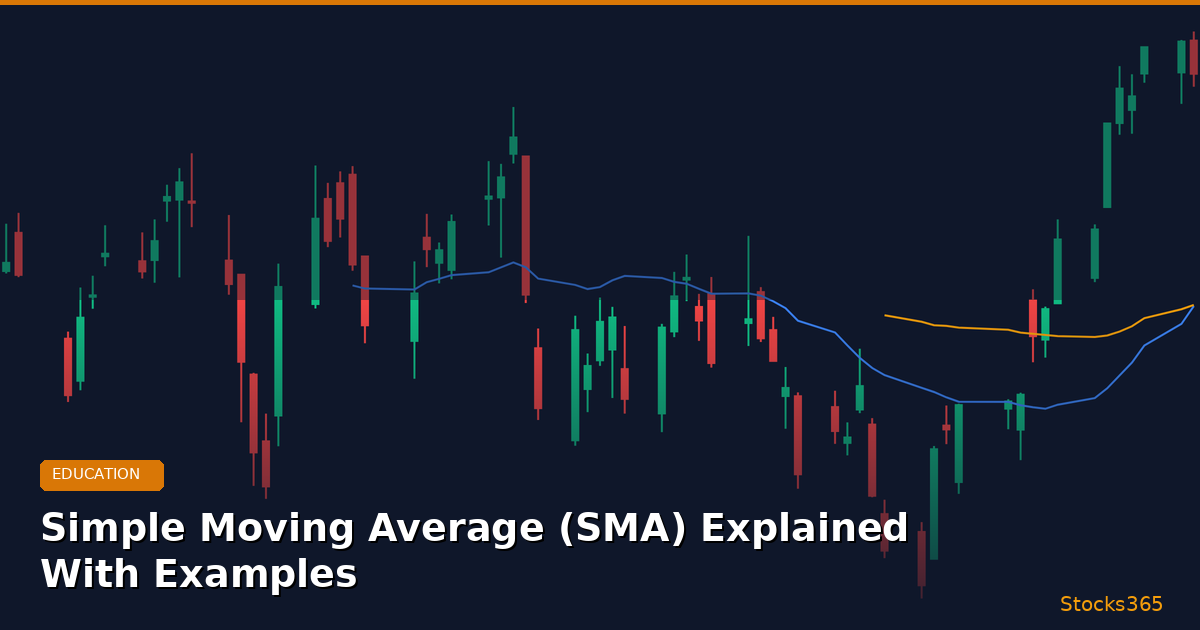
What Is a Simple Moving Average (SMA)?
The simple moving average is one of the most widely used tools in technical analysis. It smooths out price data by calculating the arithmetic mean of a set number of closing prices over a defined period. The result is a single line on your chart that filters out short-term noise and reveals the underlying trend direction.
Simple. Powerful. Often underestimated.
Unlike oscillators that measure momentum or volume indicators that track participation, the SMA is purely price-based. It answers one question: where has price averaged over a given window of time? That single answer drives an enormous number of trading decisions every day across stocks, crypto, forex, and futures.
How to Calculate the Simple Moving Average
The SMA formula is straightforward. Add together the closing prices for a chosen number of periods, then divide by that number of periods.
SMA Formula: SMA = (P1 + P2 + P3 + ... + Pn) ÷ n
Where P = closing price and n = number of periods
For a 10-period SMA, you sum the last 10 closing prices and divide by 10. Each new candle, the oldest price drops off and the newest price enters. The average rolls forward — hence the name moving average.
SMA Calculation Example
Imagine a stock closes over five consecutive days at relative values of 100, 103, 101, 107, and 105. The 5-day SMA equals (100 + 103 + 101 + 107 + 105) ÷ 5 = 103.2. On day six, if price closes at 110, the oldest value (100) drops off and the new SMA becomes (103 + 101 + 107 + 105 + 110) ÷ 5 = 105.2. The line moves with price, always trailing behind by design.
That lag is intentional — and it's also the SMA's biggest limitation. More on that shortly.
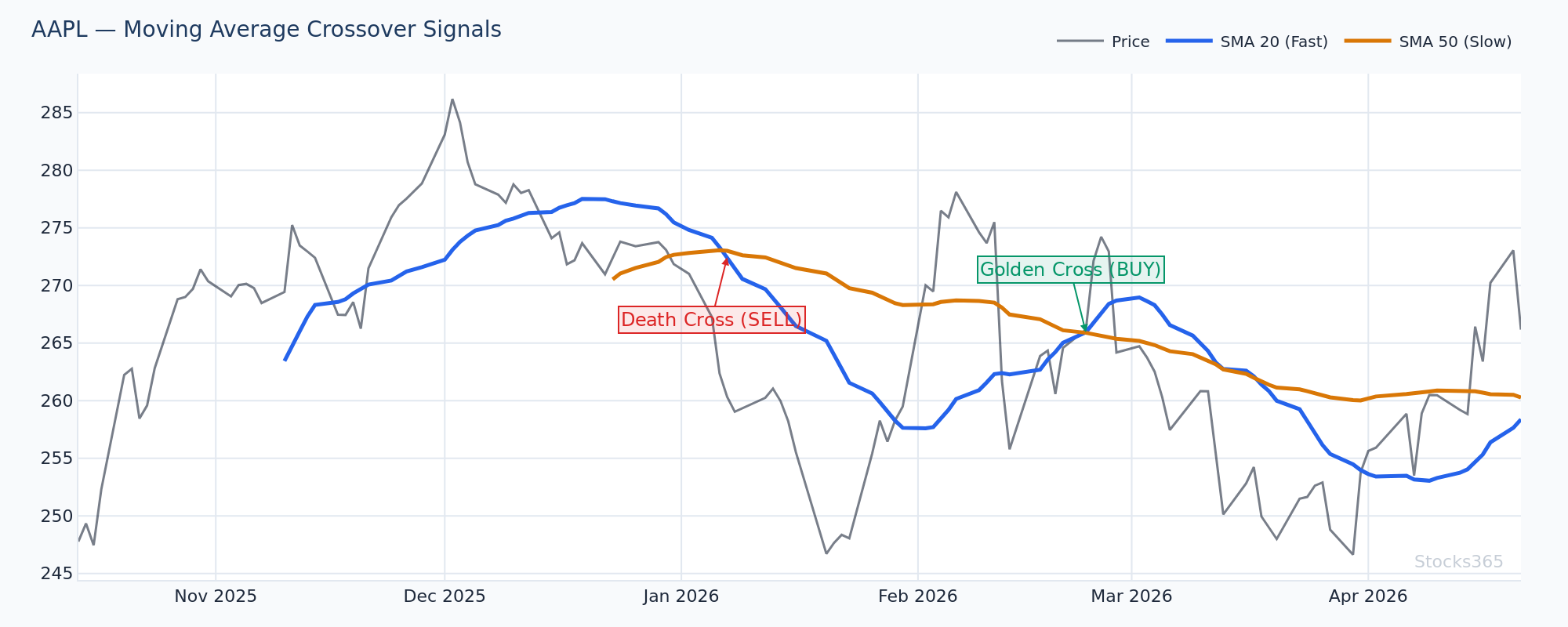
This chart shows the 20-SMA and 50-SMA plotted together on a daily timeframe. When the 20-SMA curves upward and trades cleanly above the 50-SMA, price typically continues in the direction of the dominant trend. A crossover — where the faster line crosses through the slower — signals a potential regime change. Confirmation comes from expanding volume and a close beyond the crossover candle's high.
Common SMA Periods and What They Mean
Not all SMAs are created equal. The period you choose changes everything about how the indicator behaves and what signals it generates.
- SMA 9 / SMA 10: Ultra-short-term. Used by intraday and swing traders to catch fast momentum moves. Extremely sensitive — generates many signals, many of them false.
- SMA 20: The workhorse. Represents roughly one calendar month of trading days. Widely watched by retail and institutional traders alike. Acts as dynamic support in uptrends and dynamic resistance in downtrends.
- SMA 50: Medium-term trend gauge. A close below the 50-SMA on rising volume is a meaningful warning signal. Many institutional algorithms reference this level.
- SMA 100: Intermediate. Less commonly discussed but useful as a mid-zone between the 50 and 200.
- SMA 200: The long-term benchmark. A stock trading above its 200-SMA is in a structural uptrend. Below it, structural downtrend. Crossovers of the 50-SMA through the 200-SMA produce the famous golden cross and death cross signals.
How Traders Use the Simple Moving Average
1. Trend Identification
The most fundamental use of the SMA is determining trend direction. Price consistently closing above a rising SMA = bullish trend. Price consistently closing below a falling SMA = bearish trend. Simple. No interpretation required.
Traders stack multiple SMAs — typically the 20, 50, and 200 — to gauge trend strength across multiple timeframes simultaneously. When all three slope in the same direction and price trades above all three, the trend is strong. When they begin to tangle, the trend is weakening.
2. Dynamic Support and Resistance
In trending markets, key SMAs act as dynamic support and resistance levels. Price doesn't just bounce off horizontal levels drawn with a ruler. It bounces off moving averages too — because so many participants are watching the same lines and reacting at the same zones.
A pullback to the 20-SMA in a strong uptrend is a textbook entry setup. Price dips to the moving average, volume dries up, a reversal candle forms, and buyers step in. The SMA becomes the floor.
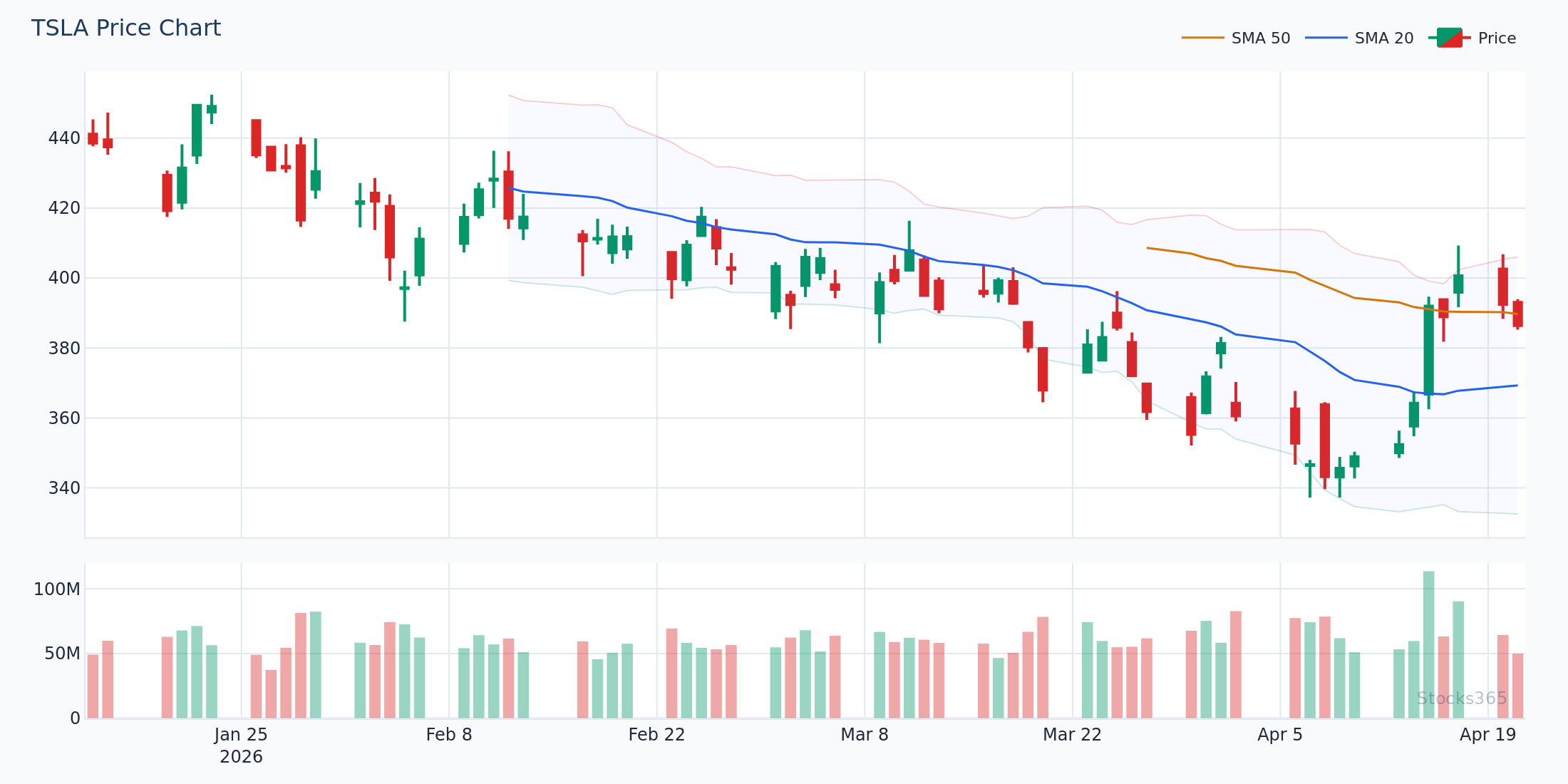
This setup shows price in a sustained uptrend pulling back to touch the 20-SMA before resuming higher. The key signal is the low-volume contraction into the moving average followed by a reversal candle with a long lower wick. What invalidates this pattern is a daily close below the 20-SMA on elevated volume — that breaks the dynamic support and changes the short-term bias.
3. SMA Crossover Signals
SMA crossovers occur when a shorter-period moving average crosses a longer-period moving average. The two most widely traded are:
- Golden Cross: The 50-SMA crosses above the 200-SMA. Bullish long-term signal. Generates significant media coverage and institutional attention.
- Death Cross: The 50-SMA crosses below the 200-SMA. Bearish long-term signal. Often seen after extended downtrends are already underway — the SMA confirms rather than predicts.
Shorter-term crossovers — like the 9-SMA crossing the 20-SMA — are popular among swing traders for faster signals with more frequency. The trade-off is more whipsaws.
4. Price-to-SMA Relationship
How far price has stretched away from its SMA matters. When price runs far above a key moving average, it becomes statistically extended and vulnerable to a mean reversion pullback. When price crashes far below, the opposite applies. This concept — measuring the distance between price and its SMA — underpins many mean reversion strategies.
Here's What Most Traders Get Wrong About the SMA
Most beginners treat a price cross below the 20-SMA as an automatic sell signal. The moment price dips under that line, they exit or short. Here's the problem: in strong uptrends, price regularly dips below the 20-SMA for one or two candles before violently reversing higher. Those who sold get trapped on the wrong side of a perfectly healthy trend.
The real signal isn't the cross — it's what happens after the cross. A one-candle dip below the 20-SMA on light volume in a bull trend is noise. A multi-day close below the 20-SMA with expanding volume and a failed retest from below? That's a signal. Context separates the trades that work from the ones that don't.
Lag is real. Accept it. Work with it.
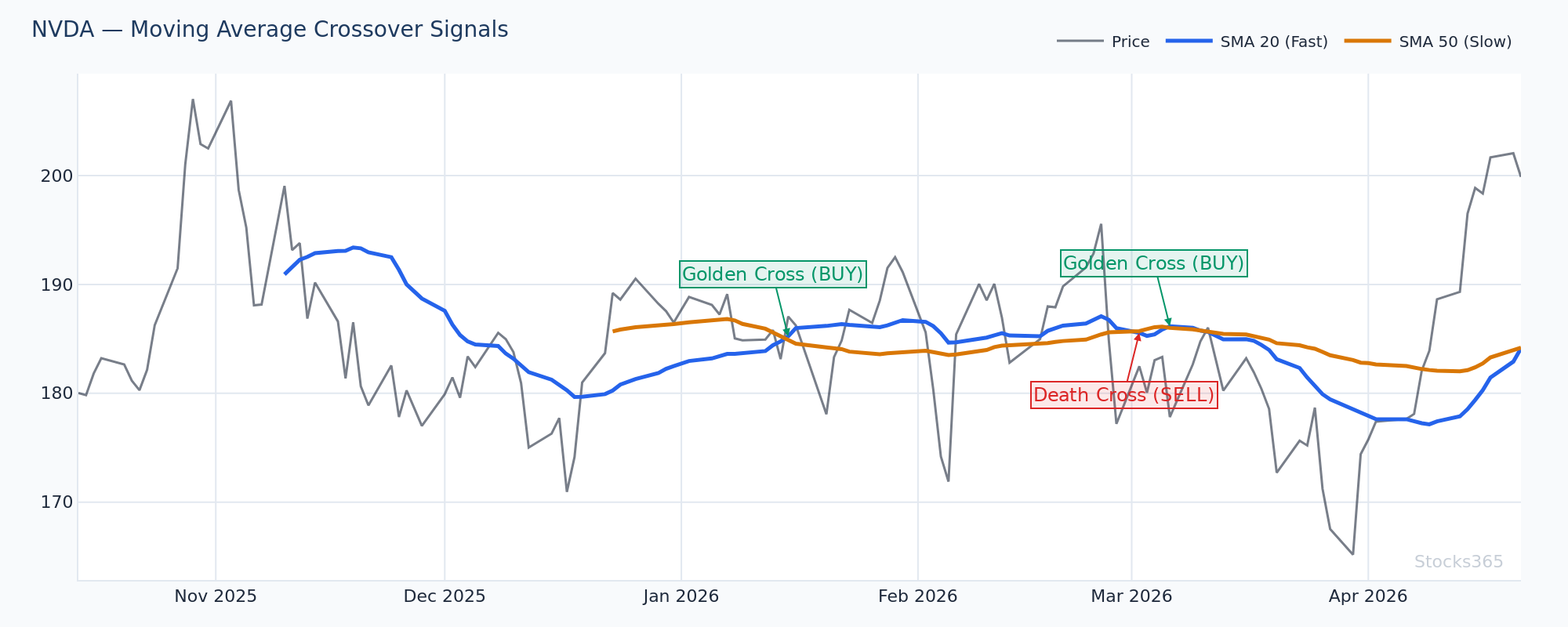
This chart highlights the 9-SMA crossing the 20-SMA in both directions during a volatile period. Notice how some crossovers produce strong directional follow-through while others reverse immediately — the whipsaw trades. What differentiates them is volume context and whether the broader trend (as defined by the 50-SMA direction) aligns with the crossover signal.
SMA vs EMA: What's the Difference?
The exponential moving average (EMA) applies more weight to recent prices, making it faster to respond to new price action. The SMA weights all periods equally, making it smoother but slower.
Neither is superior. They serve different purposes.
Day traders and momentum traders typically prefer the EMA because it reacts faster, giving earlier signals. Swing traders and position traders often prefer the SMA because its signals are cleaner and less susceptible to intraday noise. Many professional systems use both simultaneously — the EMA for entries and the SMA for trend context.
Combining SMA With Other Indicators
The SMA doesn't work in isolation. The most reliable setups combine it with at least one confirming indicator.
SMA + RSI
Pairing the SMA with the Relative Strength Index (RSI) produces high-quality setups. When price pulls back to the 20-SMA in an uptrend and RSI simultaneously drops to the 40-50 zone without breaking oversold levels, the alignment signals a healthy trend continuation. The RSI confirms that momentum hasn't been destroyed — it's just resting.
For a deeper look at how RSI calculates and what those levels actually mean, read our full guide on how RSI is calculated and our complete beginner's guide to RSI. Understanding RSI alongside the SMA significantly sharpens your read on trend quality.
Want to know how to apply RSI practically alongside trend tools like the SMA? The ultimate step-by-step guide to using RSI in trading covers exactly that.
SMA + Volume
Volume is the SMA's best friend. A price break above the 50-SMA accompanied by a volume surge of 1.5x to 2x average is far more credible than a break on thin, below-average volume. Always check volume when evaluating SMA breakouts or breakdowns.
SMA + RSI Divergence
RSI divergence against a key SMA level creates some of the highest-probability reversal setups available. When price retests the 200-SMA from above while RSI prints a higher low (bullish divergence), the combination of structural support and momentum shift is powerful. Read our full breakdown of RSI divergence signals to understand how to layer this on top of your SMA analysis.
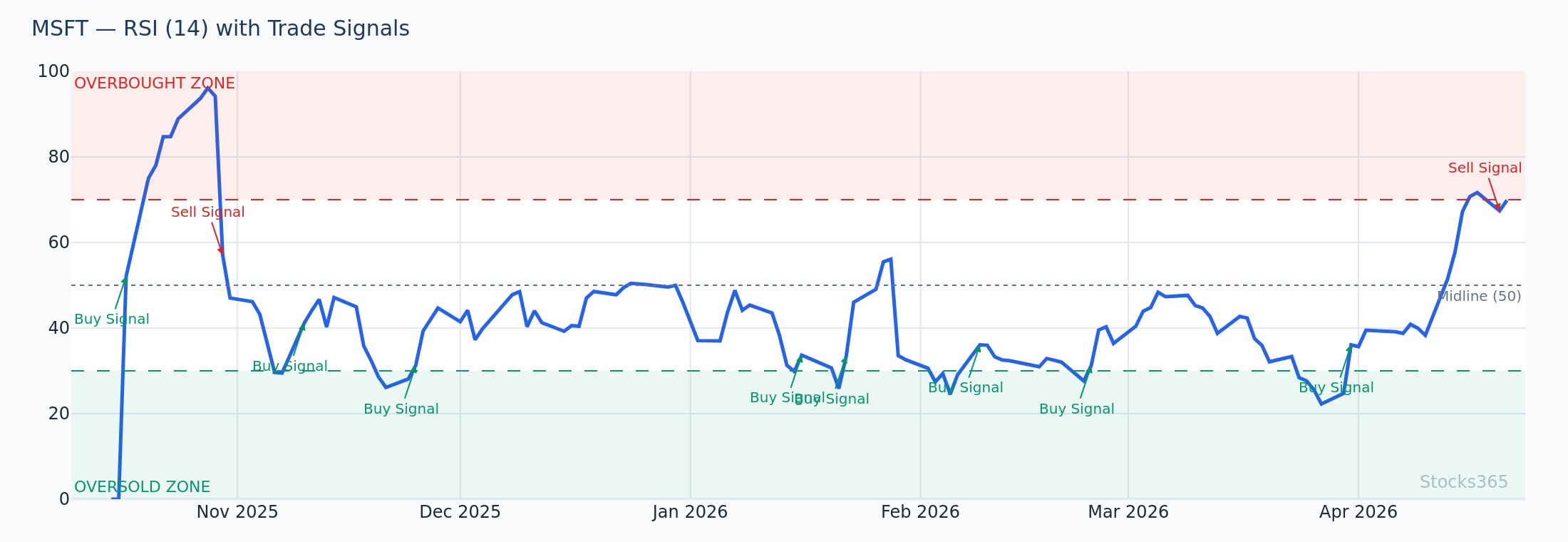
This chart shows RSI holding above 50 while price pulls back to the 20-SMA — a classic trend continuation signal. The RSI holding above the midline while price tests the moving average confirms that underlying buying pressure remains intact. The setup fails if RSI breaks below 40 and price closes beneath the 20-SMA with conviction.
Real-World SMA Trading Setups
Setup 1: The Moving Average Bounce
In a confirmed uptrend (price above rising 50-SMA and 200-SMA), wait for price to pull back and touch the 20-SMA. Look for a bullish reversal candle — a hammer, engulfing candle, or doji — forming at the moving average on declining volume. Enter on the break of the reversal candle's high. The invalidation is a close below the 20-SMA on above-average volume.
Setup 2: The Golden Cross Entry
When the 50-SMA crosses above the 200-SMA (golden cross), don't chase the breakout immediately. Wait for the first meaningful pullback after the cross — ideally back toward the newly risen 50-SMA — and look for a low-volume consolidation followed by a reclaim of the prior swing high. This entry gives a tighter risk point than buying the initial crossover candle.
Setup 3: The 20-SMA Rejection Short
In a confirmed downtrend (price below falling 50-SMA and 200-SMA), price rallies up to retest the 20-SMA from below. The moving average acts as resistance. When you see a bearish reversal candle forming at the 20-SMA rejection zone — especially with RSI approaching the 50-60 range without breaking through — the setup favors continuation of the downtrend. Check our guide on RSI overbought and oversold levels to understand what RSI readings look like in bearish regimes.
What the Data Shows About SMA Signals
Theory is useful. Data is better.
Our analysis of 3,332 signals tracking price crosses below the 20-SMA found a 50.9% win rate over a 10-day holding period, with a profit factor of 1.06. That's slightly better than a coin flip — not explosive, but meaningful when combined with proper risk management and additional confirmation. Crypto led all asset classes at 66.8% win rate on this signal, while forex lagged significantly at 42.5%. The asset class you trade matters as much as the signal itself. Explore the full dataset at Stocks365 Insights.
Importantly, Stocks365 research across 3,289 signals for price crosses above the 20-SMA showed a lower 48.3% win rate with a profit factor of 0.88 — a below-breakeven result on a standalone basis. Stocks performed best at 52.3%, while crypto underperformed sharply at just 36.9%. This asymmetry reveals something important: crossing above the 20-SMA alone isn't enough. The context of the broader trend and asset class dramatically changes the signal's value.
Signals without context are noise dressed up as strategy.
SMA Limitations You Need to Know
- Lag: The SMA is inherently backward-looking. It tells you what price averaged in the past, not where it's going. In fast-moving markets, the lag can be costly.
- Whipsaws in sideways markets: When price chops sideways in a range, the SMA generates repeated crossover signals in both directions with no follow-through. Moving averages perform poorly in trendless environments.
- Equal weighting problem: The SMA treats a price from 20 days ago the same as yesterday's close. In fast markets, this makes the SMA slower to reflect new information than the EMA.
- Self-fulfilling prophecy dynamic: Because so many traders watch the same SMA levels (especially the 20, 50, and 200), the levels sometimes hold simply because enough participants act on them — not because of any inherent mathematical significance.
What to Watch For
- Flat 20-SMA + price coiling: When the 20-SMA flattens and price compresses into a tight range just above it, watch for a high-volume expansion candle. The breakout from this compression often produces a fast, sustained move as trapped sellers give up and new buyers enter simultaneously.
- 50-SMA reclaim after failed breakdown: When price breaks below the 50-SMA, spends one to three sessions underneath, then reclaims it with a strong close above — that failed breakdown is frequently the setup for an aggressive rally. The stop-hunt below the SMA shakes out weak longs and reloads the move.
- 20-SMA acting as resistance three times: If price tests the 20-SMA from below and gets rejected three consecutive times without breaking through, the moving average has established itself as hard resistance. The next rejection often produces a sharper, faster move down as conviction builds on the short side.
- RSI hidden divergence at the 20-SMA: In a strong uptrend, when price pulls back to the 20-SMA and RSI makes a higher low compared to the previous pullback's RSI low, that hidden bullish divergence signals trend continuation with high probability. Our guide on hidden RSI divergence explains this pattern in depth.
- Crypto golden cross with volume confirmation: In crypto markets, golden cross formations (50-SMA crossing above 200-SMA) accompanied by a sustained increase in average daily volume — not just a single spike — have historically preceded extended trending periods. Without volume confirmation, the golden cross frequently fails within a few weeks.
How Stocks365 Uses This
At Stocks365, the simple moving average is one of more than 12 technical indicators integrated into our proprietary Trust Score system. Specifically, SMA positioning contributes to the regime scoring layer — which evaluates whether a given instrument is in a trending or mean-reverting state at the time a signal is generated.
When the Trust Score algorithm evaluates a signal for a stock like AAPL, it checks whether price is above or below key SMAs (20, 50, 200), the slope of those moving averages, and whether recent SMA crossovers align with the signal direction. A buy signal occurring while price trades above a rising 50-SMA carries a materially higher Trust Score contribution than the same signal generated during a downtrend. This regime context helps filter low-probability setups before they reach the signals dashboard.
The goal is not to eliminate all losing trades — no system does that. The goal is to weight signals toward higher-probability environments. SMA regime analysis is core to that weighting process.
Key Takeaways
- The simple moving average (SMA) calculates the arithmetic mean of closing prices over a defined period, rolling forward with each new candle.
- Common periods — 20, 50, and 200 — each serve different functions: short-term trend, medium-term trend, and long-term structural bias.
- SMAs function as dynamic support and resistance in trending markets and are most powerful when price approaches from within the trend direction.
- Crossover signals (golden cross, death cross) are lagging by nature — use them for trend confirmation, not prediction.
- Combining the SMA with RSI, volume, and momentum oscillators significantly improves signal quality over using any single indicator alone.
- The SMA underperforms in choppy, sideways markets — always assess whether a trend is present before applying moving average strategies.
- Asset class context matters: data shows crypto and stocks respond differently to SMA cross signals than forex does.