
Why the RSI Moving Average Strategy Outperforms Either Indicator Alone
Most traders discover RSI and moving averages separately — then spend months wondering why their results feel inconsistent. The real breakthrough comes when you combine them. The RSI moving average strategy pairs a momentum oscillator with a trend-following tool, creating a system where each indicator compensates for the other's weaknesses.
Moving averages tell you which direction the market is trending. RSI tells you how much energy remains in that trend. Used together, they form a confirmation framework that filters out false signals and keeps you trading with the dominant flow rather than against it.
In this guide, you'll learn exactly how to build, apply, and refine this combined approach — with real chart examples, precise entry and exit rules, and practical tips used by professional traders on platforms like Stocks365.
- The RSI moving average strategy combines momentum and trend-following for higher-probability setups.
- A 200-day or 50-day moving average establishes trend direction; RSI confirms entry timing.
- The most reliable buy signals occur when price is above a rising MA and RSI pulls back to the 40–50 zone.
- Overbought/oversold RSI readings carry more weight when they align with a key moving average level.
- Applying a second MA (e.g., 9-period EMA) directly to the RSI line creates an additional confirmation layer.
- Always combine signals with volume and risk management rules for best results.
Understanding the Two Pillars: RSI and Moving Averages
What Is RSI and Why Does It Matter?
The Relative Strength Index (RSI) is a momentum oscillator that measures the speed and magnitude of recent price changes on a scale of 0 to 100. Developed by J. Welles Wilder, it remains one of the most widely-used technical indicators in 2026. If you're new to the concept, our article What Is RSI? The Complete Beginner's Guide provides an excellent foundation.
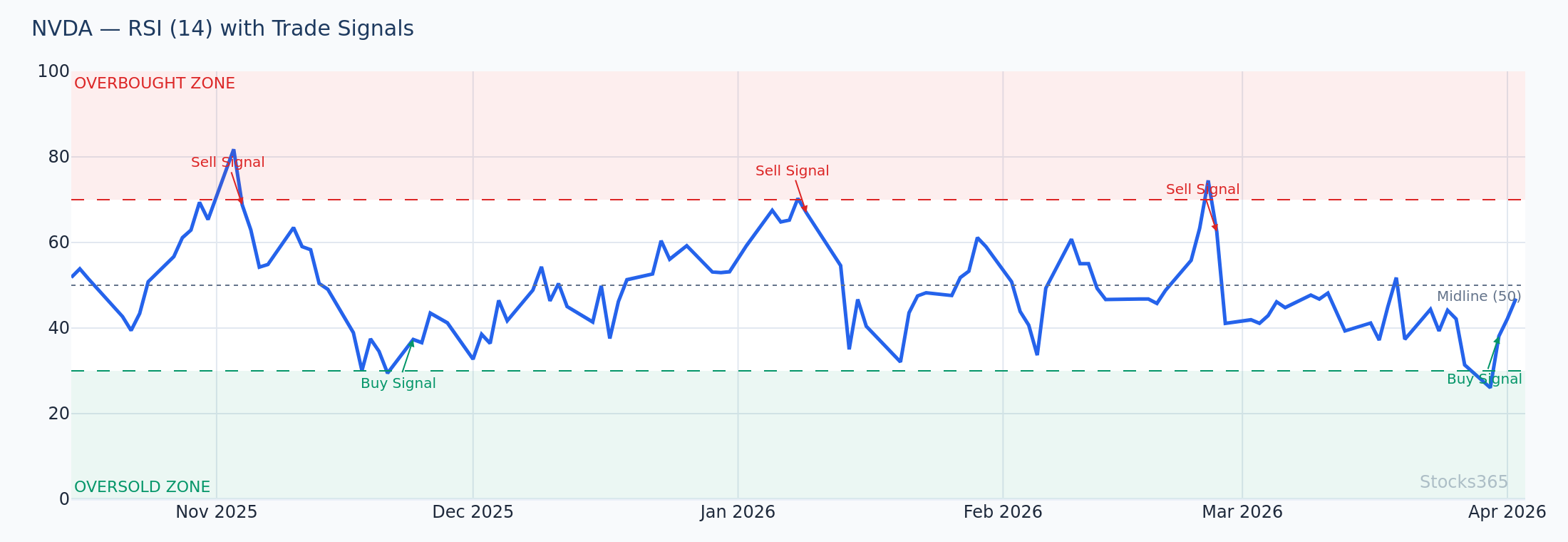
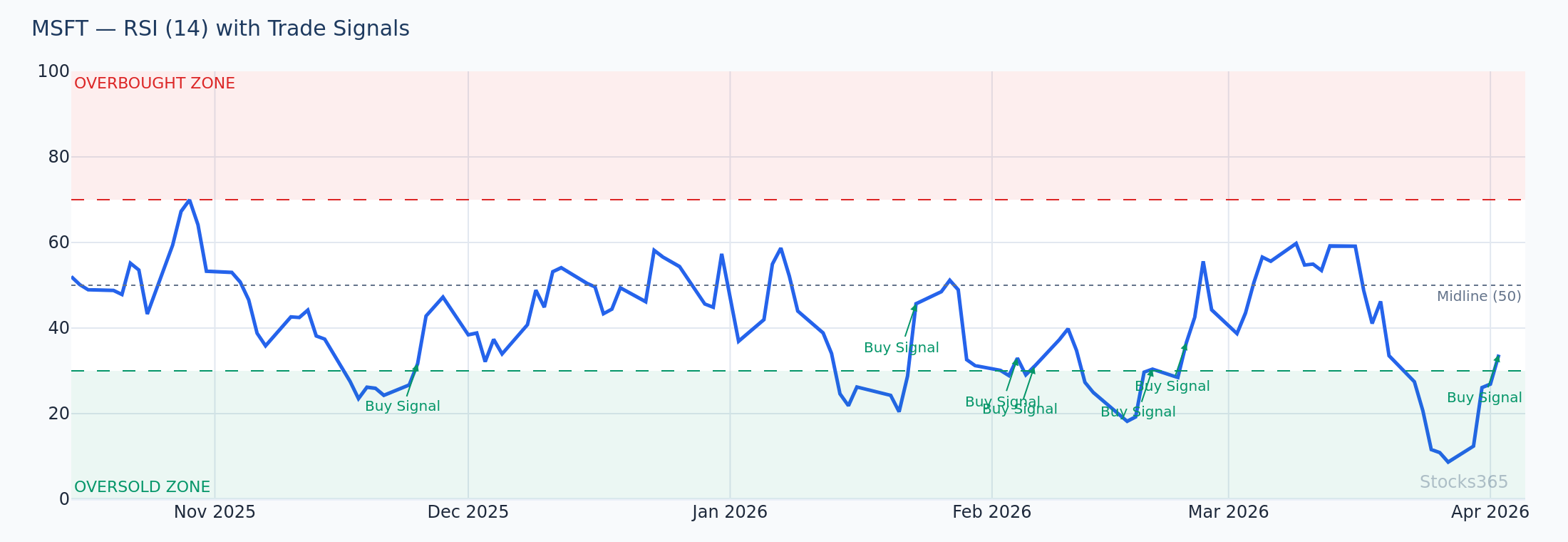
The standard RSI calculation uses a 14-period lookback window. When RSI rises above 70, the asset is considered overbought; below 30 signals oversold conditions. However, as you'll see, these thresholds become far more meaningful when combined with moving averages. To understand the math behind the indicator, see our deep-dive on How RSI Is Calculated: Formula Explained Step by Step.
What Role Do Moving Averages Play?
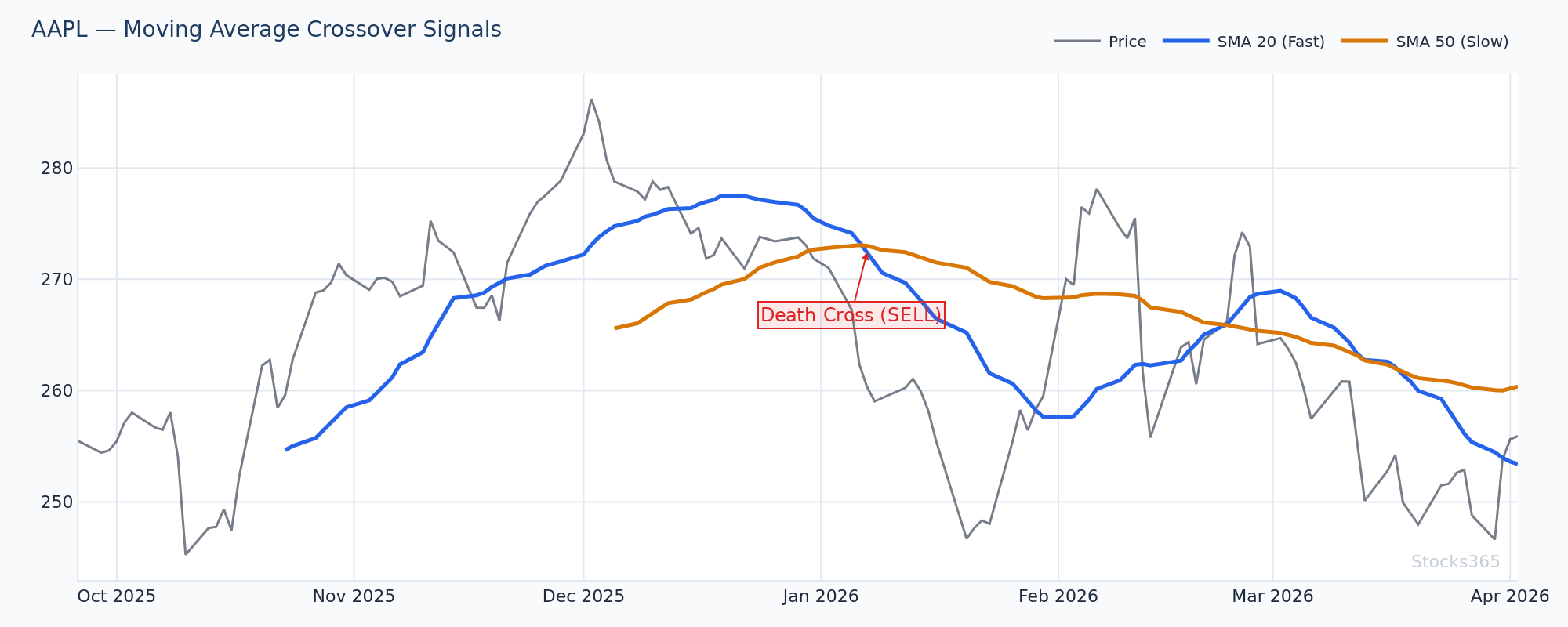
Moving averages smooth price action over a defined period, revealing the underlying trend direction. The three most commonly used types in trading strategies are:
- Simple Moving Average (SMA): Equal weight given to each period. The 50-day and 200-day SMAs are key institutional reference points.
- Exponential Moving Average (EMA): More weight placed on recent prices. The 9, 21, and 50-period EMAs are popular for shorter-term strategies.
- Weighted Moving Average (WMA): Linearly weighted, offering faster response than SMA but smoother than EMA.
For the RSI moving average strategy, the choice of MA period depends on your trading timeframe — a topic we'll explore in detail below.
How to Build the RSI Moving Average Strategy Step by Step
Step 1: Define the Trend With a Moving Average
Before looking at RSI at all, establish the dominant trend. This is non-negotiable. The moving average acts as your macro filter:
- Price above the 200-day SMA: Bias is bullish — look for long entries only.
- Price below the 200-day SMA: Bias is bearish — look for short entries or stand aside.
- Price between the 50-day and 200-day SMA: Transition zone — tighten criteria and reduce position size.
This single filter eliminates a significant percentage of losing trades. Shorting a stock that's 20% above its 200-day SMA, or buying one that's 15% below it, immediately puts probability against you.
Step 2: Time Your Entry With RSI
Once the trend direction is confirmed, RSI becomes your precision timing tool. The key insight: don't buy when RSI is already at 70 in an uptrend. Wait for RSI to pull back to the 40–50 zone, signaling a healthy correction within the larger bullish trend.
Here are the core entry rules:
- Bullish setup: Price above 200-day SMA + RSI pulls back to 40–55 zone + RSI turns back upward = buy signal.
- Bearish setup: Price below 200-day SMA + RSI rallies to 45–60 zone + RSI turns back downward = sell/short signal.
This approach aligns with the principle that pullbacks in strong trends are buying opportunities, not warnings. For a complete breakdown of overbought and oversold thresholds, visit our guide on RSI Overbought and Oversold Levels: Master the Signals.
Step 3: Apply a Moving Average to RSI Itself
Here's a powerful enhancement most retail traders overlook: apply a short-period EMA (typically 9-period) directly to the RSI line. This creates an "RSI signal line" — similar to the MACD concept — and generates crossover signals with less lag.
The rules are simple:
- RSI crosses above its 9-EMA: Momentum turning bullish — potential entry in an uptrend.
- RSI crosses below its 9-EMA: Momentum turning bearish — potential exit or short in a downtrend.
This variation of the RSI moving average strategy is particularly effective on the daily and 4-hour charts for swing trading, where crossover signals have time to develop cleanly.
Step 4: Identify Your Stop-Loss and Target
No strategy is complete without risk management. For this combined approach:
- Stop-loss: Place below the moving average that defined your trend (e.g., below the 50-day EMA for a swing trade), or below the recent swing low — whichever is closer.
- First target: The most recent swing high or a 1.5:1 reward-to-risk level.
- Trailing stop: Once price moves in your favor, trail the stop to the moving average. Exit when RSI pushes above 70 and begins to roll over (in a standard uptrend trade).
Practical Trading Examples With Real Price Levels
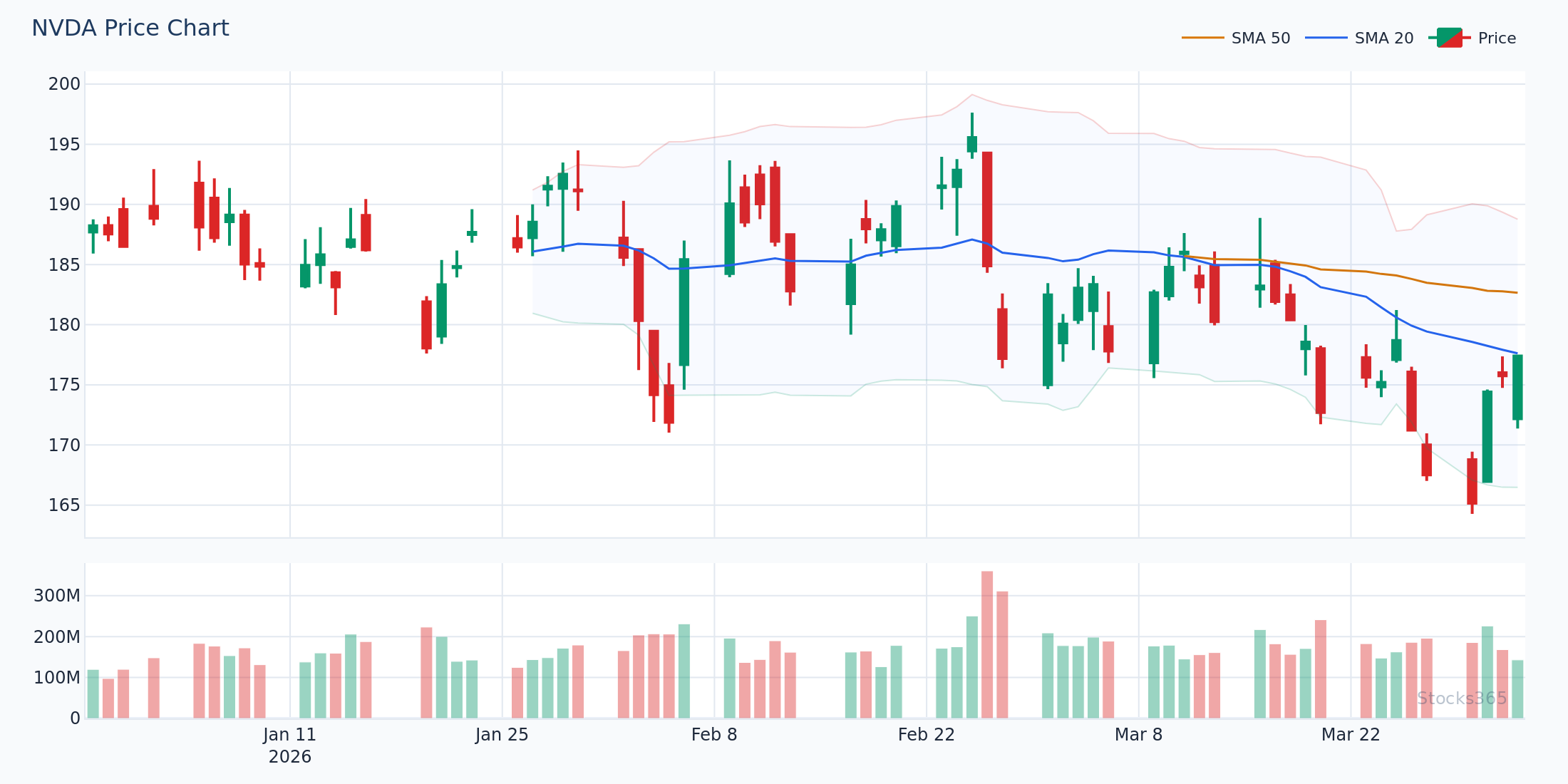
Example 1: NVDA Swing Long Setup
Imagine NVIDIA is trading at $142.50, well above its 200-day SMA sitting at $118.00. The broader uptrend is intact. Over the course of 8 trading days, NVDA pulls back to $136.80 — a 4% correction. During this pullback, RSI drops from 71 to 46, landing squarely in the bullish reload zone.
As NVDA finds support at the 50-day EMA ($135.20) and closes back above $139.00, RSI simultaneously crosses back above its 9-period EMA. This is the confirmation signal. A trader entering at $139.50 would:
- Place a stop at $133.80 (just below the 50-day EMA — approximately 4% risk)
- Set a first target at $151.00 (prior swing high — approximately 8.2% gain)
- Achieve a risk-to-reward ratio of roughly 2:1
This is the RSI moving average strategy working exactly as designed — the MA identifies trend structure, RSI identifies a low-risk entry point within that trend.
Example 2: TSLA Bearish RSI Moving Average Setup
Tesla is trading at $198.40, below its declining 200-day SMA at $221.00. The trend is bearish. RSI has been oscillating between 30 and 58, consistent with a bear market regime where rallies fail at lower RSI levels.
TSLA bounces to $211.30 on a 3-day rally. RSI climbs to 58 — approaching but not breaking into the 60–70 zone where bear market rallies typically exhaust. RSI crosses back below its 9-EMA at $209.50, giving the short signal.
- Short entry: $209.50
- Stop-loss: $218.00 (above the 200-day SMA — approximately 4.1% risk)
- Target: $194.00 (recent swing low — approximately 7.4% gain)
- Risk-to-reward: Approximately 1.8:1
Platforms like Stocks365 provide real-time signal analysis for setups like these. You can explore TSLA's live signal data or view our full signals dashboard for cross-market opportunities.
RSI Moving Average Strategy: Advanced Techniques
Using Multiple Moving Averages for Layered Confirmation
Professional traders often use two or three moving averages simultaneously to create a confirmation hierarchy. A popular setup combines:
- 200-day SMA: Long-term trend filter (institutional bias)
- 50-day EMA: Medium-term trend and dynamic support/resistance
- 21-day EMA: Short-term momentum gauge (useful in fast-moving markets)
When all three MAs are stacked in the same direction (200 below 50 below 21 in a bull trend) and RSI pulls back to the 40–55 zone, you have maximum confluence. These are the setups worth sizing up on.
Combining RSI Divergence With Moving Average Signals
One of the most powerful enhancements to this strategy is integrating RSI divergence analysis. When price makes a new high but RSI makes a lower high (bearish divergence) at a key moving average resistance level, the odds of reversal increase dramatically.
Conversely, bullish divergence — where price makes a lower low but RSI makes a higher low — becomes especially significant when it occurs at a major moving average support level (like the 200-day SMA).
For a complete guide to this technique, read our article on RSI Divergence Explained: Master Bullish & Bearish Signals. Advanced traders should also explore Hidden RSI Divergence: The Advanced Signal Most Traders Miss — a continuation signal that works powerfully alongside moving average trend filters.
Optimizing RSI Period Settings for the Strategy
The default 14-period RSI works well for daily swing trading, but you may want to adjust it depending on your timeframe and strategy style:
- RSI(9) + 20/50-day MA: More responsive, suited for short-term swing trades and 4-hour charts.
- RSI(14) + 50/200-day MA: The standard combination for daily chart swing trading. Balanced sensitivity.
- RSI(21) + 100/200-day MA: Slower, fewer signals, but higher reliability for position traders and investors.
For detailed guidance on choosing the right RSI period, see our comprehensive breakdown at RSI Settings: Master the Best Period for Your Strategy.
Common Mistakes Traders Make With This Strategy
Ignoring the Trend Filter
The biggest error is treating RSI oversold readings as automatic buy signals without checking the moving average context. An RSI reading of 28 in a stock that's 30% below its 200-day SMA is not a buying opportunity — it's a warning sign of potential capitulation. Always establish trend direction first.
Using the Wrong Moving Average for the Timeframe
A 200-day SMA on a 5-minute chart is meaningless. Match your moving average period to your trading horizon. Intraday traders should use EMAs in the 9–50 range. Swing traders use the 21–200 daily range. Position traders rely on the 50–200 weekly range.
Over-Optimizing the Strategy
Traders often backtest dozens of RSI and MA combinations until they find one that worked perfectly on historical data — a trap known as curve-fitting. The most robust version of the RSI moving average strategy uses standard, widely-followed parameters (14-period RSI, 50/200-day MA) precisely because institutional players watch the same levels.
Skipping Risk Management
Even with excellent signal quality, no strategy wins 100% of the time. The RSI moving average strategy typically achieves 55–65% win rates in favorable market conditions. This means 35–45% of trades will lose. Without proper position sizing and stop-losses, a string of losses can damage your account regardless of long-term edge.
RSI + Moving Average vs. Other Combined Strategies
How does this approach compare to alternatives? The RSI moving average strategy excels at trend-following entries with momentum confirmation. Compared to pairing RSI with Bollinger Bands, for example, the MA-based approach provides cleaner trend context and is less vulnerable to volatility spikes in news-driven markets.
When comparing RSI to other oscillators entirely, our detailed comparison in RSI vs Stochastic Oscillator: The Essential Guide shows that RSI tends to produce fewer false signals in trending markets — exactly the environment this strategy is built for.
For traders who want the complete picture of RSI-based trading before applying it alongside moving averages, How to Use RSI in Trading: The Ultimate Step-by-Step Guide covers every core application in detail.
How Stocks365 Enhances the RSI Moving Average Strategy
Manually scanning hundreds of stocks for RSI + moving average confluence is time-consuming and prone to missed opportunities. The Stocks365 platform automates this process through its proprietary Trust Score system, which weights technical signals — including RSI momentum and moving average alignment — alongside fundamental and volume factors to surface the highest-probability setups in real time.
When you view a signal like Apple's signal page, you instantly see whether RSI is in a favorable zone relative to the stock's trend structure, saving hours of manual chart analysis. The Stocks365 signals dashboard filters the entire market for these convergence points daily.
"The edge isn't in finding a perfect indicator — it's in combining complementary tools so that each signal requires multiple conditions to be true before you act."
Frequently Asked Questions
What is the best moving average to use with RSI?
For daily chart swing trading, the 50-day EMA and 200-day SMA are the most effective moving averages to pair with RSI. The 200-day SMA defines long-term trend bias, while the 50-day EMA acts as dynamic support and resistance for entry timing. For shorter timeframes (4-hour or 1-hour charts), the 21-period and 50-period EMAs work well.
How do I avoid false signals with the RSI moving average strategy?
The most effective filter is requiring multiple conditions to align simultaneously: price must be on the correct side of the trend-defining MA, RSI must be in the appropriate zone (not already extended), and RSI should show directional confirmation (crossing its signal line or turning from an extreme). Volume confirmation adds another layer of validation.
Can this strategy be used for day trading?
Yes, but the parameters need adjusting. Day traders typically use shorter RSI periods (7–9) and faster moving averages (9-period and 21-period EMAs) on 5-minute to 15-minute charts. The principles remain identical — establish trend direction with the longer MA, time entries with RSI pullbacks — but signals occur more frequently and require faster execution.
What RSI level should I buy at in an uptrend?
In a confirmed uptrend (price above its 200-day SMA), the optimal RSI entry zone is typically 40–55. This range represents a healthy pullback within the trend without signaling a potential trend reversal. RSI dropping below 40 in a strong uptrend can indicate more significant weakness and may require reassessment of trend strength before entering.
Does the RSI moving average strategy work in all market conditions?
This strategy performs best in trending markets and struggles in choppy, sideways conditions — a limitation it shares with most trend-following approaches. During range-bound markets, RSI bounces frequently between 30 and 70 without moving average confirmation providing reliable direction. In these environments, it's often better to reduce position size or wait for trend to reassert itself before applying the full strategy.